Artist, Linda Lucas Hardy mid-life charge earns international fame
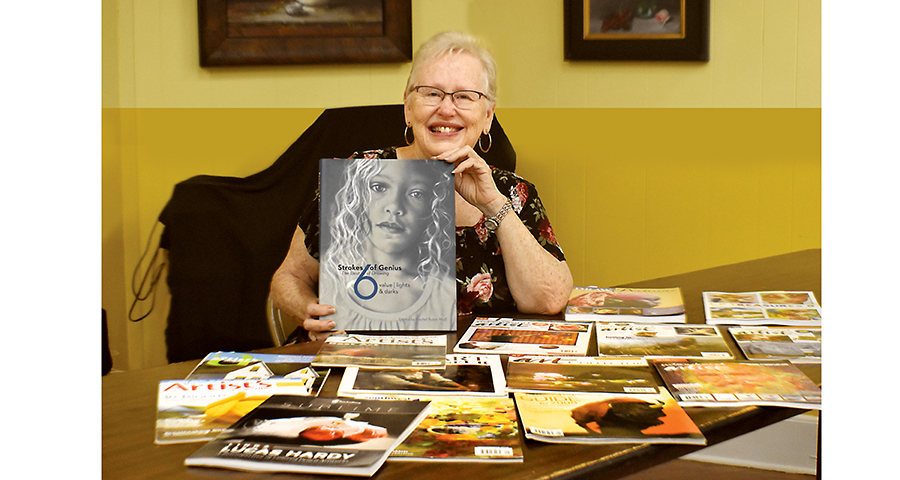
Above photo, Linda Lucas Hardy poses with her cover illustration for one of 17 books featuring her work. She’s been the subject of another 26 feature articles – 27, now.
From The East Texas Journal, June 2022
By Hudson Old, Publisher
OMAHA, TEXAS – “I wake up and go to work,” said Linda Lucas-Hardy, whose spin on art is a business on mission.
In that sliver of American culture in the know, she’s a rising star.
The International Artist Magazine gave her a six page spread. Now in her 70’s, her career’s gathering steam with increasing speed.
Her studio’s at home.
Her education ended with an “almost accidental” 2-year associate’s degree crowning an eight-year community college career.
“I sketched my way through history,” she said, all but indifferent to whatever she might have missed when her attention to required core curriculum dissolved, melting into pictures rising from margin doodling.
“All I was thinking about was what I was picking up from Olive “Ollie” Theisen,” she said. Dr. Theisen was a source shining a light inside her head when Mrs. Lucas-Hardy enrolled at the college in 1985, a year after it opened. Dr. Theisen cultivated an understanding of things she’d intuitively known.
Here’s an example: “I see in color,” said Mrs. Lucas-Hardy, “but I learned to think in black and white,” a discipline clearing her view of the “value” of light.
A mysterious force, more concerning the value of light is being saved for the climax of Mrs. Lucas-Hardy’s story.
The subject matter of her colored pencil, “photo realism” style is without limits – consider “The Old Cookville Store” beside the cover art selected for the book “Strokes of Genius, 6” a portrait of a child who caught her eye in Walmart.
In a still life, she most precisely recreated the reflection of her light source bending over the curved wall of a clear vase, something a tuned-in photographer might have nailed.
As subjects, anything goes.
“There seems to be nothing she can’t do,” said Southwest Gallery Manager Melissa Butler, whose eye is among those making the call when deciding what makes the cut at the 16,000 square foot Dallas gallery saying who’s in and who’s out.
Besides being colored pencil – a medium seldom recognized as high art – there’s something just beyond the hard edge of mirror-image realism in the Omaha artist’s work, Ms. Butler said.
“Her ‘art’ is creating a picture within a picture,” Ms. Butler said, taking a shot at it when asked to explain what she means when she says Mrs. Lucas-Hardy’s work has an “artistic bent” making it one of the sliver of submissions making the cut for the gallery floor, slipped in alongside 19th century European oils.
Straight-line descendants of the Renaissance, European oils have held the high ground since the Pope began hiring artists connecting spiritual imagery to the world through the tip of a brush, the cultural state of mind groomed since Southwest began grooming its standing as a cultural oasis 50 years ago.
The styles of American artists emerging from a European parent culture have never been as celebrated in the New World – artists funnel a wealth of submissions into a tiny market, an advantage in cherry picking work.
“We look for the best representation of a type,” Ms. Butler said. “We represent many of the premiere contemporary artists.”
Mrs. Lucas-Hardy’s larger canvasses are presently hitting something north of the $10,000 milestone. The gallery takes a “deserved” 50 percent commission, she said.
“But for galleries, there wouldn’t be a market,” she said, opening line of a dream-come-true story that almost ended with the close of her eight year collegiate career. For the next seven years art faded to mist. After Dr. Theisen, the next connection was a woman she met on an Italian vacation.
“Italy’s art overload,” she said, describing a business known to locals as “The Fort,” where she talked to a woman who for two years had been working on the restoration of “a Rafael,” a 15th-century painter as famous in Italy as Elvis is in Memphis. They’ve got Rembrandt, we’ve got Dolly, performers so familiar in their respective cultures as to require but a single name.
The woman working in the fort “had such reverence for her work,” said Mrs. Lucas Hardy, whose fading dream of being an artist had lain fallow seven years – an Italian-moment epiphany washed over her like a wave. If she was ever going to do what she imagined, “it was now or never,” she said.
Weeks turned to months turning into three years during which she boiled all that she knew down to a mission defining a style that begins with her camera as a tool, creating an exacting reference.
“It’s the way I’m wired,” she said.
Reduced to its simplest definition, she gives equal weight to paired considerations: “There’s composition and there’s the value of light, the shades of light and dark,” she said.
It’s the lesson she teaches when she’s booked to teach workshops on cruise liners, a career perk that’s picked up the tab for tours of the Caribbean and an Alaskan voyage. Without values determined by light, composition is left flat.
“Shine a quartering light from a single source and things happen,” she said. “You get highlights, body tone, body shadow, reflected light, shadows and underside dark – over the years the words change. I’m going with the terms I’ve learned.”
The terms define a punch list of things she looks for. Thinking in black and white is critical.
“Color will lie to you,” she said. “Color lies because in and of itself it has value. Darker blue has more value than lighter yellow.”)
It’s a way of seeing the world, an awareness that grows with intentional focus.
There’s a performance edge to her perception of artists. She has you in mind as she works.
“I mean to entertain you,” she said.
In the universe of Texas artists, “The Bosque Five” are legendary. As in Bosque County, a slab of Hill Country left largely undisturbed.
“Five artists got this old college building in Clifton that they’ve turned into a conservatory,” she said. “They’ve got a lot of patrons.
“When I got home from Italy I began entering shows. For three years before I made myself submit an entry, I watched the Bosque Art Show.” The $5,000 top award generates a competitive landslide.
“I felt like nobody from nowhere,” she said. “When I got a letter telling me I’d made the show, I cried. It was a huge boost to my confidence.”
She returned to the community college as adjunct faculty and taught there eight years.
She went corporate, driving to Plano to teach at Hobby Lobby.
She was 53 and had raised seven children in the “Now or Never” moment she was touched by the Italian woman’s reverence for the world seen through the eye of an artist 600 years before.
From that came inspiration that drives her business, the fuel that wakes her up to work, every day.