Line-up changes fuel team’s climb to 1966 conference crown
Ernie McAnally named to Paris Hall of Fame
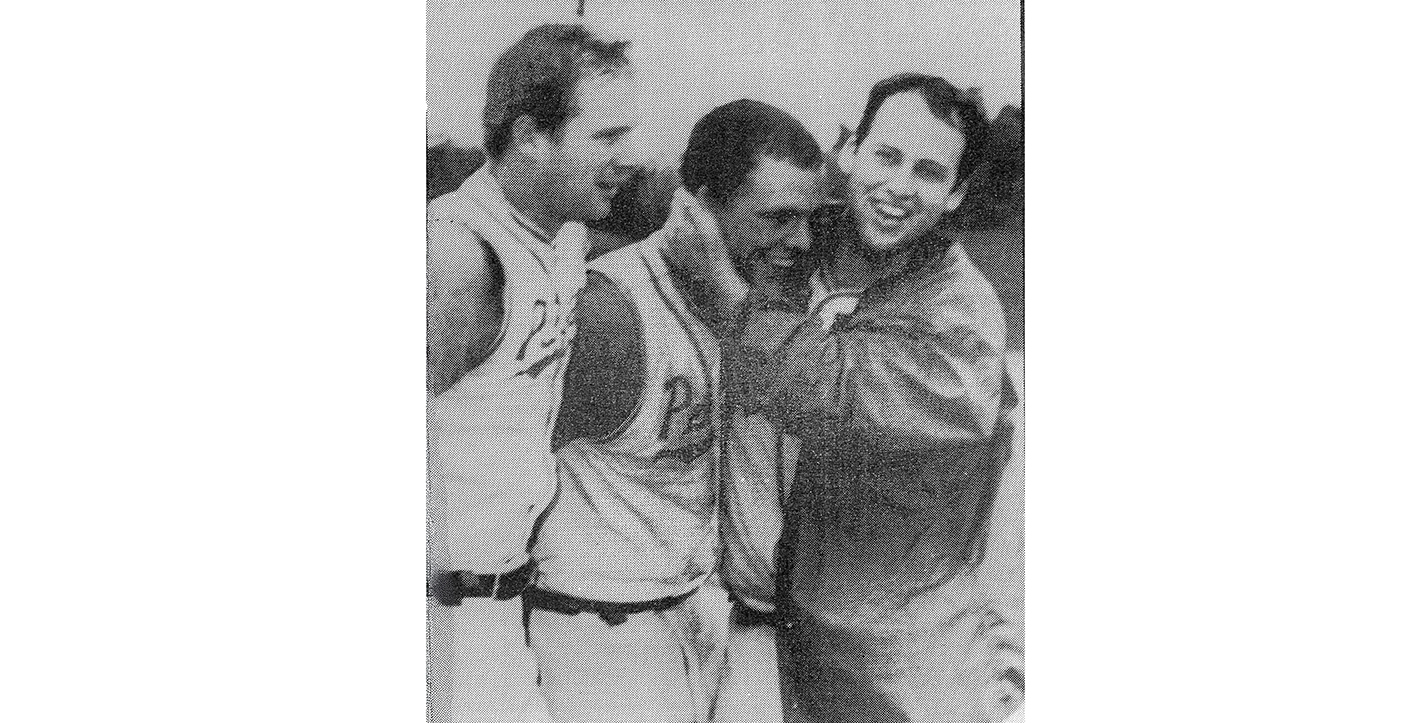
Above Photo: Ernie McAnally, center, is congratulated after driving in the winning run, launching Paris Junior College on the road to the National Junior College tournament in 1966.
From The East Texas Journal, January 1995
By Hudson Old, Publisher
PARIS, TEXAS – Mt. Pleasant resident Ernie McAnally has been inducted into the Paris Junior College baseball Hall of Fame. In the spring of 1966, his play both at and behind the plate earned him the catcher’s slot on the Junior College All-American team.
“Robert Royer says I’d never have had a prayer except that his glove beat mine out at third base,” Ernie said.
It was that spring of ’66. The team’s catcher had replaced a center fielder and the backup catcher had just gone out with an injury.
Coach Jim Campbell, now dean at Kilgore Junior College, called one of those conferences on the mound.
“We were out there kind of drawing straws to see who was going to play catcher,” Ernie said, “so I mentioned that I’d been a catcher before — in little league.”
“Great,” the coach said. “You’re it.”
In the position shifts that followed, Royer was moved from short to third where he instantly became known as one of the best fielding third basemen in the conference.
Meanwhile, the opposing team had the deal figured the moment Ernie got behind the plate.
Testing the new catcher’s arm would be a priority item.
“They had a man on first and he broke with the first pitch,” Ernie said.
Despite coaxing, Ernie declined opportunity to describe that cannon ball delivery to second, the one he could have thrown without ever coming out of his squat, for literary purposes.
Such shadowy recollections of sports history are part of the magic of baseball, especially when remaining witnesses would be recalling 30-year-old memories.
Said honest Ernie, instead: “I dunno, I may have jumped up and taken three or four steps. I couldn’t swear I didn’t run halfway to the mound. But I did throw him out.”
His arm and his bat earned him a shot at the majors.
He came home for just a few weeks that summer, just long enough to earn a place in little league hearts as the assistant coach to a town father and dry goods salesman drafted into the head coaching job. Ernie spent some Saturday mornings hitting towering fly balls to the outfield, until his team could judge a ball. He peppered the outfield with base hits until they cut them off.
He peppered the infield with line shots and made kids make throws until they did it to suit him.
He threw batting practice until 12-year-olds wanted to beg for rest, but couldn’t, because he was the town’s baseball hero, headed for the pros.
“I was a minor league gypsy,” he smiles. In the four years following that summer of ’66 he was in Virginia, Minnesota, California, Florida, Puerto Rico and Winnipeg.
“You couldn’t make a living playing minor league ball,” he said. “I had some, uh, interesting off-season jobs.”
His resume could include drilling water wells with Fred Lawrence, shift work in a Chicago piston ring factory, insurance adjusting, real estate — he was a banker and worked once, when he was home, on a clean out at the oil refinery.
Then came the expansion draft of 1968. The Mets traded him to the expansion club, Montreal.
By then, he was pitching.
His curtain call to the big leagues came in the spring of ’71, when he broke spring training with the Expos.
There were 10 summers in there after he coached us in little league, and we heard about him, talked about him, saw his name in the box scores, sometimes in a story.
He’s home again now. He’s traded his cleats for boots, his cap for a cowboy hat.
He travels the nation for Priefert Manufacturing, a home-grown second-generation cattle equipment manufacturer that started in a shop behind the house and now ships coast to coast.
For all the imagined romance of the pros, there’s one slightly faded memory of a moment in time 29 years ago this spring, frozen in black and white.
The picture shows a younger Ernie McAnally coming off the field to a hero’s welcome. Robert Royer, the guy who claims his glove at third base is what gave Ernie his shot at being an All American, is in that picture.
Ernie surmises that Mr. Royer’s wide grin is related to the fact that he was on deck man in a tie game in the bottom of the last inning, playing for the conference championship when Ernie stepped up to the plate and clubbed in the winning run.
Had Ernie failed, Coach Campbell had ordered Mr. Royer to conduct a suicide squeeze.
That’s the play where the runner on third breaks with the pitch and the batter better lay down a bunt
– if he misses, the runner’s dead.
“Oh,” says Ernie, “I’m sure Robert could have handled that kind of do or die pressure, but thanks to my bat, we never had to find out for sure. Write that down and I’ll make sure he gets a copy for his scrap book.”