Roots of cultural ties splinter into Pittsburg Community
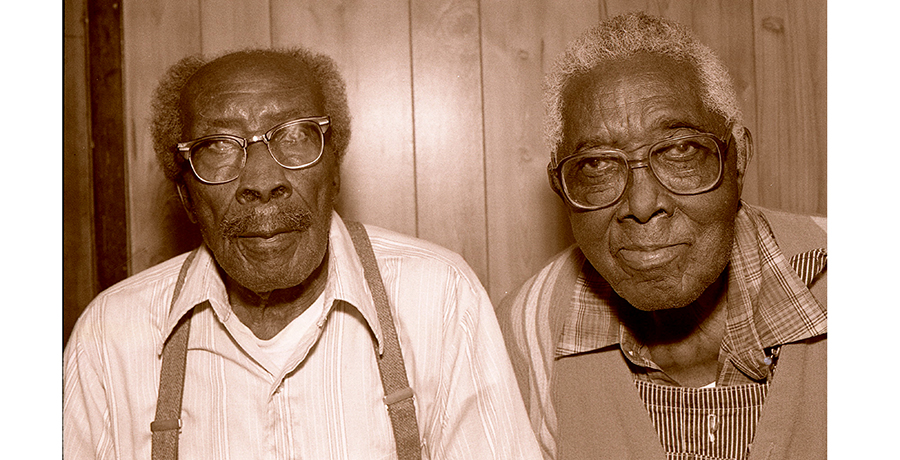
Above Photo: Robert Mitchell and Roosevelt Fleming are in-laws who have lived together since Robert’s daughter married Rose 66 years ago. Born in 1887, Mr. Mitchell will be 108 this February. They came through hard days, a generation away from slavery in Mr. Mitchell’s case. His father, born in 1811, was brought to East Texas from the Georgia coast. In the late 1950s, both men came to live on the Laney farm where James and Bobby Burns spent time at their grandparent’s home. James especially spent time trailing after Robert, and in its way, each family was able to benefit from the trust of the other.
From The East Texas Journal, January 1995
By Hudson old, publisher
PITTSBURG, TEXAS — Being curious, I asked James Burns, straight up, where he and his brother Bobby are from. The brothers have a pawn shop here, delight in trading guns and knives, deal and trade in anything, the way a pawn shop does.
On the wall behind the counter are pictures of James’ horses and he talks with knowledge about racetracks around the country and high stakes horse trading.
The coffee pot’s always on here — regulars from friends to trading partners drift in and out through the day. In the flow of conversation, you grasp that Bobby would drive two days and nights non stop for a good bird dog deal.
Stand at the counter on enough days, and you’ll hear big old raw boned, ham fisted Robert Potter — a guy with a Yankee accent who expects to get local treatment, and does — you can get him talking about old boxing days.
There’s the big Swede or German looking orchard man, McPeak — okay, so the name doesn’t fit, but there’s a Nordic look to him that’s not familiar, a perception probably influenced by the fact that he didn’t spontaneously rise from the soil like it sometimes seems most of everything else here did.
He came here not long ago and started from scratch building an orchard that will rival those here for generations when all his trees grow into production.
Judge McCaslin drops by some — this is a place where political exchanges can be confrontational without being angry. There should be more places like this in the world, where there’s a tangible bond, a social clique with no criteria other than representing yourself for what you are.
So I wonder about two brothers who’ve made such a place.
“Where’d you guys come from,” I asked James, a story teller.
“Six miles out in the country,” he said, “following behind the tailgate of a wagon down a two-rut sand road.”
Recalling old times meant recalling Robert Mitchell.
“I guess Robert’s gonna be, what, a hundred and six or seven next year,” he said.
Maybe it was because Christmas was near, but in short order, James and I were headed for the Robert Mitchell place.
James stopped at the bakery just long enough to pick up pies we stacked carefully on the seat of his old Dodge pickup. The home was a little brick house on a rise in the sandy land.
Mrs. Roosevelt Fleming, daughter of Robert Mitchell, answered the door.
The day outside was raw and wet — inside, the house was sultry warm and close. Robert Mitchell sat alone in his bedroom in an overstuffed chair. James gave Robert the pies. Robert spit an expert stream of snuff juice in his spittoon.
“Robert goes back to the first things I can remember,” James said. “You remember milking for my grandmother over on the Laney place? I’d always want to sit with you when you came in for breakfast.”
Robert Mitchell’s memory kicked into gear.
“The old Laney place,” he said. “Last place Rose and I share cropped before we got our place.”
From the moment Roosevelt Fleming married his daughter, Robert Mitchell had a partner. They spent their working lives building toward a place of their own.
“If we ever had a cross word in 66 years,” said Mr. Fleming, “I don’t recall it.”
They’re still together, under the same roof.
Mr. Mitchell started telling a story, straight up, with the same blunt-styled detail you might hear among friends at the pawn shop.
“One of the ways the man could keep you down when you share cropped in those old days was to make you plow his mules,” Mr. Mitchell said. A sharecropper using his own team got a bigger cut of the crop. He and Rose had a team, but couldn’t find a farm that would let them plow.
Mr. Mitchell wriggled into the world in February, 1887, one of 12 children born to Willis and Delvhy Mitchell. Willis, his father, was born in 1811 and died of “slow fever” in 1902.
“It was just a fever that came on you, worked slow, and burned hotter and hotter,” Mr. Mitchell said. “It could run a man crazy or kill him.”
Medical care was limited to what a share cropping family could manage on its own.
“You did what you could do and that’s all you could do,” Mr. Mitchell said.
After Willis died, the family continued “cropping around,” place to place.
Mr. Mitchell was already into his 60s that fall he and Rose couldn’t find a farm to work. The next best work available for men with a team was logging — they were on their way to the woods when they were offered work for themselves and their mules on the Laney farm.
“We worked that place into shape,” Mr. Fleming recalls, “made good crops.” But when Lone Star Steel expanded its hearth operation in the 50s, Rose jumped at the chance for cash wages.
Mr. Mitchell kept working the Laney farm. Rose began saving his paychecks until they put together the money to buy their 80 acre farm.
Rose considered it good fortune to consistently draw graveyard shift at the steel plant.
“Robert was on the farm working every day, daylight to dark,” he said. “I’d be coming in from graveyard just in time to go through the kitchen and grab something to eat, then go to the fields. In the afternoons, I’d go in, eat, sleep and be back at the farm in the morning.”
There was a bonding between the Laney family and Robert Mitchell’s family.
“I remember going into town once with a wagon load of sweet potatoes,” he said. “The man said my potatoes weren’t worth 10 cents a pound, so I told him they were the Laney family’s crop and he went back to paying what was fair. He made out the check to Miss Laney. She was somebody I knew I could trust to be fair with me because that was right.”
All he and Rose ever needed, he said, was the same break they asked for their mules.
“Man or mule,” he said, “you got to allow either one a chance to pull on his own.”
He remembers how their 80-acre farm prospered.
“There were trails all through the country leading here, trails from the sharecropping homes on every farm around. People came into our fields to pick as they needed. We never asked a dime, because they took out of their need and didn’t have money.”
James tried getting Mr. Mitchell to remember the old Laney syrup mill — he remembered he’d cooked enough syrup “to fill a creek.”
“If I could remember it all, all 107 years, line by line, a paper wouldn’t hold it all,” he said, and not long after that, James and I were gone.
On the way back to town, he showed me the old Laney place his brother now owns. And he threw me one more curve about who he is, where he’s from, how he became what he is.
“Before I moved home,” he said, “before I came back to stay, I’d drive in on weekends just to sit down and visit with the old timers. I always intended to write it all down.
He should.
In East Texas, it’s a part of where we’re all from.