Sam Rowland: The Man Hanged for Murder in Titus County
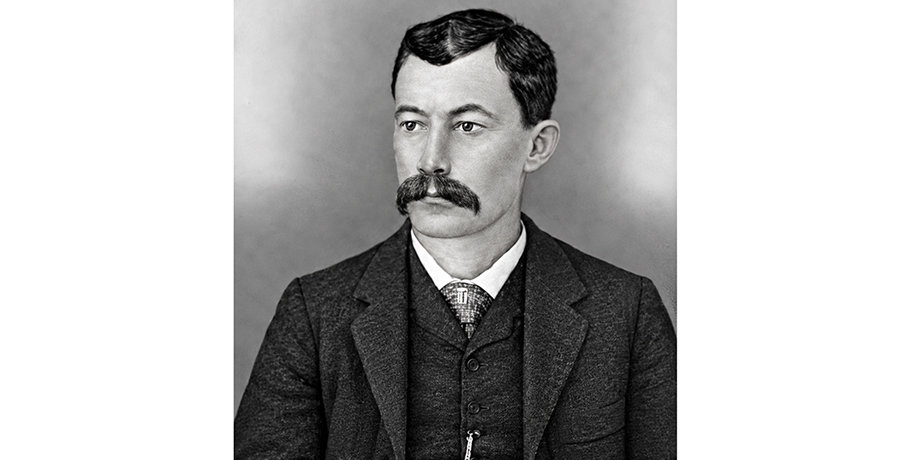
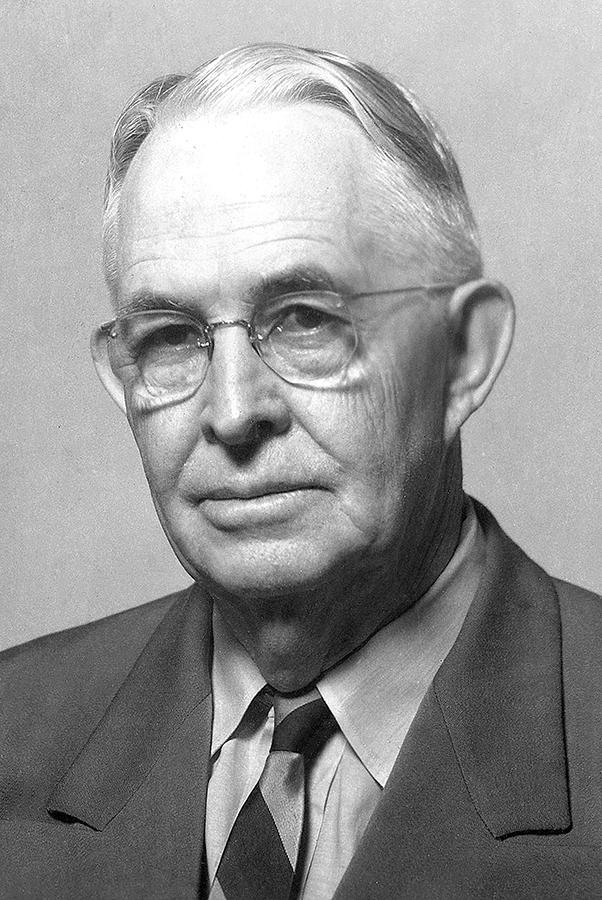
Above Photo: Sheriff Bill Edwards, served as Titus County, Texas sheriff from 1871 to 1882, and hanged James C. “Sam” Rowland on May 3, 1872.
From The East Texas Journal, August 2024
By Hudson Old, Publisher
A Jewish backpack peddler, Casper Abraham was murdered in Mt. Pleasant and buried at West New Hope in the fall of 1871, R.L. Jurney wrote in his History of Titus County, 1846-1960, nearly a century after the case.
There’s no cemetery at the Methodist church at West New Hope but there’s an old graveyard nearby, fenced off now, as good an image as any to leave with Russell’s writing that years after he was buried there Abraham’s family came for him, that they dug him up and took him “back east” but left his grave open so for years that was made note of whenever the story was told.
Casper Abraham’s killer was the first husband of Sarah Patience Nevill, the daughter of a patriarch. Alexander Nevill came from Tennessee during the Texas Republic Days, arriving in 1838, before there was a Titus County.
His descendants deeded the family cemetery to the Nevill’s Chapel Missionary Baptist Church in 1906.
“A grave of interest is that of James C. ‘Sam’ Rowland, a Nevill son-in-law, one of the few men to be officially hanged in Titus County,” reads the cemetery historical marker. If ‘officially’ means ‘legally,’ Sam Rowland’s the only one record.
Enough edges of his story show up in an appeal court ruling denying him a new trial mention his death sentence.
The district court records went up in flames in the courthouse fire of 1875.
The Clarksville paper reported a state Supreme Court decision affirming the district court instruction for Sam Roland to hang on May 3, 1872.
Before pulling the trap door, Sheriff Bill Edwards “offered to pay the hire of any person who would come up and do the hanging, but none would and Edwards had to do it himself,” Jurney said.
Sam was no common outlaw.
“Rowland is said to be a man of intelligence and has a wife and two young children,” reported the April 6, 1872 Clarksville Standard’s one-paragraph mention of the Supreme Court upholding Sam’s conviction and death sentence.
“Jesse Reed, Rowland’s accomplice in this crime, is still at large, but it is hoped will be arrested. It was a crime of an atrocious character, as the murder was purely for money. Abraham was accompanied in his business by a man named Cohn, who was also badly wounded, but recovered,” the Clarksville paper said.
They day they hanged him, Sam dressed and stood for a photo surrounded by the men who walked him to the gallows built for him by Sheriff Edwards himself, says Traylor Russell’s 1964 account, “The Murder of the Peddler by Rowland” from his History of Titus County.
Times were lean, hard and dangerous in the conquered Confederacy in the decade after the war. Titus County is noted in stories of notorious characters, outlaws in the New Rebellion that for a time in places generated more trouble than it made.
“In the 1870’s there was so much robbing, stealing and killing going on that a committee of vigilantes was organized to drive the outlaws out of the county and maintain order,” Jurney wrote. “However, reckless and dangerous men became members of the Vigilantes and it wasn’t long before they were guilty of almost as many crimes as the outlaws.”
The war ended in 65.
Colonel Edwards moved to Titus County in 1867, “when it took a brave man to be sheriff,” Jurney said.
Where Russell says Edwards built a gallows, Jurney says he hung Rowland from a tree.
Both stories were written from third-hand accounts. But they come together three blocks west of the courthouse on a rise above a spring-fed stream “near the high school.”
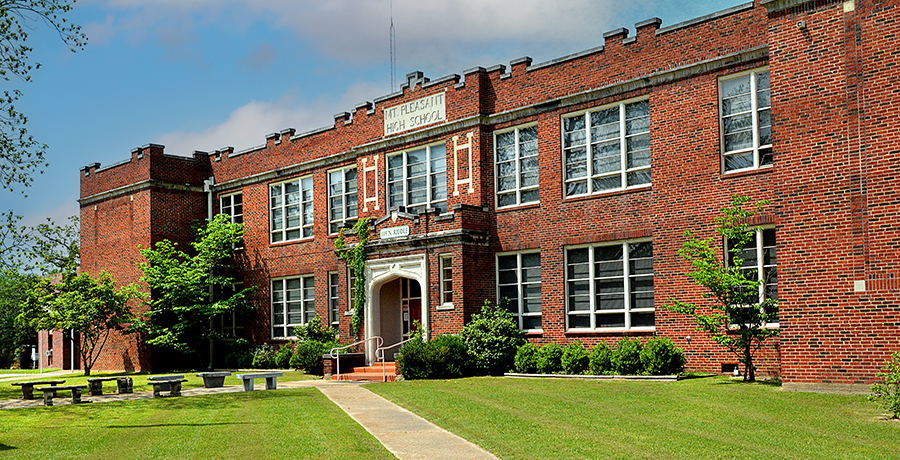
Titus County was hung in the vicinity of the old high school on Riddle Street.
Both say Sam was hung near the school west of Riddle Street where in 1937 the government paid for construction of native stone bleachers built into the side of the hill like an ancient amphitheater overlooking the football field alongside a stream bed channeled with the same dressed rock they used to build stone bleachers.
It was a public works project during the Great Depression.
The bleacher and the field are a city park now, across Edwards Street from Edwards Cemetery, not far from where Sheriff Edwards was living in the fall of 1871, when Casper Abraham and the associate known only as Cohn reached Mt. Pleasant.
Following paths blazed by American pioneers, Jewish back pack peddlers brought the pots and pans. They worked rural backroads.
It was risky business.
Random newspaper accounts chronical “fates that befell them, particularly robberies and murders,” writes Hasia Diner, a New York University historian.
Frontier families invited peddlers to the table in turn for a look at their wares, a scene described by Hasia in The Great Jewish Migrations to the New World and The Peddlers who Led the Way.
Many came from Germanic lands, feudal states where occupations for Jews were limited. A Jew had to have permission to get married.
Citing census stats, Hasia says there were 2,000 Jews in America in 1820 and 250,000 by the turn of the century, most of them from regions “that in 1871 coalesced into a united Germany.”
It was the peddler’s tradition to insist on payment for refreshment, food and lodging, when offered.
Somewhere west of town, Abraham and Cohn slept at the Rowland place the night before Abraham was murdered. Cohn was shot, cut and left for dead.
The story is Rowland got a flash of the peddlers’ bankroll the night before. When Sheriff Edwards caught up with Sam Rowland on the same day as the murder, the killer still had the roll of cash in his pocket.
He’d enlisted Jesse Reed and they ambushed the peddlers that morning. Jesse may have been a hired hand or a single man who lived on the Rowland place.
“A woman was washing clothes in a creek near the scene of the murder,” Jurney said. “She witnessed the killing and identified the murders. Rowland was captured. His accomplice escaped to Arkansas and was later shot and killed in Hot Springs.”
Sarah Patience Nevill was widowed twice more. She was 74 when she died in 1922 in Fort Worth, where she had gone to live with a son.
She was returned for burial at Nevill’s Chapel.