“I’ll go if you will,” said one to the other
VIETNAM – It was September 5, 1969, the day the war ended for Titus County battlefield medic Jimmy Franks, who’d just finished surviving his teenage years.
The morning air was alive with aircraft and gunfire, cannons, bombs and battle sounds. A nearly perfect ambush, the opening salvo caught infantrymen guarding the base in the open, lining up for morning chow.
“They usually didn’t attack a base in daylight,” Jimmy said.
Casualties were mounting, bodies and wounded stacking up in a fortified bunker where Jimmy worked alongside a doctor he particularly admired. Outside, soldiers were falling with sickening regularity.
“I liked him because he liked me,” Jimmy said. “Usually, he could depend on me not to puke.”
Vomiting interrupted the work flow. From the relative safety of a fortified position, the other two medics watched as sheets enemy fire held medevac helicopters at bay.
Glancing up, the doctor gestured with his eyes to the medics in the doorway.
“You guys get some of these bodies out of here,” he said. Days before, Jimmy had been separated from his company when he was flown in into the base as a casualty and given time to recover from an ankle sprain.
The other two medics were men he’d never seen in action and both stood frozen, summoning courage.
Jimmy thought of Killer, a courageous officer who’d provided the example of the courage the moment demanded. He hesitated a moment, considering the paralyzed medics.
Packing and pressure bandaging a gaping wound for the soldier on the table, the doctor hooked up an IV line, passed the plasma bottle to Jimmy, then locked his gaze on the frozen medics at the door. Another medevac chopper was coming in. The doctor looked at the other medics again, locking a strictly business gaze on them.
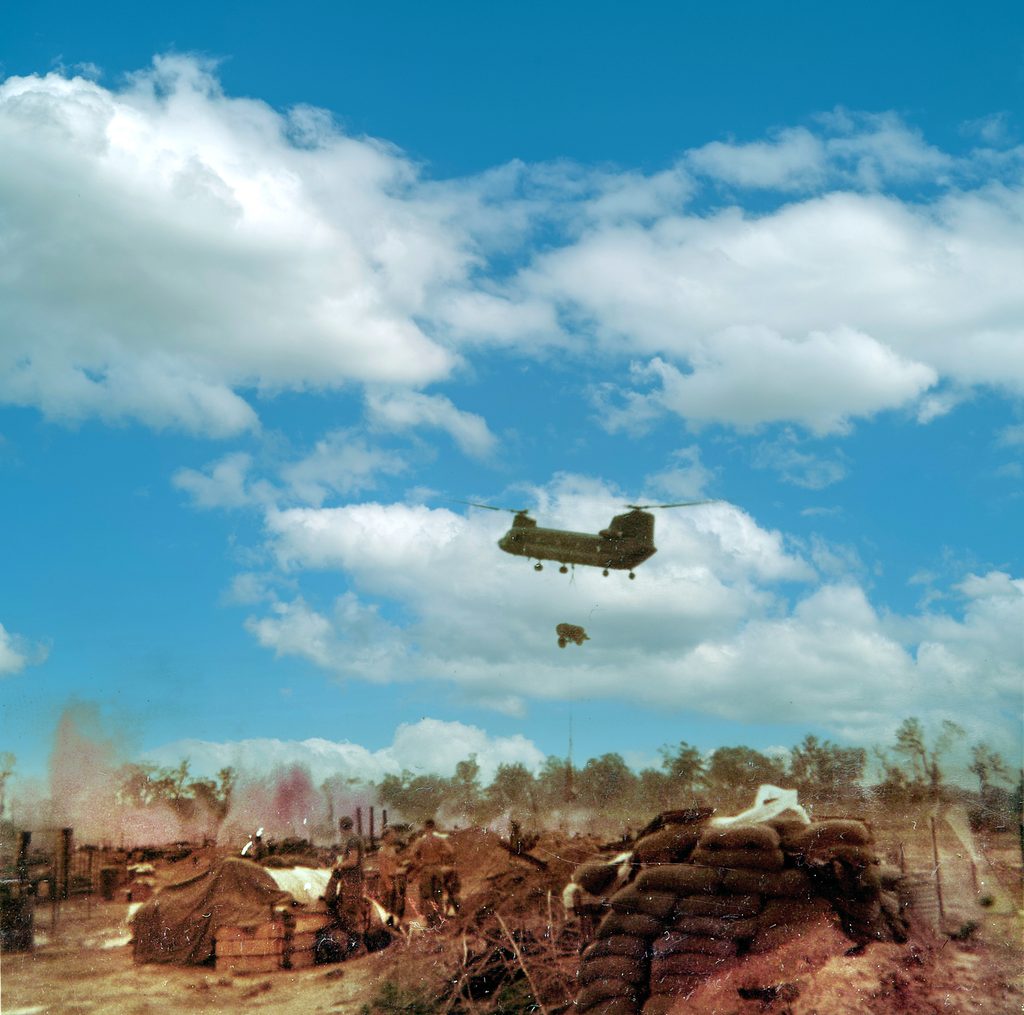
“Get this guy out to the landing pad,” the doctor deadpanned. “Get him out of here.” Jimmy’s gaze following the doc’s, letting his eyes single out a medic.
“C’mon,” Jimmy made the pick for them. “I’ll go if you will.”
They made it out.
“Medic!” a wounded soldier screamed.
“Get him,” Jimmy sent the other soldier, still holding the plasma bottle, then watching as the other medic shucked terror and moved.
“I watched until they made it back,” Jimmy remembers.
In a flash, everything changed.
He glimpsed the rocket propelled grenade when it kicked up dirt between the feet of the wounded soldier an instant before the world exploded in a shower a shower of blood, bone, excrement and burning shrapnel. Both the plasma bottle and the soldier disintegrated.
Fifteen of some 70 soldiers guarding the base were killed or wounded that morning.
Everybody thought it was over hours earlier, when a dark-of-night assault had been repelled with relative ease, except for a new officer who’d been cut in half by friendly fire.
“I’ve forgotten his name if I ever knew it,” Jimmy said. “He was fresh out of NCO school at Fort Benning.”
The new guy never fired a shot.
War was particularly tough for new guys.
New arrivals weren’t warmly welcomed.
“Nobody wanted to be with a new guy,” Jimmy said, “because they might do something stupid.”
“Sappers” penetrated the fortified compound about midnight.
“I never knew why we called them sappers,” Jimmy said. They came in small groups.
“It’s a suicide mission,” Jimmy said. “The guys in the lead would cut through the perimeter wire. The rest come crawling through with satchel bags packed with explosives.
“Their mission was getting close enough to the bunkers to throw in the bags and see how many of us they could blow up before we got them,” he said.
On this night, the sappers never had a chance, being discovered before they cleared the wire. At once, behind the bunkers, gunners leveled the barrels of howitzers to fire rounds three feet off the ground.
“They’d aim between the bunkers,” Jimmy said.
Nobody ever knew for sure, but the consensus was that when the new arrival heard the firing order, he might have thought it was the order for a mad minute.
“A mad minute was when everybody charged the perimeter and you shot blind into the night as fast as you could,” Jimmy said.
So the soldier who never fired a shot charged out of the bunker and was bisected in the opening howitzer barrage that lit him up like neon, and strangely, from the inside out, a thing unlike anything Jimmy’d seen.
By then, Specialist Franks had seen lots of death, but this was different, reminding him of a guy named Hill, the lone solider once out of step in a boot camp marching drill. Drill sergeants loved singling out an errant soldier as the butt of a joke everybody hated.
“Everybody but Hill’s out of step!” the sergeant bellowed. “The rest of you, drop and gimmie ten!”
The number of repetitions of ten pushups a drill sergeant might call for depended on how mad he wanted to make everybody else at the soldier who’d been out of step.
But instead of a sergeant taking aim at a single soldier, death singled out the new guy the night before.
At daylight, Jimmy went out with four others assigned to make a body count, to see how many enemy soldiers died in the night.
“I went out for a souvenir,” he said. He wanted a pair of shoes the GI’s referred to as “Ho Chi Minh Racing Slicks.” He also wanted a silver belt buckle of the sort worn by North Vietnamese officers.
The soles of racing slicks were crafted from automobile tires.
“They made straps from inner tubes,” said Jimmy. As it turned out, he didn’t have time for souvenir collecting.
“At the edge of the wood line we heard them setting up mortar tubes,” he said. “It makes clicking metallic sounds.” In the same moment, the Vietnamese spotted the Americans and opened fire. Jimmy’s small group dropped and returned fire.
Cyberspace says about a third of medics in Vietnam became casualty statistics. Not all medics carried rifles. Jimmy did.
“A lot of medics were conscientious objectors,” he said, “but they had to register for the draft or they could get prosecuted and sent to prison. The other option, if they got drafted but couldn’t handle the thought of killing, was volunteering to be a medic.”
When the shooting started, radio word from the bunkers gave them five minutes to make it back in before their guys opened fire from fortified positions. Getting back meant crossing an open field of fire.
“We broke and ran,” said Jimmy, who was moving with surprising ease on the healing ankle sprain he’d suffered two weeks earlier, bailing out of a helicopter.
“God won’t give you more than you can bear, but He will push you right up to the edge,” said Jimmy, and so would Killer, the hero commander who’d likewise pushed Jimmy to the edge the afternoon they leapt from a flying helicopter into a fight in progress.
He crawled to an organized line of soldiers making use of what cover there was; they’d formed a fireman’s line passing loaded magazines of ammunition up to five guys up on a firing line who were passing them back empty.
Somebody bellowed for a medic.
Killer, whose real name was Captain Raymond Armour, came crawling by Jimmy, heading into the fight. He preferred being addressed as Killer rather than by his rank.
“C’mon Franks, there’s people up there needing you,” Killer growled.
“Killer, it’s raining mortars,” Jimmy answered.
“Yea and any minute there’s gonna be one land on top of us and kill us all if we don’t move,” the officer said and waiting no longer, “he grabbed my collar and started pulling me along,” Jimmy said.
Jimmy slipped into practiced gear, pulling three guys back to where a second medic was stuffing wounds with toilet paper and wrapping them in pressure bandages. His ankle was on fire. He was exhausted.
“There’s more guys up there,” the other medic said.
“I know,” Jimmy said. “Your turn.”
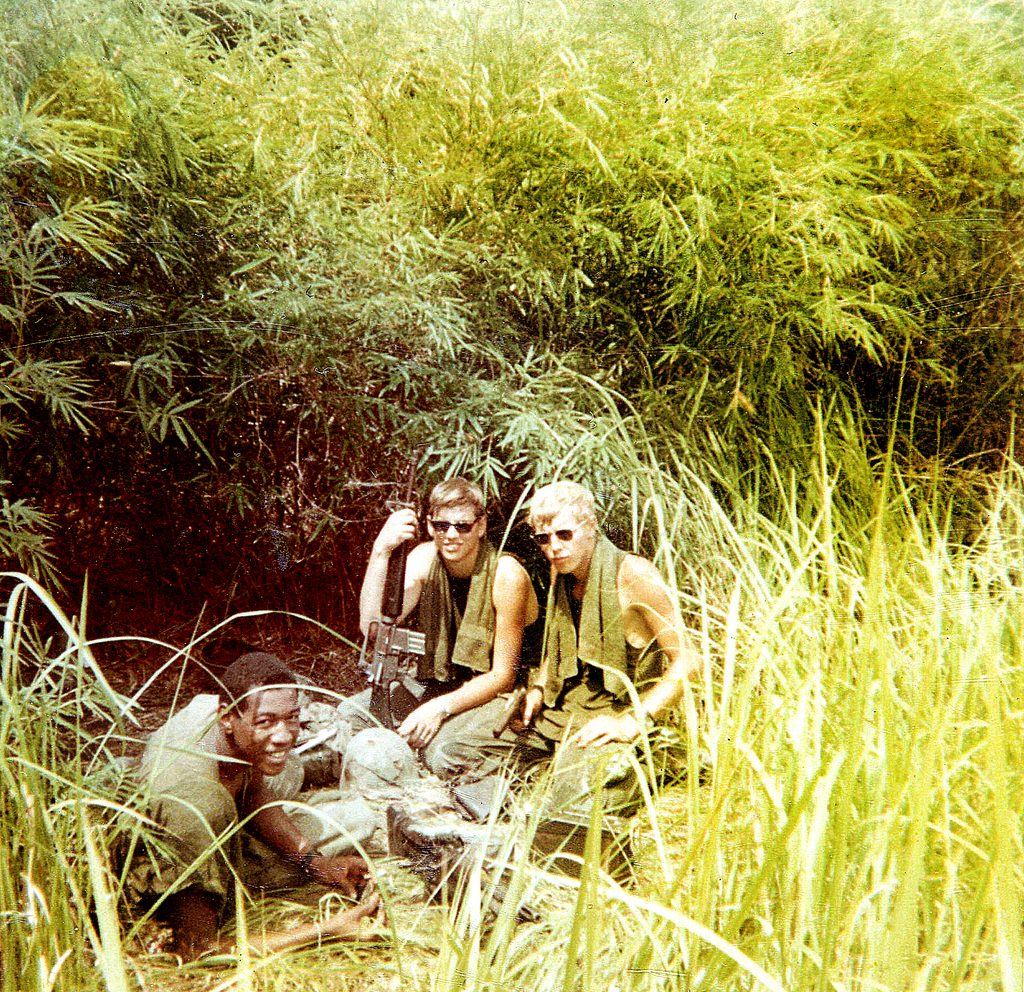
Fire fights like that, Jimmy said, seldom lasted longer than ten minutes, which was about as long as it usually took for the Americans to respond with overwhelming fire force from an array of flying death machines.
When this one was over, Killer grinned at Jimmy,
“You’re bleeding, Franks,” he said. Jimmy looked at his arm and picked out a piece of shrapnel. “I’m putting you in for a purple heart.”
“For this?” Jimmy asked.
“You’re bleeding, aren’t you?”
His ankle was swollen to the girth of his knee. The next day he was flown back to base to recover, which was why he happened to be on the night Vietnamese “sappers” came crawling in.
Otherwise, medics spent three weeks in the field, then got a week back guarding the base.
On September 5, after the soldier he couldn’t save was blown up, it seemed things might go either way.
It was raining mortars.
The third medevac helicopter attempting to land had turned away.
He’d been in one place too long.
He heard a fourth helicopter coming, hope for the wounded soldier he tended.
When the pilot cleared the tree line, he was so low and so close Jimmy could see the bird on his helmet, a colonel, a commanding officer in action in a desperate moment.
“He was coming so fast I didn’t think he’d ever get it down,” Jimmy said. “It was a hard landing, almost a crash.” Then the RPG hit between the soldier’s feet. For some indeterminate length of time, that was the last thing he was sure that he saw that was really happening.
The battlefield noise grew distant, fading away, making it easier to remember a teacher who’d praised him when he was the best reader in the first and second grade room of the four room school back in Titus County at Sugar Hill.
His father, a man he much admired, never had a chance to learn to read.
“Hard times,” Jimmy says, of the way his father grew up. “His parents divorced when he was young. His father remarried and moved on. His mother took him with her when she left Sugar Hill for Arkansas. He came back as a young teenager and worked alongside his grandfather on his mother’s side.”
His grandfather was a sharecropper.
“They farmed in the summer and made whiskey in the winter,” Jimmy said.
Years later, when logging and whiskey making had become his father’s way, an odd thing happened.
“He went to see a fortune teller at the county fair,” said Jimmy, “and she told him he was headed for lots of trouble if he didn’t make a major change in his life.
Fate made the change for him.
“Two weeks later, he got drafted and right after that the feds came in and raided all the whiskey stills,” said Jimmy, so instead of going to jail, Jimmy’s father went to World War II.
He remembered the Bible he’d gotten one Christmas when he was a child, and taking it to school to show everybody it was his and it was brand new.
When Jimmy left for the service, his girlfriend dumped him.
“I hope you’ll be waiting for me when I get back,” he told her.
“Forget that,” she said. “I’m not sitting home alone.”
That was a good thing, in a way.
There was a character named Jody that every soldier with a girl waiting for him learned to hate during basic training, a mythical persona from boot camp.
“Drill sergeants were always razzing the guys with girlfriends, and Jody was the guy they’d tell them was with her every night,” he said. “Listening to those guys being mocked every day made me glad I didn’t have a girl.”
A patriot, the day Jimmy Franks came into Mt. Pleasant to hunt down the recruiting office, he told the recruiter he wanted to go airborne, envisioning himself parachuting into battle.
Besides his father’s service in World War II, he had an older brother who’d served and made it back from Vietnam.
“I figured it was my turn,” Jimmy said.
The rigors of basic training scarcely tested him. Five foot ten and a whipcord 130 pounds, he was in shape when he got there.
“I was 12 when I started cutting bois d’arc posts with the Blalock boys,” he said. The Blalock boys were prosperous. They had a pickup to haul posts.
“We got a quarter each for 3-inch top posts,” Jimmy said.
In his teens, he worked with his father, sawing logs.
He put on 15 pounds of muscle in basic training at Fort Polk, Louisiana. He was told it was because of his high test scores that he was being sent to San Antonio to be trained as a battlefield medic before being sent to Georgia to learn how to safely jump out of airplanes. Also, given their 30 percent attrition rate, there weren’t enough conscientious objectors to fill the medical corps ranks.
Given time and experience, a guy can figure these things out for himself.
“San Antonio was pretty nice and training was easier than basic,” Jimmy said. “We got weekends off.”
When he wasn’t working or sleeping, he was on the San Antonio Riverwalk or drinking beer with the boys.
He ultimately made it to jump school where airborne soldiers learned new lyrics sung to the tune of the Battle Hymn of the Republic. Verse after verse, they sang about the lethal results of a parachute failing to open, surreal poetry broken up by a grim chorus in which Battle Hymn of the Republic lyrics “Glory! Glory Hallelujah” were changed to this:
Gory! Gory! What a helluva way to die!
Gory! Gory! What a helluva way to die.
He ain’t gonna jump no more!
No, he ain’t gonna jump no more!
Gory! Gory! What a helluva way to die.
There were other things, similarly strange for the guys on his side to be teaching their men.
Once, after jump school when he volunteered for Special Forces training, they’d been out in the field, living in tents, half-starved on short rations for days.
“Everybody was hungry, longing for whatever food we’d get at the end of the day,” he said, “So they rode by and pitched us out three live chickens.”
Only a minority of soldiers in late 1960’s America had any experience in dressing chickens, a fact causing this exercise in learning how to do what any soldier from Sugar Hill knew how to do.
Jimmy dressed the chickens and in short order had a creamy stew simmering and soldiers drooling.
Then the sergeant returned.
“Looks good, Franks,” he complimented the cook. “Lemme try it.”
“Yes sir!” Jimmy served him up a dish of chicken gruel.
The sergeant tasted, looking thoughtful.
“Needs some spice,” he said.
Scooping up dirt, he threw a double handful in the pot, laughed and rode away.
“The whole thing was about working you to a nub or making you so mad you’d quit,” Jimmy said, “and what they wanted was guys who wouldn’t quit.”
That evening, he dined on chicken stew strained through bandages.
It all came to make sense before he shipped out for Vietnam.
“There was no compassion, no sympathy for anything,” he said. “When you’re in the heat of the deal there’s no time to feel sorry for guys who die, guys getting wounded or yourself. It’s the way we were taught.”
If there was no sympathy for comrades, there was utter disdain for enemies considered something less than human.
“The first day I was helicoptered into a base there was a dozer digging a deep ditch just outside the perimeter,” he said. “They were pushing a pile of dead Vietnamese into a common grave.”
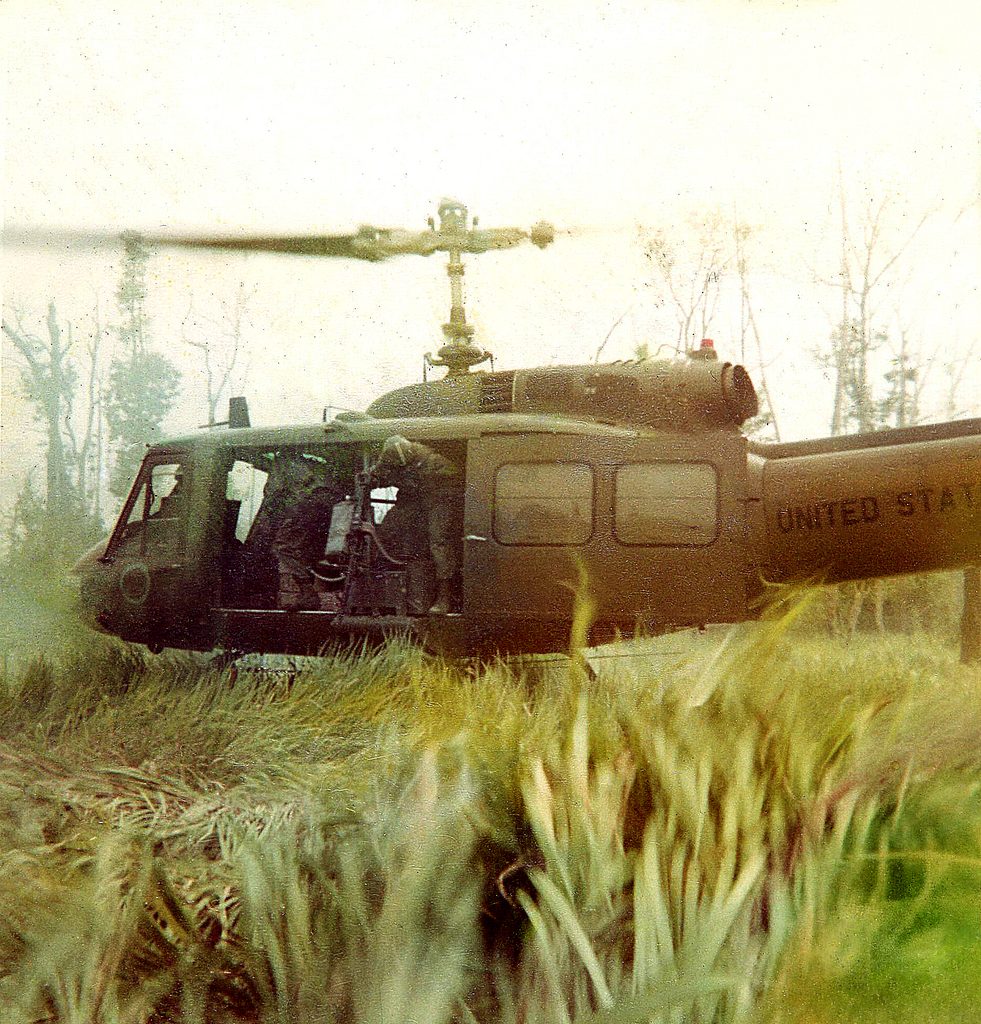
“You want morphine?” a familiar voice once broke through the haze, sobered him enough to think. It was a doctor he liked.
“I’ve already given myself a dose,” Jimmy answered, cutting through the cobwebs, remembering the helicopters that couldn’t land, the mortars, the soldier who’d blown up. Battlefield medics had lots of morphine.
He remembered hearing the metallic clink of mortars setting up, the moment’s warning before hell broke loose. He remembered making it back to the bunker where the doctor was working, where bodies and wounded were piling up.
“Franks, there’s no more room to lay you out in the helicopter, but we can strap you in the gunner’s seat – it’s gonna be rough. Do you want a shot of morphine?” the doctor was repeating himself.
“I already gave myself some,” Jimmy likewise repeated the answer he’d already given.
“I’m talking about the good stuff,” the doctor said, slipping the needle in.
The next six months were a drug-fueled haze, lots of time dreaming in medical induced commas between surgeries.
The confusion of hospitals ended with leave that brought him home for two weeks.
At home, “I slept,” he said. The highlight of his return was discovering the indoor plumbing installed while he’d been gone.
Fort Polk, Louisiana, May 7, 1971 –
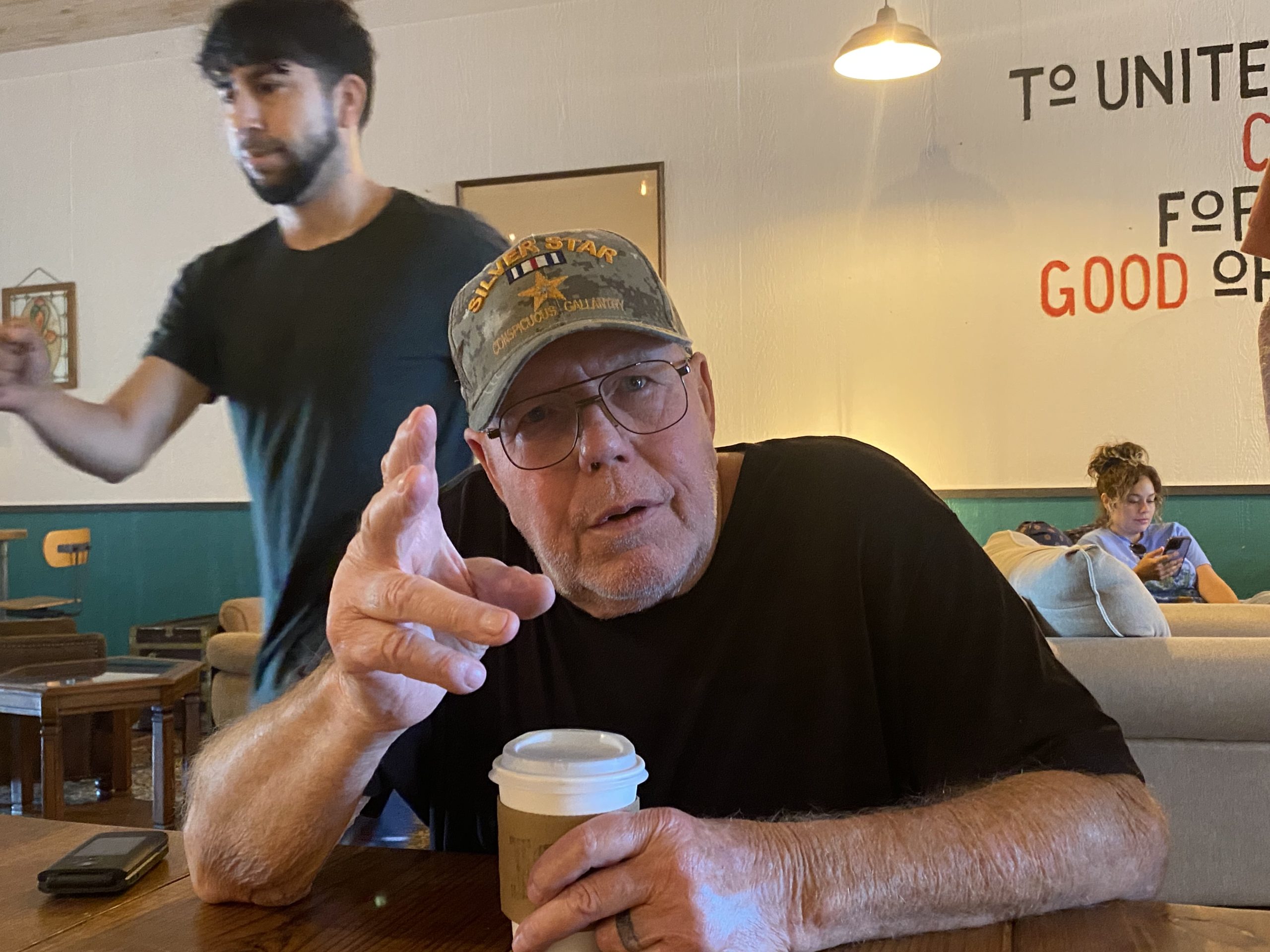
“Spec. 5 Jimmy D. Franks of Titus County, Texas received the nation’s third highest award for valor from Brig. General Henry J. Muller here today,” read the wire service news release blazing headlines across state lines in the following days.
“For gallantry in action while engaged in military operations in the Republic of Vietnam,” the citation said. “Specialist Franks volunteered to leave the relative safety of a bunker on a Fire Support Base in Tay Ninh Province, moving to evacuate the seriously wounded to meet medevac ships when an incoming rocket exploded directly before him. His gallant action is in keeping with the highest traditions of the military service and reflects great credit upon himself, his unit and the United States Army.”
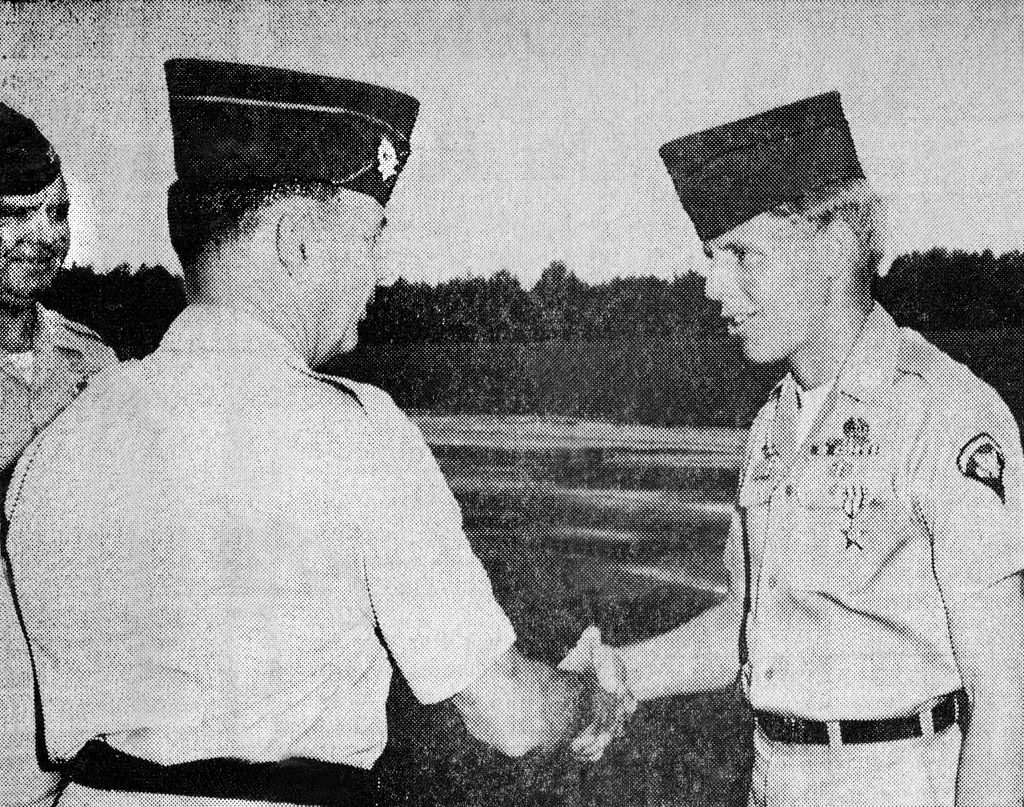
A week after the story broke in Louisiana, the Mt. Pleasant Daily Tribune picked it up.
“Bravery Earns Titus County Soldier Nation’s Silver Star,” read the front page headline.
By then, Jimmy was into a down-hill run through the final months of a military tour that ended at Fort Benning, Georgia.
Here’s some irony – to get out of the service on time, he had to shell out $100 to pay an “Article 15” fine to keep from being court martialed.
The only time he ever defied a direct order, he was out of harm’s way, working as a medic in a mocked up Vietnam village where soldiers trained in a Georgia forest.
“It was hot, but that was it,” he said. “The most dangerous duty I had was treating guys for heat exhaustion.” The facilities were impressive.
He was particularly dazzled by the underground network of passages where “tunnel rats” trained.
Tunnel rats were soldiers running on pure adrenaline, crawling and digging through tight, confined spaces leading to mocked up underground command and arsenal facilities.
“Most of those guys went in with knives instead of pistols because a pistol full of dirt was too likely to misfire when you needed it,” he said.
Recovering from war wounds, he’d drawn his gravy train assignment until “I was told I was being put in charge of the barracks,” he said, when he was weeks away from being discharged, saving up gas money for the trip back home to Titus County and Sugar Hill.
“I told them I didn’t wanna be in charge of anything,” he said, which offended command enough to threaten a decorated war hero with prosecution. “I didn’t wanna tell anybody what to do.”
The way it wound up, he was given his choice of paying up an Article 15 civil fine, receiving an honorable discharge or being prosecuted and probably locked up for an additional 30 days.
Money was tight because of the car payment eating up all but $60 of a monthly check otherwise committed to paying off a sleek new hot-rod Chevy Jimmy figured was fast enough to run down the girl of his dreams when he got back to Sugar Hill.
“I made it home in style,” Jimmy said, and he smiled.