Lead Belly’s Texas Roots: The DeKalb Story of Huddie Ledbetter
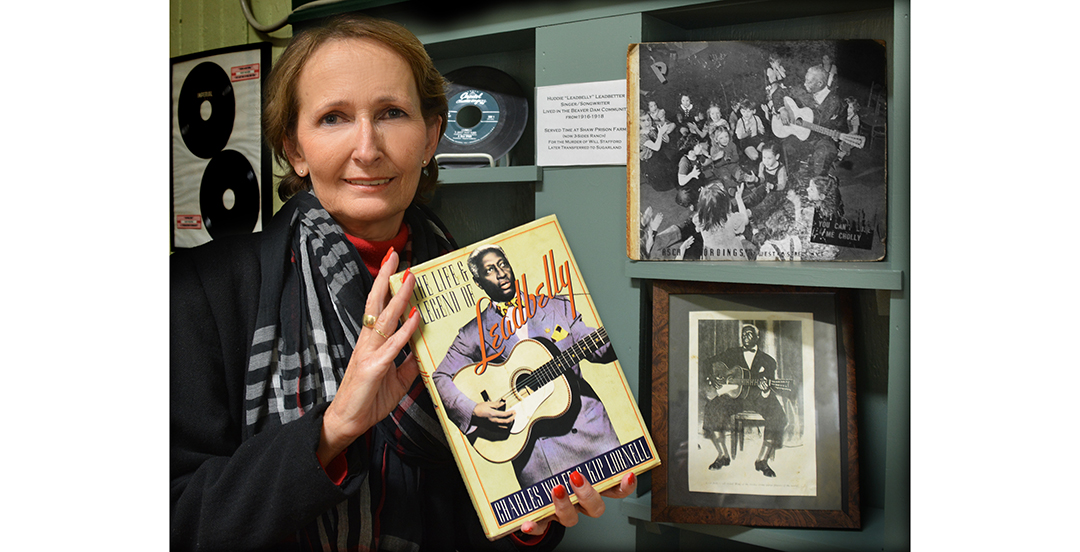
Above Photo: Joni Haldeman provided research documenting Lead Belly Ledbetter’s work as a sharecropper on the lamb, living under an alias in Bowie County. The murder rap that sent him to prison also drew attention to his music and the governor of Texas is said to have been among the first to make note.
Ed’s note: In defense of a story including amoral, racist and assuredly offensive to political correctness references, as best I can tell that’s how it was.
From The East Texas Journal, November 2014
By HUDSON OLD, Journal Publisher
DeKALB, TEXAS — Lead Belly liked his women loose and his music tight, working a Texas-born Boogie Woogie bass-string rhythm into masterful play of his 12-string guitar.
The often macabre poetry of a violent rogue who sang his way out of prison drew fuel from the Bowie County dirt where he and his wife once sharecropped, where he wrote his “DeKalb Blues” after being sentenced in 1918 to seven to 30 years on Shaw Prison Farm north of town.
“When Lead Belly sang he was really telling his story,” said Mt. Pleasant Edison Phonograph Museum curator Dustin Ellis. “He honed what the blues were all about — instead of grieving about his sadness, he sang about it.”
He did time on the Shaw Farm in the Red River bottom north of DeKalb, at Imperial Farm in Sugarland and a last stretch in Louisiana’s notorious Angola, where he was “discovered” in 1933 at the height of the Great Depression.
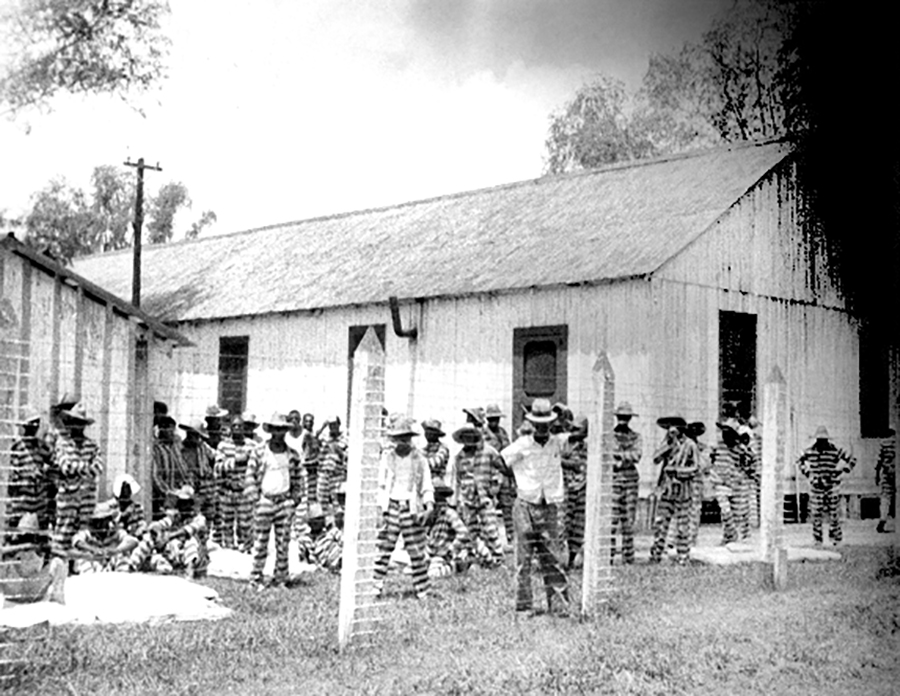
Wikipedia postulates that Huddie William Ledbetter picked up and latched onto the nickname Lead Belly during prison years. Maybe it was a play on his family name and note of his prowess.
“During his second prison term, after another inmate stabbed him in the neck, Ledbetter nearly killed his attacker with his own knife,” the on-line encyclopedia says. “Others say he earned the name after being wounded in the belly with buckshot.”
He was good looking, trim and charming, reported DeKalb Williams Museum docent Joni Haldeman, now a municipal judge who was working the Mothers Day rush at the family flower shop when a pair of researching authors on Lead Belly’s trail arrived in DeKalb in 1991.
Contradicting reports said he was either paroled or had escaped a Harrison County chain gang where he’d been working off time on a weapons conviction in 1916.
“They’d heard re-occuring accounts of his being subsequently convicted of murder in Bowie County,” Judge Haldeman said, and connecting circumstantial evidence included sheet music for his “DeKalb Blues,” a unique piece now on display at her town’s Williams Museum.
(Unique because you’ll have to go to DeKalb to read those lyrics – after half an hour in cyberspace, we declared the search a dead end.)
Recruited to dig through the courthouse for any Bowie County records of Lead Belly, Judge Haldeman likewise came up empty until she came up with his alias, connecting a singing sharecropper going by the name Walter Boyd to the tale.
Accused of killing Will Swafford in a fight over a woman named Champ Jones, Walter Boyd was arrested at John McCowan’s farm, where he and his first wife, Aletha “Lethe” Henderson, had arrived in 1917.
The law firm of Mahaffey and Keency was appointed to represent Boyd after he was declared an indigent farmer without property.
“Jack Mahaffey said his father was reluctant to take the case,” Judge Haldeman said. “Not only was the evidence clear cut, he feared Lead Belly wouldn’t get a fair trial because a black man in the legal system in those times had rights ‘equivilant to a stray dog.’”
Walter Boyd was a good looking man with a rougish charm, she said, a noted womanizer with a “love for Bowie County women.” His pursuits reflected his passion for music, dancing, drinking and gambling in dives in the backwoods of black communities on the Red River, places the white arm of the law of the day didn’t reach, an era when – short of murder — black on black violence was an accepted way of things.
Based on the judge’s work, the DeKalb chapter in Charles K. Wolfe and Kip Lornell’s 1999 book “The Life and legend of Leadbelly” (sic) includes an account of his overpowering a guard and escaping the Bowie County jail three days after his arrest.
There’s another tale of his escaping the Shaw Prison farm with two others who were soon captured. Lead Belly surrendered later, and then only after taking to the Red River and being held at bay by the hounds.
His conforming to prison farm life is evidenced by his appointment as “leader of a hoeing squad,” working under the watchful eye of the “walking boss . . . some of whom advocated that every black prisoner needed a taste of the leather.”
In a misty tale once seeping from the underbelly of a Texas prison farm, Governor Pat Morris Neff (who ultimately paroled Lead Belly) “had regularly brought guests to the prison on Sunday picnics to hear him perform.”
It was during the Great Depression, an era when federal money was poured into everything from local infrastructure projects to cultural study that Lead Belly was discovered, singing in the fields of Louisiana’s Angola Prison.
In 1933, three years after being convicted of “attempted homicide for stabbing a white man, he was discovered by folklorists John Lomax and his son Alan,” Wikipedia reports. “The Lomaxes recorded him on portable aluminum disc recording equipment for the Library of Congress.
“On August 1, 1934, he was released following a petition the Lomaxes had taken to (Louisiana) Governor Oscar K. Allen on his behalf.”
The petition took the form of a song later recorded on the flip side of his signature classic, “Good Night, Irene.”
From the bayou forests near his Marshall home in Harrison County, Texas historian Jack Canson declares the Louisiana elitists claiming right to Lead Belly’s musical origins may have his body, but his soul rests in ghosts of rail camps on the shore of Caddo Lake.
Only the diligent work of a Wikipedia researcher comes close to making the Boogie Woggie railroad connection rising from the landing where a steamboat delivered the rails and the locomotives igniting the music of workers building the 1870 line from Caddo Lake and the Cypress River into Marshall.
Best described as “haaahh!” Lead Belly explained that the unusual sound made in some of his songs, like “Take This Hammer” and “Linin’ Track” came from the chants sung by Southern railroad “gandy dancers,” the one-time slaves singing chants to the rhythms of steam engines as they worked.
“Dr. John Tennison is a San Antonio psychiatrist and internationally respected musicologist and Boogie Woogie expert,” Mr. Canson said. “After years of research, he determined that Marshall is the most likely original hub from which Boogie Woogie music spread to the rest of the world.”
Lead Belly’s prowess with a 12-string guitar included the melancholy sense of minor chords picked to the repeating rhythms born on pianos in railroad camps.
“In the case of Boogie Woogie, that repeating element was inspired by the chuffing sound of steam locomotives. Specifically, the eight beats to the bar of classic Boogie Woogie is associated with two rotations of a steam engine driver wheel,” Dr. Tennison reports.
Rhythmic runs along piano keys including the “Tyler Tap” and “The Big Sandy” were named for stops on the Texas and Pacific Line pulling out of Marshall.
Those same elements, moving from piano to 12-string guitar, are found in Lead Belly’s music, Mr. Canson said.
Born just across the Louisiana line in either 1888 or 1889, census records put Lead Belly in Harrison County in 1910.
“Marshall is the most logical place where the merging of railroad sounds with African musical sensibilities could have happened in the early 1870’s,” Dr. Tennison concludes. “As a rail hub, Marshall was a launching pad for a musical style that went around the world.”
They drove rail spikes to a rhythm.
“Every time the men say ‘haah!’ the hammer falls,” Lead Belly sang. “The hammer rings and we swing and we sing.”
In 1936, an early Time-Life newsreel featured Lead Belly’s New York performances at Harlem’s Apollo Theater.
On April 19, 1937 Life magazine ran a three-page article titled “Lead Belly – Bad Nigger Makes Good Minstrel.”
Modern rock audiences hear his music in Nirvana’s “Where Did You Sleep Last Night?” a song Lead Belly recorded as “In the Pines” in the 1940’s, a lyrical collision leaping from a man’s allegation of a woman’s infidelity to a woman’s lament of her husband’s death.
“Black girl, black girl, don’t lie to me / Tell me where did you sleep last night? In the pines, in the pines, where the sun never shine / I shivered the whole night through.
“My husband was a railroad man / Killed a mile and a half from here / His head was found in a drivers wheel / And his body hasn’t never been found.”
In the wake of his legacy’s Louisiana kidnapping, the home-spun Williams Museum where the ladies bridge club also meets weekly makes DeKalb maybe the only town in the Lone Star State actively telling the tale of Lead Belly’s Texas roots.
“Listen,” says music historian Jack Canson, a man with an appreciation for any place working to keep Texas tales alive. “I forget the year and my files aren’t handy at the moment, but when he was editor of the Marshall News Messenger Max Lale took up this subject. At that time, there was only a simple marker on Lead Belly’s grave at Shiloh Baptist Church cemetery, just a few miles east of the Texas line toward Blanchard where a handful of other Ledbetters known to have lived in Leigh, Texas, are buried. Lale made a similar case to the one I made earlier that Lead Belly was a true son of Texas and his connections to Louisiana were not much more than a) a little time in the red light district in Shreveport, b) a cutting affray in Mooringsport, and c) a few years in Angola. Max proposed that Lead Belly be reinterred in Marshall, where his niece Irene Campbell was a respected school teacher, for Good Night’s sake, and that Marshall hold an annual Lead Belly Blues Festival every year. Shreveport media reacted indignantly and immediately a fund raising effort commenced and they installed the very impressive gravestone and wrought iron fence that now graces his grave, attracting many visitors throughout the year, including some very notable ones. They went on to erect a statue of Lead Belly at Earl G. Williamson Park in Oil City, a place there is no evidence he ever visited although he probably did, and another statue of him on Texas Avenue in downtown Shreveport. Prior to Max’s articles, no one in Louisiana had paid any attention to Lead Belly and his legacy. From that moment on they have put him on a celebrity tier with Governors Jimmy Davis and Huey Long and reverentially and falsely claimed a Louisiana birthright for his musical accomplishments comparable to that they rightfully have for Louis Armstrong.
“There’s no fault in what Louisiana has done,” Mr. Canson said. “They saw an opening and they took it, and it serves their state’s brand well. Texas has neglected to honor and claim Lead Belly, just as our state has been slow to acknowledge most of the musical heritage of the entire northeast Texas area. Arguably, more significant contributions to the blues, boogie woogie, gospel, country, rockabilly, and rock and roll music arose in northeast Texas than any other region of our state. But there is a stereotype about Texas music that persists even among our own arts community. If it happened east of I-35 and if it ain’t wearing a cowboy hat, it’s not Texan enough for some people.”
In the DeKalb museum exhibit, there’s a grainy snapshot of Lead Belly, a copy of the book for which Judge Haldeman provided the Texas research and a jacket from the Smithsonian Folkways album, “Lead Belly Sings for Children.”