Fact or fiction: century old government study probed practice of water witching
From The East Texas Journal, January 2016
By Hudson Old, Publisher
So it’s the Sunday morning gathering of the tribe, Wayne Ruyle strolls in, drops an envelope on the table and it makes a muted metallic ding when it hits.
Envelopes aren’t supposed to ding.
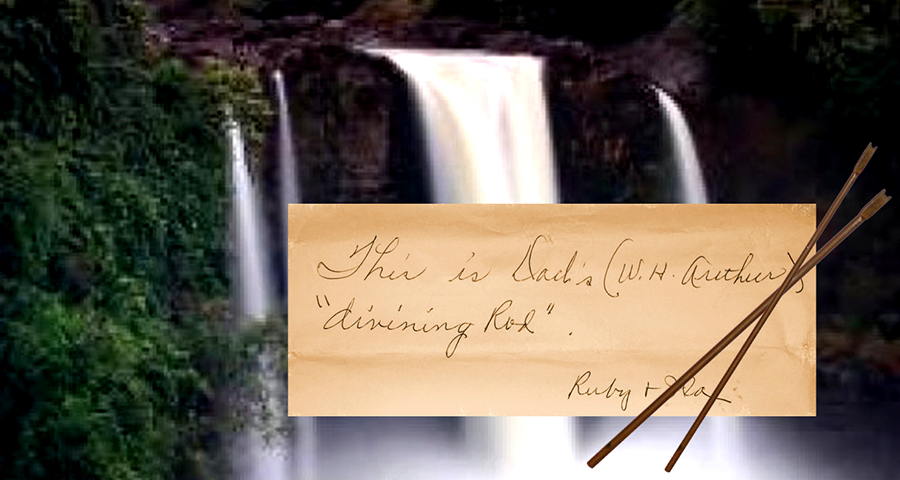
“Here’s you a story, Chief,” he said, and pushed it to me. Noted on front of the envelope, “This is Dad’s divining rod.” Wayne’s mother wrote that. In a leather case inside the envelope, the metallic lengths of four rods about as thick as a kitchen match and something short of a foot long belonged to Wayne’s grandfather who died in 1949.
Wayne’s an engineer who retired from Dallas ivory tower corporate and said he had no idea how his grandfather’s divining rods were supposed to work.
“But I can tell you this,” he said. “I’ve seen a guy looking for a pipeline take two coat hangers bent at 90 degrees, walk holding them pointing forward and when they turned he stopped and dug and found the pipe.”
Based on that, he reasoned the mystery of “water witching” and “divining rods” possibly has something to do with anything creating a reservoir, a stream or a furrow, some energy transmitted by something irregular or channeling through the crust of the earth.
A hundred-year-old government study tracing the history of divining rods suggests that for a few thousand years the use of such instruments was something of a mystery but otherwise a practical matter and that its practitioners went about their business with no fear of condemnation before the 17th century, when the French stirred it up.
Writing on behalf of the church, in 1659 Jesuit Father Gaspard Schott denounced those employing the practice as “instruments controlled by the devil,” a conclusion he later denounced as “monks of great piety have used it with really marvelous success.,” Second thoughts based on observation led him to conclude that the movement associated with a divining rod or forked branch in locating water “does not at all proceed from either Satan or the strength of the imagination of him who uses it.”
It was simply a mystery, not unlike the mystery of conception concluded a French physician of the same era.
It was too late. Father Schott’s earlier writing ignited a topic hotly debated for the next hundred years by the church, and still lingering in government circles three centuries later.
“Ecclesiastical controversies” reads the table of contents of the 1917 United States Geological Survey’s (USGS) “Water Supply Paper 416, The Divining Rod / A History of Water Witching” by Arthur J. Ellis.
The introductory note by O.E. Meinzer explains that the government was looking into water witching to “furnish a reply to numerous inquiries that are continually being received by the Survey from all parts of the country.”
For those not up to the whole of a paper opening in the misty times of Genesis, coming up through the ancient Persian empire, swinging through the Orient with Marco Polo, considering German applications in the middle ages, the official U.S. Government conclusion in 1917 could be found at the close of the introduction.
“It is by no means true that all persons using a forked twig or some other device for locating water or other mineral are intentional deceivers,” Mr. Meinzer said. “Some of them are doubtless men of good character and benevolent intentions. However, as anything that can be deeply veiled in mystery affords a good opportunity for swindlers, there can be no reasonable doubt that many of the large group of professional finders of water, oil or other minerals who take pay for their services or the sale of their instruments are deliberately defrauding the people, and that the total amount of money they obtain is large.
“To all inquirers the Survey therefore gives the advice not to expend any money for the services of any water witch or for the purchase of any instrument devised for such purpose.”
Additional “applications of the divining rod” in the government review of the ages included “locating ore deposits, finding buried treasure and lost landmarks associated with property boundaries, detecting criminals, analyzing personal character, curing disease, tracing strayed animals, providing immunity against ill fortune, locating wells and determining the volume and flow of underground streams.”
In spite of its conclusions and its wariness of swindlers, from a 1598 account of the Life of Saint Teresa of Spain, the USGS investigators found record of the Sister being offered a site for a convent with one problem – no water.
Along came Friar Antonio with a twig in hand, stopping “at a certain spot where he appeared to be making the sign of the cross,” she reported, “and then he said, ‘Dig just here,’ and they dug and a plentiful fount of water gushed forth, excellent for drinking, copious for washing and it never ran dry.”
More recently, I handed W.H. Aruthur’s metallic divining rods to Ty and Valerie Russell, the pair of electrical engineers using the Journal as the neighborhood construction office during their ongoing restoration of an 1890’s storefront on 2nd Street.
“No attraction,” Ty said, testing the metal with a magnet.
“Possibly copper,” suggested Valerie, “a great conductor so maybe it had something to do with an electrical field.”
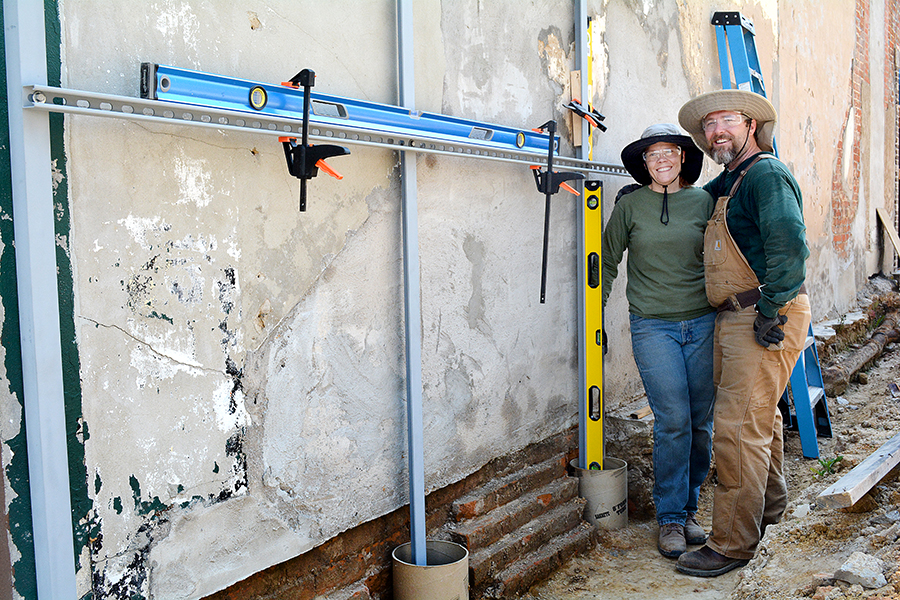
A civil engineer, Lonnie Smith never looked into divining rods in the course of his career, but speaks of personal observation suggesting a recognized connection between the underground movement of water and electrical fields.
“My dad worked for a small-town gas company all his life,” he said. “By small town I mean that he set meters, fixed leaks, got called out in the middle of the night and if they needed somebody to knock on doors to collect past due bills, he’d do that.
“What I can tell you is that whenever they laid a new gas line they insulated it. They grounded it which suggests to me there was some history of the underground movement of water generating an electrical field that can trigger a spark.”
Having the same idea in the latter years of the 18th century, Dr. Pierre Thouvenel, physician to King Louis XVI, became interested in another French peasant, a known “hydroscope” named Barthelemy Bleton.
Bleton confined his work to finding water. He believed divining rods had no power in and of themselves, but was an outward expression of what he felt internally when he passed over water. After observing Bleton’s movements, he described them as a “tremor first attacking the diaphragm and communicating itself through the body and hands to the rod.”
Then he blindfolded Bleton, led him back to the place he’d found water, but then had him walk on glass and observed no tremor. He concluded that the insulating glass suggested Bleton’s sensitivity to electrical radiation rising from the earth.
Writing in times when the government had no qualm with those turning to scripture for practical answers to riddles, the USGS survey affirmed written accounts of the mystical power of rods, “especially in the books of Moses.” A favorite reference for those advancing divination as a means for finding water was Numbers, 20:9-11 where Moses drew water from a rock by smiting it with his rod.
Ezekiel 21:21 makes historical note of the pagan king of Babylon employing divination to make “his arrows bright.”
The concerns of French authorities began before the paper written by the Jesuit priest in 1759. Born in 1576, the Baron of Beausoleil, Jean-Jacques de Chatelet, became one of the foremost mining authorities of his day, traveled extensively through Europe, visited America before the Pilgrims landed and busied himself locating ore deposits with forked twigs and metal rods. Early on, he and his wife were commissioned by dukes, emperors and even the Pope in hopes of unearthing riches.
He later fell into disfavor in royal circles and became subject to the authority of the church.
Those “mechanical” rods, not the twigs, became the basis for a charge of sorcery. The Baron was arrested and thrown into prison at Bastile, where he died in 1642.
In 1692 the use of divining rods took a hard turn into the moral universe and criminal matters when a French peasant named Jacques Aymar claimed the ability to trace fugitives.
“This incident, described in great detail by several writers, was the apprehension of a criminal who was arrested, confessed and was the last person in Europe to have been broken at the wheel.”
During the hundred years after the Jesuit priest’s writings touched off debate, the church went both ways. As late as 1703, the same guy who’d fingered the criminal pulled apart on the rack “employed his divining rod to point out Protestants for massacre,” further incentive for French Huguenots riding a rising protestant tide of reformation opting to flee to the New World.
Later, “a careful analysis of the numerous official and other records of Jacques Aymar’s part in his first criminal case shows he had obtained important clues before he was publically set to work.”
In 1701, the French Inquisition abolished the use of divining rods in criminal cases.
Fast forward to Mt. Pleasant some 270 years later and a drought so severe the city council was talking about hiring a pilot to seed any cloud that appeared with dry ice, hoping to trigger a chain reaction of condensation that would feed upon itself as it brought cooling rain.
“I wasn’t drilling water wells, but I got in the business right quick,” said Carr Denman Jr., whose Denman Drilling Company came to life on construction sites, drilling piers for foundations. “I didn’t have a license to drill wells but the way it was right then nobody cared or bothered about that if you could find water.”
The jobs came rolling in.
“I don’t know if I believe in witching for water or not, but I can tell you that before I showed up lots of people would have their spot witched before I got there,” he said, “and if we ever drilled a dry hole I don’t remember it.”