Pal’s Fish Camp on Cypress Creek, served fish, barbcue and passing gangsters
The Pittsburg Gazette reported that 42-year-old P.D. Thornton “is said to have an even chance for recovery” after one man held him while a second man cut him “across the abdomen at Pal’s Fish Camp on Cypress Creek,” the newspaper reported on July 19, 1935.
“The affair occurred as Thornton was closing his place for the night and is said to have been the result of a long-time disagreement,” the report said.
The proprietor was tough enough to match times when the remotely-located camp and its cafe drew storied gangsters.
“Securing a weapon, Thornton held his assailants until officers could be summoned to the scene,” the newspaper said.
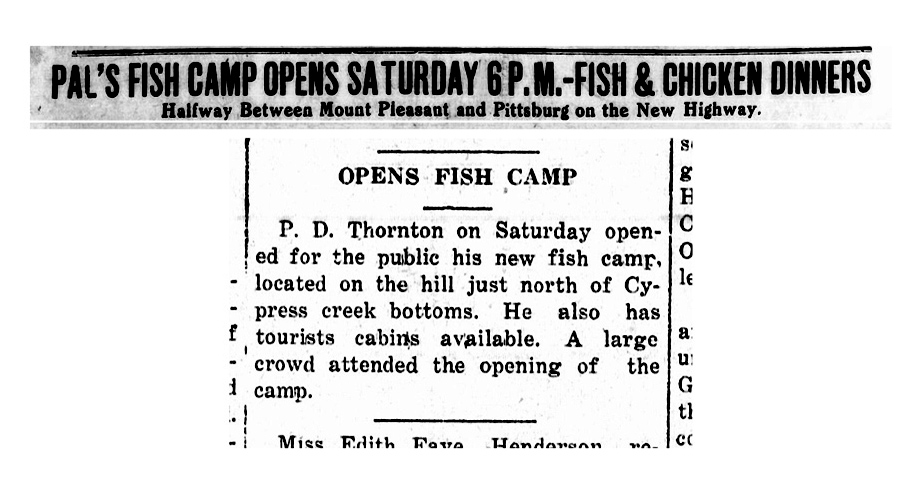
Acting on the recommendation of friends, notorious gangster Pretty Boy Floyd stopped in at Pal’s Camp, the finest dining between Pittsburg and Mt. Pleasant, said Mr. Thornton, who opened the camp’s café and creek-side cabins on June 13, 1931, “halfway between Pittsburg and Mt. Pleasant on the new highway,” said the Mt. Pleasant Daily Times. He ran the restaurant 10 years.
Turning out orders from a wood burning stove, in its first six weeks the joint served “over 6,000 pounds of fish and 300 dozen barbecued chickens, Mr. Thornton told Donna K. White, who interviewed him in 1979 as part of an oral history project preserved at the Mt. Pleasant Public Library. For a transcript of the interview, go to easttexasjournal.net, P. D. Thornton.
.
Two Oklahoma brothers with eight or ten hired men moving oilfield equipment from Oklahoma to Kilgore stopped regularly, he said.
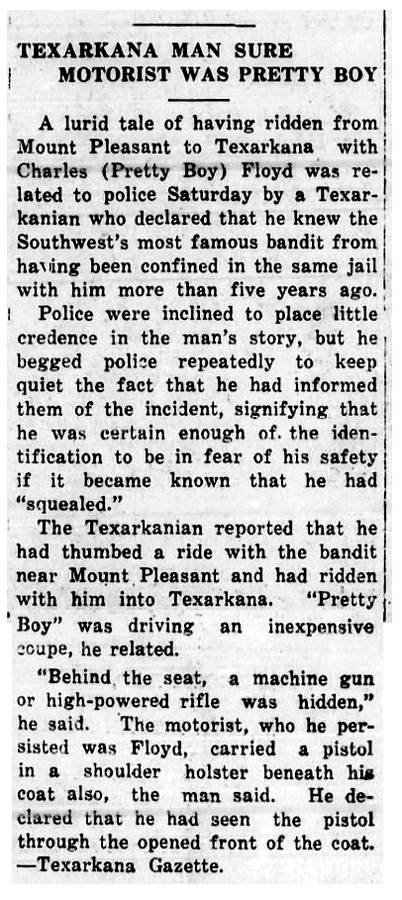
“One day one of them asked Mr. Thornton if Charlie Floyd had been to see him,” White wrote in her synopsis of the interview. “Mr. Thornton said he didn’t know any Charlie Floyd and Mr. Taylor told him that was the one they called “Pretty Boy,” and that he was living in an oilfield camp.
Mr. Thornton said he’d gotten to “robbing around to help friends and family when times got hard.”
“So Pretty Boy came to see Mr. Thornton and stayed until another car drove up so he left and went to Mt. Pleasant and spent the night in a boarding house,” Ms. White wrote. Mr. Thornton told her at one time or another customers included Machine Gun Kelly and Bonnie and Clyde. “Mr. Thornton said those folks wouldn’t do nothing to you, they wouldn’t bother you.”
The “Department of Justice” in Dallas contacted local authorities advising them to be on the lookout for John Dillinger’s “outlaw gang” said the April 13, 1934 report in the Daily Times.
Dillinger and his accomplices were reported to be headed for Mexico.
“The telegram said that the car was headed this way and that one of the men was wounded and might stop somewhere for medical attention. Deputies met a car matching the description given near Winfield shortly before noon.
“They turned around and gave chase but the car sped away. It contained two men and a woman, one of the men lying on the back seat. The driver refused to pull over when the officers’ car neared them and sped up to about 65 miles per hour. Not being sure they were the right parties, the officers didn’t fire on them but telephoned to Sulphur Springs for officers there to stop them when they got to that city.
Radio KIMP Wednesday reported that Clyde Barrow had been in Mt. Pleasant Tuesday and members of his gang might be hiding in Titus County. “Two Men and two women who might have answered the description of Barrow, Bonnie Parker and others stopped here for lunch Tuesday,” the report said.
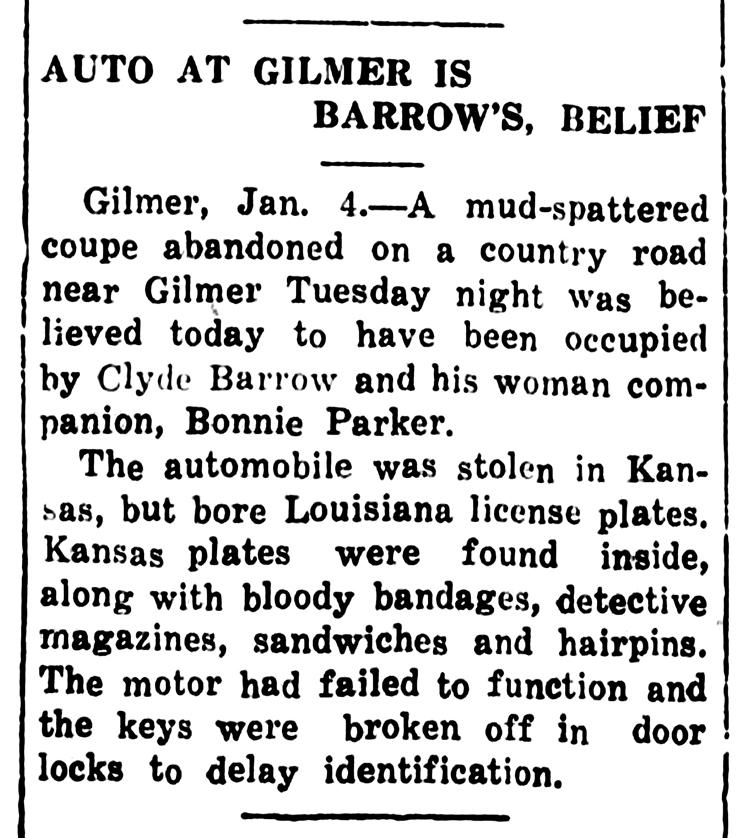
The way Mr. Thornton remembered, it had been raining all morning and he’d been late getting out to the camp. He’d just gotten a fire going when the car pulled in. One man was big, the other one slender. Both women and the slender man “commenced to playing the slot machines,” he said.
“They ordered dinner and the slender man said he didn’t want nothing to eat. So they ordered three fish dinners,” which were advertised at 50 cents each and came with three quarters of a pound of fish.
He said they were driving “that car Bonnie and Clyde were killed in.”
They acted just like anybody else, he said years later, and he remembered that when the other three were done eating, the slender man decided he wanted something, so he had a fish dinner and then “he ate two ham sandwiches. So they went on and that was it.”
One night that he remembered because he and Ewell McClinton, a local electrical contractor, had gone to Dallas and bought a lamp that lit up the whole place, a big handsome fellow and a beautiful woman drove up in a maroon Buick. The man was blond haired but had a beard as black as could be.
The woman wore a hat; the man had on a silk shirt, a fine pair of pants and matching alligator shoes and belt. They were nice talking and congenial. They came in about 9:30 and stayed until closing at 1 a.m.
Old Man Penn Brock was there and “two or three days later he came in shaking all over. He had a Dallas news and there was a picture there of a man and woman and a car and they’d been arrested in Memphis, where they’d gone after they left the camp that night.
“It turned out to be Machine Gun Kelly. But they didn’t bother anybody, just tried to get along and have a good time,” Mr. Thornton said.
Born in 1893, “Mr. Thornton said he plowed and hoed more cotton than anybody” when growing up six miles out of Pittsburg, which was what inspired him to become a school teacher. He taught at Weaver’s Chapel School in Camp County, eight miles south of Pittsburg. He put a twist in the story of the origin of Pittsburg Hot Links.
He said when he was growing up there was still a saloon in town with a horseshoe counter in a big room in back and that was where you could order “all the hot links you could eat for a dime.” If you didn’t want liquor to drink, you could order root beer that was made in a place where they made soda water in town. It was run by a Frenchman.
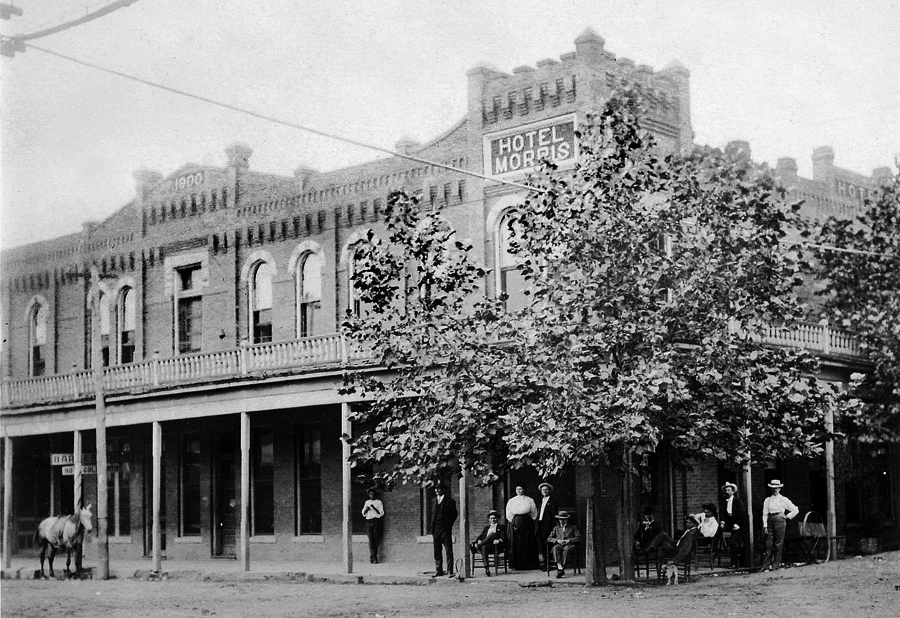
On election night in 1912, he said he and another fellow rode the train to Mt. Pleasant to be the first to hear election results, and that they sat outside the Lilienstern Dry Goods store which was on the first floor beneath the Morris Hotel, which was at the corner of what’s now Jefferson and 3rd Streets.
“There was a string of chairs on the sidewalk,” he said.
In 1916 he and his wife moved to Mt. Pleasant where they traded a horse and buggy and $200 cash for a Model T Ford Roadster, the 149th car registered in Titus County. They lived in town but drove the car out to Union Hill, where they both taught for a year before he went into the automobile business. He sold Maxwells that cost him $600 for $800, and they brought them from Dallas.
The roads weren’t much, he said. It took eight or nine hours to get to Dallas and he’d take boys with him to drive cars back to Mt. Pleasant.
“When they came to a mudhole, the boys would have to get out and rock and push a first car across – after the first car got through they’d use it to pull the others across.”
In 1918 he started a taxi service and in 1919 he opened a dry cleaning business.
His son, P.D. Thornton, Junior made a lawyer and Mr. Thornton said he was the first lawyer in Mt. Pleasant with a downstairs office, that all the other lawyers kept upstairs offices because rent was cheaper.