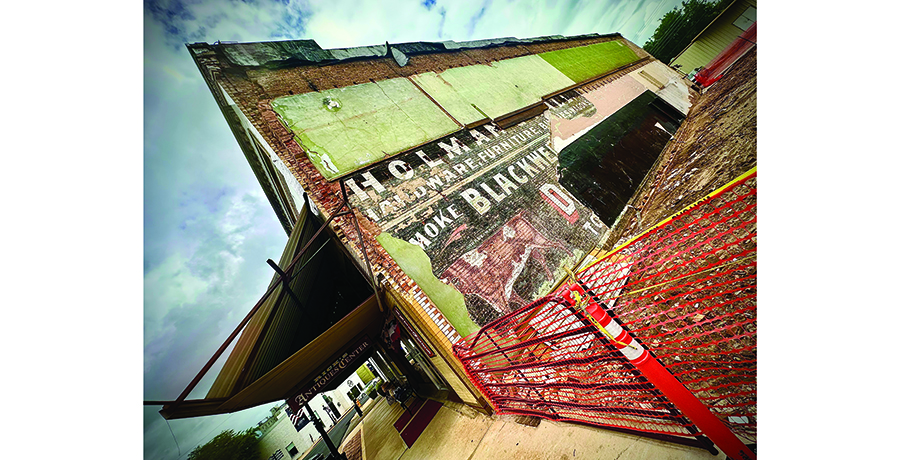
Ghost sign appears on town’s main street
PITTSBURG – Don’t hold your breath waiting for the arrival of the mob. There’s a narrow niche of Bull Durham Ghost Sign enthusiasts who’ll turn flips over the revelation of the Pittsburg version of the ghost of the tobacco brand bull.
That sliver of cultural historians now has a new local entourage of converts.
Those signs are what’s left of America’s first outdoor advertising campaign.
“If only there were a way I could get it out to the peach shed,” said Greg Efurd, who put tractors sitting on a lake by the “peach shed” in the generational farm story of a family building a landmark three generations in the making.
Ghost signs affect such spirits.
Bull Durham’s 19th century national ad campaign caught the imagination of the day’s leading wits.
“Mark Twain was said to have complained that he could hardly see the pyramids in Egypt for the Bull Durham signs,” says the Bull City Mutterings blog about the tobacco company logo, written by Reyn Bowman, one of Bull Durham’s champions.
In the 1870’s, the South Carolina-based company ripped off Durham, England’s Durham Mustard bull and made it their own, conspiracy theorists allege.
Long forgotten, Pittsburg’s piece of the story appeared with the shock of a comet, unseen since the Parker Furniture building went up, rediscovered when the building was recently torn down.
On the adjacent wall of what was John Holman’s general store when the Parker building was built, once again each day’s morning sun falls on the artistry of the “Wall Dogs” who emblazoned the building with the Holman name alongside Blackwell Tobacco’s Bull Durham.
A 16-year-old farm worker when he arrived in Camp County in the 1870’s, John M. Holman became one of the town’s biggest merchants. He moved into manufacturing and invested in multiple community business enterprises.
For a Wall Dog artist, the length and height of the east face of the Holman Building was a blank canvass on the main drag when the roads converging in the town’s heart were named for the cities from which they came.
So Pittsburg’s bull stood on Quitman Street, the road to Quitman.
Ten miles away in Mt. Pleasant, where the north face of the 1894 Caldwell-Carr building towered over the wagon yard and Cotton Belt Train depot to the east and south and the Titus County Courthouse to the west, the roving band of Bull Durham Wall Dogs hung on scaffolds to paint a second story bull, perhaps pre-dated by the Pittsburg piece including the first letters of the parent company name, Blackwell Tobacco, a firm established prior to The War.
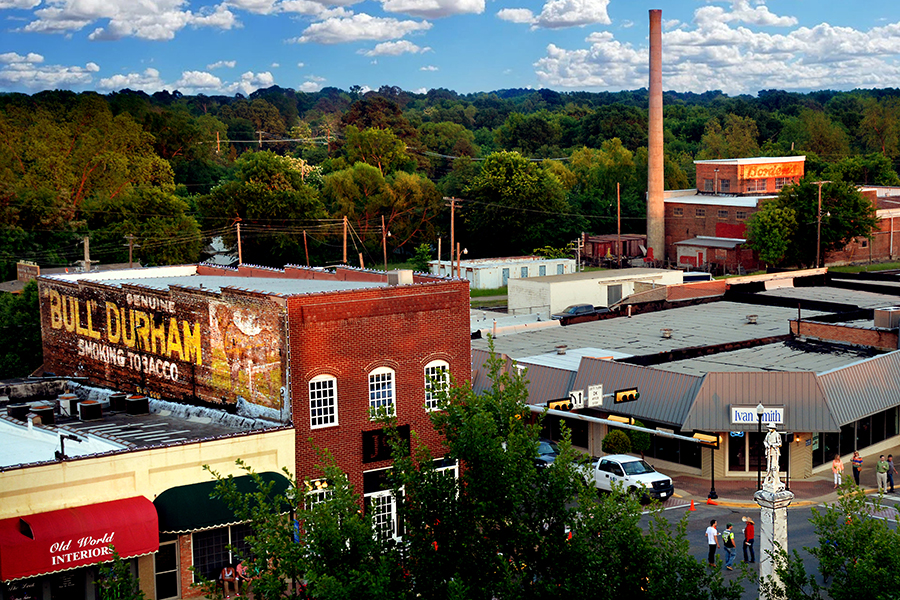
Wall Dog work leapt from the sides of buildings to billboards later, after they made cars.
Wall dogs were teams of four painters employed by a New York artist working as Ruben Rink when he cut a deal to send painters out across the land. Blackwell backed the plan.
Large scale, unending ad campaigns at the time were considered risky if not fruitless in generating sales. Bull Durham proved doubters wrong.
Beginning in 1870, either Rink sold the company or the company bought his thinking. As many as four crews of four Wall Dogs worked across America painting Bull Durham signs for the next 40 years.
The forces validating Bull Durham’s advertising feat date back more than a century.
The August 1918 edition of Advertising and Selling cited Bull Durham’s impact in tying an image to a brand that became a household name. Bull Durham charged on, printing its bull on labels, in magazines newspapers and trade journals.
Artists painted wooden bull ads along the outfield walls of ballparks, wrote Peter Moris in his work about an early alliance between tobacco and major league baseball’s sports franchises.
The company gave any batter hitting its bull $50. The connection influenced language, lending itself to the term bullpen.