Mechanical Phonographs Brought Music Home
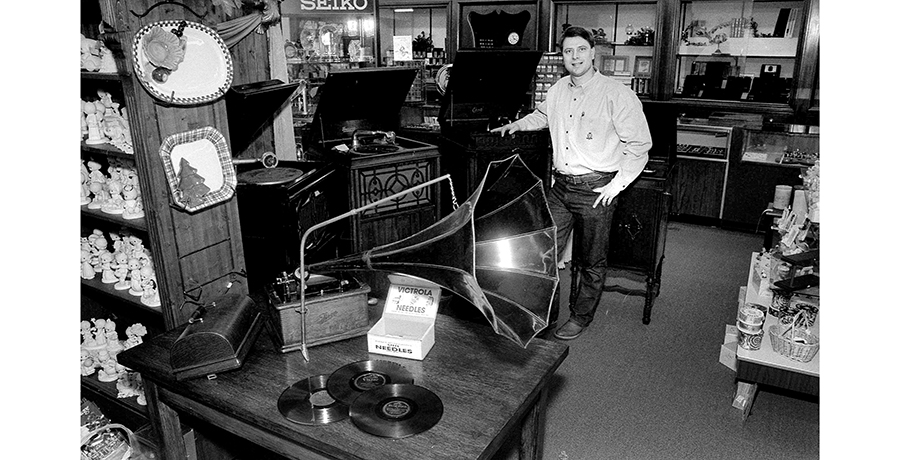
Above Photo: David Hoover shows some of his turn-of-the-century mechanical phonographs. They work.
Originally published in The East Texas Journal, January 1998
By Hudson Old
Mechanical Phonographs Still Play in East Texas
Before radio and television, mechanical phonographs brought music into American homes for the very first time.
In Pittsburg, Texas, jewelry store owner David Hoover has spent years preserving that history. His collection includes working phonographs from the late 1800s and early 1900s.
Inside Hoover’s Jewelry, visitors can still hear the machines perform exactly as they did generations ago. The polished wooden cabinets, brass fittings, and spring-driven motors remain fully mechanical.
“They’re all mechanical,” Hoover said. “There’s no electricity involved.”
Because of that, Hoover deeply admires the inventors who first created them.
“I marvel at the imagination behind the first phonographs,” he said.
Antique Mechanical Phonographs Preserve Early Sound
Hoover’s love of machinery extends beyond phonographs. At his home workshop, he restores antique trucks, tractors, and automobiles.
Right now, he is rebuilding two Diamond T trucks from 1937 and 1947. Since original parts are scarce, many components must be recreated by hand.
That careful craftsmanship mirrors the work found inside the early phonographs themselves.
As a teenager, Hoover first learned precision repair in the family jewelry business. At age 13, he cleaned watch cases and sized rings while learning the trade.
Later, he and his wife, Wyn, purchased Hoover’s Jewelry on Rusk Boulevard in Pittsburg.
Years ago, Hoover displayed only a few phonographs in the store. However, the collection steadily expanded as his interest grew.
Today, the machines serve as both working antiques and historical artifacts.
Thomas Edison Changed History With the Phonograph
Inventor Thomas Edison introduced the first phonograph in 1877. His early machines used rotating wax cylinders to record and replay sound.
At the time, the invention amazed the world. For the first time in history, people could hear a voice after the speaker had left the room.
Soon afterward, the technology advanced rapidly.
Around the turn of the century, machinist Eldridge R. Johnson developed a spring-driven motor that kept records spinning at a constant speed.
As a result, flat-disc records became more practical and reliable. Johnson later helped build the Victor Talking Machine Company, which eventually became part of RCA Victor.
Eventually, the familiar 78 RPM record became the standard for recorded music across America.
Mechanical Phonographs Created a Music Revolution
By 1900, nearly 500 phonograph companies operated in the United States. Yet competition and changing technology soon reduced that number.
By 1930, only a handful of major companies survived.
Even so, phonographs had already transformed American life.
Small home models sold for about $25. Larger cabinet versions sometimes cost several hundred dollars. Nevertheless, families eagerly purchased them.
For many Americans, the phonograph became the center of home entertainment. Families gathered around the machines to hear music, speeches, and comedy performances.
The phonograph also transformed politics.
President Theodore Roosevelt became one of the first candidates to widely distribute recorded speeches.
“Teddy Roosevelt was the first candidate to record his platform speech,” Hoover said. “He was really the first president whose voice became familiar to the nation.”
Some recordings of Roosevelt still survive today. Collectors consider them important pieces of American history.
Early Recorded Music Still Fascinates Collectors
For Hoover, mechanical phonographs offer more than nostalgia.
Instead, they provide a direct connection to another era. When an original record spins on a spring-driven machine, listeners hear music almost exactly as people heard it more than 100 years ago.
That experience continues to fascinate collectors, historians, and music lovers alike.