Gypsy follows navy family’s Texas voyage
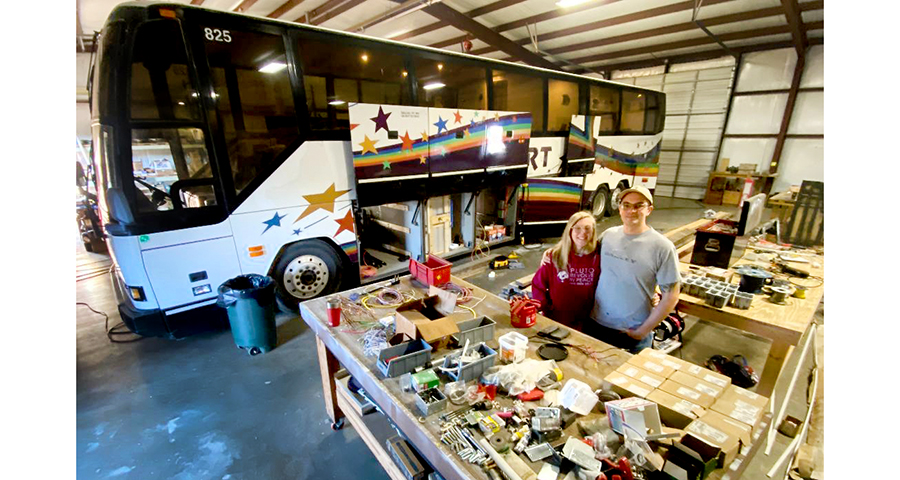
Above photo, once upon a Dallas city bus, when Samantha and Jordan finish it’ll be a two bedroom bath and a half motor coach for six. While Navy engineering work provided experience that could open career doors, they share an entrepreneurial spirit. “There’s no ceiling in private enterprise,” Jordan said. They named their plan for repurposing passenger buses Phoenix Skoolies. Add dot com for the website. Each bus is a custom job – with acquisition cost of the bus, this one will go out the door in November for just under $140,000.
From The East Texas Journal, September 2022
By Hudson Old, Publisher
The civilian gypsy in the third generation of a Navy family, Tabatha Lyon recently returned from three months in Central and South America. In turn for bunkhouse-style living quarters with a chicken-wire window handy for hanging wet socks and providing a view of the ply board outhouse and shower facility, she worked some in a jungle monkey sanctuary in Columbia.
In a road house for the river of refugees flowing down into Columbia from Venezuela, she made beds, washed dishes and helped tend children.
Standard fare for any well-rounded resume, the monkey sanctuary was on a river where, for something less than a couple of dollars, once a week she’d catch the boat into town where she could do laundry and get a hot shower.
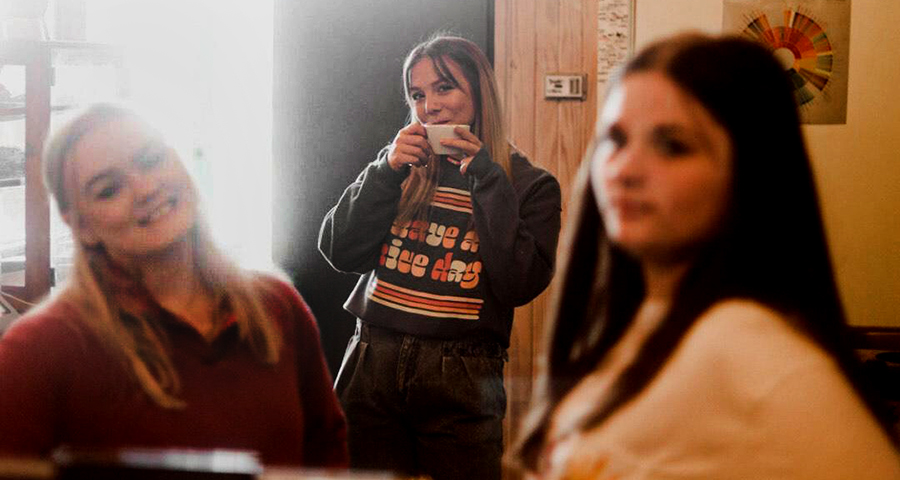
She booked her trip through Workaway, a $44-a-year phone app that reels in economy-minded adventurers with some degree of “save the world” mentality.
As an added benefit, “it helped with my Spanish,” said Tabatha, a 24-year-old American barista with a dominant cosmic streak. She can explain love.
Love is a Subaru she’s buying from a dad who gave her a really good deal. She’s buying it because he teaches that we all pay our way. He buys and fixes things.
“He can fix anything,” she said.
Wesley Lyon was a sailor.
At first glance, anybody else who was a sailor would catch the couple of battle stars on the bar on his cap.
One time, “I didn’t get as many medals in 20 years,” said Wesley’s dad, a career Navy man saying as best he could how good it is to have a son return from war.
“He was a tough guy,” Wes said.
In another family demonstration of tough love, one time the school truant officer came to arrest Wesley because Tabatha was cutting class.
“You can do that?” he asked the truant office. Turns out, they could.
They could put him in jail, the judge was explaining by early afternoon as teenage Tabatha wept in distress.
How could her father be jailed for what she’d done? Or hadn’t done. Was there an appeal process. Might not more reasonable people would see it her way – Netflix is better than geometry.
Tough love is your dad in handcuffs answering, “Do what you gotta do,” every time the judge explained details related to jail time.
She settled, enduring high school until it caused a diploma before leaving for California.
“She’s my gypsy,” said Wes.
The way his father made Wesley a mechanic, he withdrew cash from the lawn-mowing money Wes had saved and brought home a vintage Ford.
“But it doesn’t run,” complained Wes.
“I know,” said his dad. “We’ll fix that.”
His dad taught him the value of thinking.
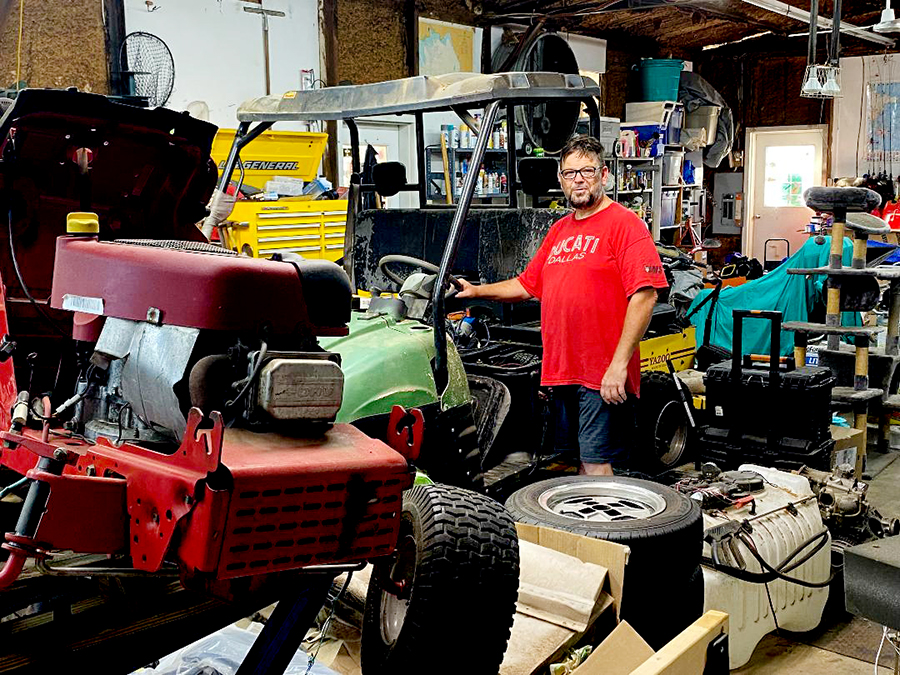
“He could think his way through anything,” said Wes, remembering the magic of a sailor who could explain anything with clarity in unquestionable terms. He was an excellent naval officer.
Wes has two daughters. He made demands on them both.
He made them study the violin. Music’s a life-long thing. While she was in South America this summer, Tabatha began playing guitar.
In South America, Love is a rented house that’s a place for “The Walkers,” refugees pouring out of Venezuela into a town high in the mountains across the Colombian border. Such is the altitude as to take your breath away, making the trek through the mountains slow. It’s cold at night.
It’s not safe to camp on the road.
Where she stayed and worked, The Walkers get all they can eat and a place to sleep, men upstairs, women and children downstairs. They have to be up and gone at 6:30 a.m., making time to get ready for the next day.
Work, when it can be found on the bottom rung of the current Venezuelan social-economic ladder, currently pays “maybe $3 a day,” said Tabatha, which is why $10 will buy a four course meal so beautiful she took pictures.
“Traveling is really cheap,” she said, “if you’re careful with your money.”
She worked a year saving up $3,000 barista dollars for the trip.
In South America, Love is more action, less emotion, a connection among kindred spirits humbled by The Walkers.
The Workaway travelers included Europeans and Asians. There was an indigenous woman in the kitchen who could create spectacular things with beans, rice, meal and fresh vegetables “who always wanted to feed me. My Spanish got better in her kitchen.
The most hopeful among The Walkers were those who had relatives who’d gone on before them. Those coming through Columbia are all moving down into South America.
In the cities, they’re building ghettos from scrap – something about land abandoned related to Covid. She rode in a cable car over the squalor. It’s far better, she said, out in the country, in the small towns.
The way Workaway works, users plug in the name of a place they wanna go and get hooked up with a place where your work pays your room and board. Travel arrangements are the traveler’s responsibility.
It was when his first daughter, Sabrina, left for the Navy that it dawned on Wes that she’d become her younger sister’s mother figure, parenting.
After fixing the Vintage Ford his father brought home, at 16 Wes got on with a Mesquite gas station with a garage. Years went by. He joined the Navy to escape.
“Every time I gave notice, they’d start counting out $20’s on the counter,” Wes said, until it got to the point that money wasn’t enough.
The Navy assigned him with “The Baby Seals,” he said. That’s mocking Navy lingo for enlistees about to go on a crash diet.
Wes went in at 215 pounds. In 16 weeks they had him down to a fit and trim 150.
“They can do it for anybody,” Wes said.
Here’s how it works.
“It was a mile and a half march to and from supper,” he said, adding that the food was terrible, “all except the made-from-scratch cinnamon rolls. He’d load up his plate with them. Starting when the last sailor sat down, they had five minutes to eat. He was last more than once, early on.
Sometimes, just because they could, as soon as he sat down somebody blew the whistle signaling time up. He’d wolf down what he could on the way out. Or sometimes, a ranking prankster would take his cinnamon rolls and leave him a bowl of tasteless gruel.
“The program really works,” he said, “plus, you learn how to get along with people you really don’t like. It’s a great lesson, necessary in the service.”
In the same 16 weeks he dropped 65 pounds, Wes learned a lot about radar. He can also spot a speeding torpedo from the deck of a ship.
On January 17, 1991, while he was passing the evening of his 20th birthday aboard “The Great White Ghost of the Arabian Coast,” a war came to life through the instruments he monitored.
“I went to wake somebody up,” he said. The Great White Ghost of the Arabian Coast, aka The USS LaSalle, was a flagship. It was the night of the start of the invasion driving Saddam Hussein’s Iraqi army out of Kuwait, a country he’d barely heard of. At that moment, the Ghost was sailing off the coast of Bahrain, less than a hundred miles from the action and underway!
When he had a chance to transfer, he stayed on with a buddy who didn’t have the option to option out as Desert Shield began turning to Desert Storm.
His next ship was the U.S. Wisconsin, a World War II battleship with guns so big engineers calculated and continually tweaked firing order to lessen the stress of recoil on the ship. A blend of World War II and late 20th century war technology, the ship launched RPV’s, early drones called Remotely Piloted Vehicles that could put crosshairs between the eyes of an enemy soldier from the sky.
But wait, there’s more. By “radar” work feeding GPS technology, the Battleship Wisconsin’s World War II guns could put a shell between his feet from 26 miles.
“Armies of Iraqi regulars evaporated in the desert,” Wes said. The Wisconsin had 17 inches of armor. There was a repetition of three armored radar room boxes at different places on the ship. In case one got hit, they had backup.
The World War II armor about the radar box was five inches thick. He could hear the “ping” of striking shells – luckily just anti-aircraft stuff, the only thing even the Iraqi elite Republican Guard had that could respond to the fiery tons of ordinance coming from his ship.
He made E-5, a lot of rank in three years during which he learned to do so much stuff that when he got out he found the value of skills. He’s an Information Technology (IT) guy. He makes his living from home.
With Sabrina in the Navy and Tabatha gone, he sold the house in Denton when he found a 1993 Bluebird Wonderlodge with marble floors, a motor coach that listed new for $800,000 in 1993. He parked at the house of a friend who needed help repairing a shop full of motorcycles left behind when her husband died.
One day, Sabrina called home from the Navy, getting near the end of her hitch. She handled engineering tasks for the Navy. Kid can read a blueprint.
“Let’s buy some land,” she said, so they found a place in Mt. Pleasant, a few acres on the edge of town with a house and a big shop. There’s a pond where their fleet includes a pair of rowboats and a paddleboat, entertainment for military friends who came for her wedding when Jordan followed her here. For the ceremony, they built a deck overlooking the lake.
Mr. and Mrs. Jordan and Sabrina Basserman have a lot in common. They served as engineers in the Navy.
A Bluebird Wonderlodge with marble floors weighs 24 tons. The one in which Wesley arrived in Mt. Pleasant sank to the axles when the landowner showing him the place they bought directed him to pull off the drive.
Later, he sold it at a profit and bought a 1991 Bluebird school bus he began converting to the motor home he might retire to, whenever he gives up working days on his phone in front of a computer screen as tech support walking somebody somewhere through administrative computer issues having something to do with the medical field.
His Navy record made him a sought-after Information Technology (IT) guy when he exited the military as an E-5 after three years.
Samantha and Jordan live in the house that came with the land. Wes built a smaller house.
Tabatha came two years ago now.
Next year, she wants to go to Europe and after that maybe she’ll build her house on the back of the land, a process already underway in her head.
Maybe she caught it from her father, who is enchanted to find himself owning land.
He’s studying botany. Instead of food and dishes, his bachelor place kitchen cupboard is stuffed with books and stacked with trays of germinating plants. He’s taken up home canning. He studies frogs, bugs and salamanders in a wet spot he quit mowing after finding so many things living there.
He’s taken up metal detecting and found a brass button from a military uniform made sometime between the 40’s and the 70’s and he’s persuaded there might have been a house where he found it.
His shop is stuffed with works in progress – four wheelers, side by sides, motorcycles – he’s almost done with an Italian sports car he’s keeping for himself.
Sabrina and Jordan are enrolled in cyberspace, studying to get degrees in engineering. Meanwhile, they’ve bought a shop and opened Phoenix Skoolies, a business retrofitting buses as motor coaches. Each project is a custom job.
Back from her summer tour, Tabatha’s returned to life as a barista, for now.