Biographer preserved the fading legend of Catfish Smith
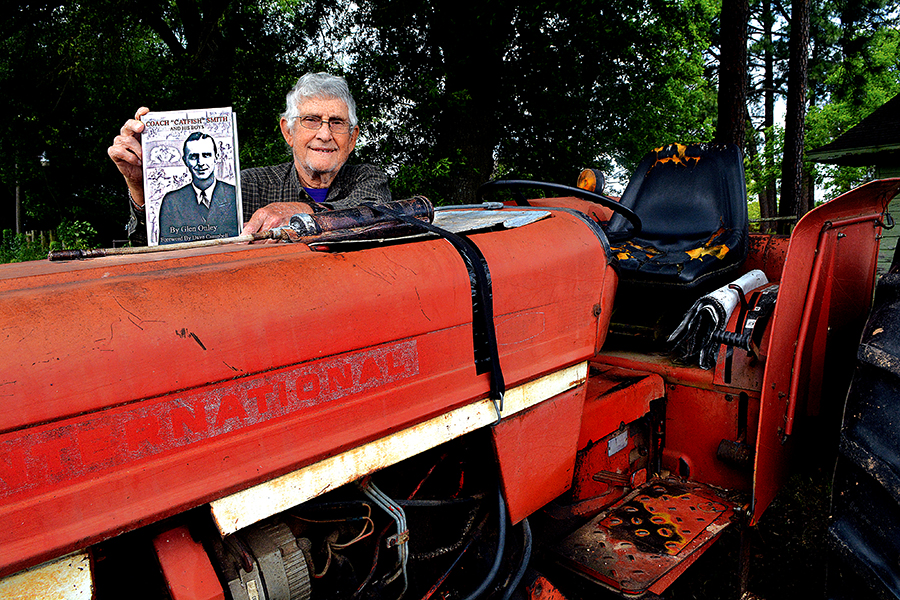
Above photo, Glen Slaughter played for Catfish Smith, an athlete and coach who played semi-pro ball for the Mt. Pleasant Cubs in the Great Depression years, then cut a swath through Texas high school and collegiate record books as a coach.
From The East Texas Journal, May 2020
By HUDSON OLD, Journal Publisher
In the Great Depression years before WWII, before man on the moon and the 1936 oil strike at Talco, Milburn “Catfish” Smith was among the Hoffman Heading Mill summer employees hired to play for the Mt. Pleasant Cubs. When virgin hardwood timber for wooden barrels was so valuable August Hoffman built a rail spur from the hardwood forests in White Oak bottom to his mill in Mt. Pleasant, his son Gus was the Cub’s pitching ace. The Cubs were the company team.
Famed Texas sportswriter Dave Campbell was a kid in the stands in the years the Cubs made their annual pilgrimage to Texas State Semi-Pro Baseball tournament at Katy Field in Waco.
“That was where I first met Catfish,” Mr. Campbell said. “Not in person – I watched him play, and I met him via the sports pages of the Waco Tribune-Herald where Jinx Tucker gave plenty of ink to a tall catcher for Mt. Pleasant named Catfish Smith.”
Teams played for “the scant money at stake and the right to advance to the national tournament in Wichita, Kansas,” Mr. Campbell said. Katy Field was named for the Katy Railroad with tracks so close passing trains deafened the crowd and added to the excitement of seeing “the best baseball in the state played. How much closer to heaven could a boy get? I was hooked,” Mr. Campbell said.
Back in East Texas, before he was Catfish, Milburn Smith grew up with Winfield fans rocking the gym when David Lilienstern’s Doris Candy Company Basketball Kids made his candy company name a staple on an East Texas traveling basketball circuit.
In the fall of 1928, 16-year-old Milburn stayed behind in Winfield to play basketball when his family moved into the first-floor living quarters of the Titus County jail in Mt. Pleasant after Sam Smith was elected sheriff.
In the fall of 1929 he moved to Mt. Pleasant to play football.
In his first and only season as a high school receiver, he caught the eye of a scout signing him to a scholarship to East Texas State Teachers College in Commerce.
He was cocky, a “raw recruit on the college roster when a Dallas sportswriter asked the 17-year-old” if he expected to match the reputation of a distant cousin, wrote his biographer, Glen Onley.
Cousin Vernon, the first “Catfish” Smith, was an All American at the University of Georgia.
“By the time I’m finished here, I’ll make Cousin Catfish look like a tadpole,” he said, then lettered four years in basketball and football, was twice selected in both sports to All Lone Star Conference Teams and was named to “several Little All American” basketball teams, Onley wrote.
After college came coaching.
In Coach Catfish Smith and His Boys, Mr. Onley describes first-year Coach Catfish Smith’s arrival in the locker room of country-school Carey Cardinal players celebrating a semi-final finish in their first basketball tournament of the season.
“He walked in the locker room with their trophy in hand. When the players saw his grim face, their chattered hushed like a spigot slammed shut,” Onley wrote.
Having their attention without so much as a word, Catfish hurled the sparkling trophy against a cinderblock wall, shattering it to pieces.
“’I’m not starting our trophy case with a second place finish,” he growled.
The man could communicate.
So can 86-year-old Glen Slaughter, who played for Catfish when he was in Mt. Vernon.
At intervals, I’ll be spiking the story of Catfish with anecdotes, like this:
Phone calls from numbers Mr. Slaughter doesn’t recognize are answered with a recitation of the number the caller has reached.
If the caller stays on, the answer continues, “I don’t buy anything over the phone. I don’t make donations. If you are calling for another reason, start talking.”
It’s not an answering machine. It’s Mr. Slaughter live, screening callers.
The season that opened with Coach Smith shattering a trophy ended with the Carey Cardinals playing for a state championship. A wide spot in the highway somewhere west of Lubbock, Coach Smith’s Carey team won the state championship the next season.
That was before the University Interscholastic League (UIL) created multiple state champions in divisions based on school enrollments. There were fewer than 100 students at Carey says the internet, where readers can find more about Catfish.
There wasn’t but one Texas high school champion then, Dave Campbell wrote in the forward of Mr. Onley’s book.
Catfish was an entertainer. He loved to laugh.
Dave Campbell had replaced Jinx Tucker at the Waco paper by the time Catfish turned up in town again, this time as Baylor’s freshman coach.
The writer was riding with the coach on a recruiting jaunt to Breckenridge, a trip with Catfish having “a fresh story for every mile,” like this:
Once upon a time with his wife along, Coach Smith checked into a Wichita Falls hotel for a coaching clinic on the same weekend the hotel was hosting a regional PTA conference.
Riding down the hotel elevator with his wife and a crowd of PTA women the next morning, Catfish slipped an affectionate arm about his bride and said for all to hear, “I’ll tell you one thing. We’re either going to get married or quit meeting at this hotel like this.”
Here’s a Mt. Vernon story from Mr. Onley’s book. It was late in the summer of 1943, the year Catfish Smith arrived in Mt. Vernon as the new coach.
He’d gotten wind of Clarence “Swede” Crowston, a strapping youngster on a farm across White Oak, in the northern part of Franklin County near Hagansport.
Driving out, Catfish found father and son working under the family Ford set up on blocks. Catfish hunkered down to introduce himself and open his pitch without disturbing progress on the Ford.
Negotiations high centered on the issue of transportation since Swede would miss the bus if he stayed after school for football practice.
Catfish wondered aloud if they might come to an agreement if he drove Swede home after practice. Mr. Crowston initially held out for help with chores Swede wouldn’t be doing if he was in town all day.
“A solidly-built man,” Mr. Crowston and son finished their work before pushing out from under the Ford to go in and talk it over with Swede’s mother, says the account from Mr. Onley’s book.
“Hold up, Son,” Mr. Crowston said.
The way Mr. Onley reported it in 2004, when there were still more witnesses, Catfish watched as father and son each put their backs to the side of the car, hunkered down to catch hold of the frame, and with a nod from Mr. Crowston, in unison they lifted the side of the Ford.
“Coach, would you kick those blocks out for us?” Mr. Crowston asked.
The coach upped his ante based on the school’s need for a 6-foot, 175-pound running back he’d just watched pick up half a Ford.
In 1943, there were no UIL rules prohibiting provision of a hotel room for a player needing to live in town to make football practice. At the Superintendent’s office, Coach Smith lobbied for Swede to be hired as a part-time janitor to fund room and board. At the Miller Hotel, Bessie Miller assured the Coach and the Crowstons that Swede would be looked after and well fed.
Catfish Smith had a gift for putting together a deal.
Seventy years later, so can Eddie Turner, a player during Catfish’s Mt. Vernon years, a career Marine who came back home as a city manager, retired and was called up for a second tour at City Hall during a contentious period.
He took the job he didn’t need on his own terms, only after everybody at city hall understood and agreed to a single philosophical point. Eddie Turner didn’t care a whit about political infighting, egos or personalities. Yesterday’s gone. It’s tomorrow that matters.
That’ll work, if its results you’re looking for.
There’s a shadow box of Mr. Turner’s medals hanging in his hallway, including ribbons with combat stars.
From the Marines, not city hall.
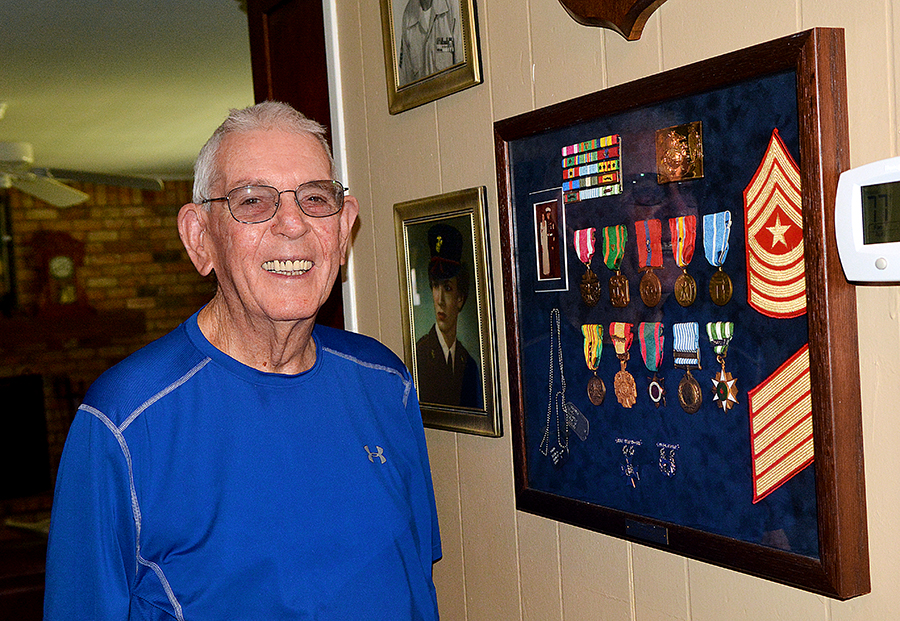
He’s retired again.
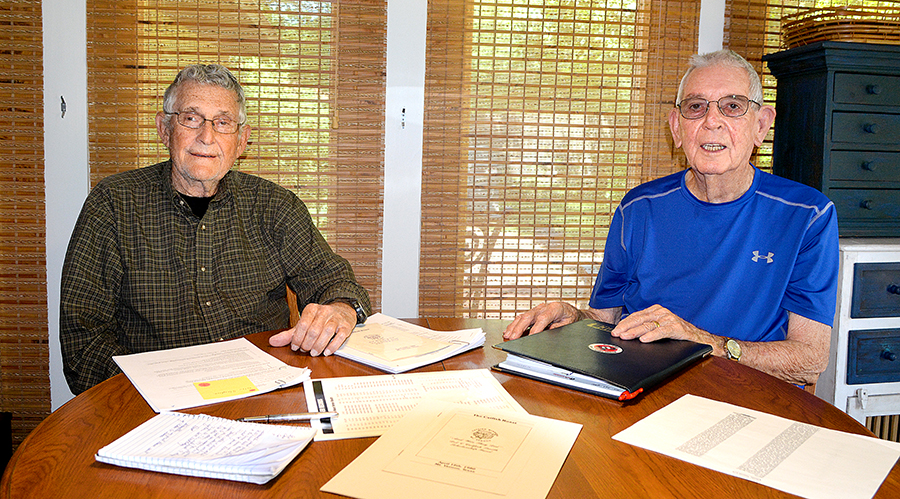
It was a sunny afternoon in the Turner home solarium, a space converted from a patio to a room with glass walls where Mr. Turner and Mr. Slaughter met to score essays written in the student competition for the Catfish Smith Memorial Scholarship established 40 years ago.
Mrs. Turner left them to their business, tuned in to afternoon TV.
Besides his military medals, Eddie Turner cleaned up his mother’s garden hoe and mounted it on a wall over the couch in the solarium with glass walls and a view of the lush back lawn. What he likes about that hoe, it’s been used, worn, filed to a nub.
He and Glen Slaughter are a remnant, two of nine surviving Mt. Vernon players they could count who’d played for Catfish during his seven seasons in Mt. Vernon where he compiled a 59-8-3 record in football and a 163-28 mark in basketball.
He remains the only high school head coach in history to win championships with undefeated football and basketball seasons in the same school year, Mr. Turner said. In 1947-48 his football team went 12-0 and his basketball team won 48 straight, taking the state title. The football team won a regional championship, which was as far as their playoffs went then.
Catfish left in 1950, cut a swath through collegiate ranks at East Texas State where his record of 30-2-1 included a 29-game winning streak during three seasons his teams won the Lone Star Conference title.
He did another high school stint in Longview before moving on NCAA Division I and Baylor.
As for Glen Slaughter, there’s a small-town local story about the way he screens calls from phone numbers he doesn’t recognize. It’s entertainment.
“Up at the hospital in Mt. Pleasant, my daughter borrowed somebody’s phone so she could put me on speaker for everybody in her department to hear,” Mr. Slaughter smiled, happy that his daughter appreciates his work. He sure appreciates hers.
She’s come twice a week to clean house since Mrs. Slaughter passed.
They were married 59 years.
She’ll have been gone four years come September.
More precisely, every morning when he wakes up Glen Slaughter can tell you years and months down to the number of nights he’s slept alone.
He’s exacting.
He measured and calculated that if you put each of the four gardens he’s planted this year into a single plot, it would measure 365 by 297 feet.

He gives himself five shots of insulin a day to control his diabetes.
He breaks his gardens with an International tractor from the 70’s.
He works the rows with a 23-year-old dinosaur Troybilt tiller, taking breaks as dictated by arthritic knees.
Gardening hurts, so somewhere in here, there’s a laugh about the irony of gunning to perfect something over two acres of gardens he doesn’t need anymore.
“I didn’t like plowing when I needed to,” he said. “Now I love it.”
After his high school playing days, he played a season at East Texas State, but came home to manage the farm when his father died in 1952.
In his 40’s, during the years the Catfish alums raised scholarship money booking benefit basketball games against whoever the Mt. Vernon coaches were that season, he’d left the farm for Lone Star Steel.
Interest in the annual alumni game spiked after Mac Gilbert suffered a wardrobe malfunction that didn’t interrupt his driving the lane for a layup while mooning the home crowd.
To help his focus, one time Catfish gave Dale Moore three licks for missing back to back layups when disciplinary policy was based on local discretion, Mr. Turner said.
As the color commentator who made Monday Night Football an American staple, in April of 1980 Don Meredith came home to Mt. Vernon as emcee for a banquet roasting Catfish Smith who’d retired from Baylor with a record that got him elected mayor of Waco in April, 1974.
If Mt. Vernon and Waco revered Catfish Smith, Don Meredith was the ringer whose presence packed the banquet that sweetened the Catfish Smith Memorial Scholarship pot that night.
“That’s the night we really bankrolled the deal,” Mr. Slaughter said, a thought leading him to remember that when Don Meredith passed he was buried in the city cemetery alongside his parents, Jeff and Hazel. During his Monday night career, Don Meredith’s tales of Mt. Vernon cast Jeff and Hazel as genteel authorities in the Mt. Vernon he made the small-town hometown of America’s heart.
“Then Don Meredith’s widow had him dug up and moved to the west side of the cemetery,” Mr. Slaughter said. “She made a little garden memorial with room for her beside him.”
Born in 1912, Catfish died in 1994.
And though he moved on, as the years passed he came to appreciate the rosters of players from his Mt. Vernon years as something more than players, memories he took with him wherever he was for the rest of his days, according to Winnsboro writer and historian Bill Jones, who wrote about Catfish in a column for his hometown paper.
“When I was in high school in Winnsboro we didn’t like Catfish,” Mr. Jones said. “We thought of him as a showboat.” He said it didn’t help that Winnsboro most often came up short in showdowns against Catfish’s Mt. Vernon teams.
“He was a great motivator who developed average young men into good athletes,” Mr. Jones wrote in the 90’s. He wrote about how his opinion of Catfish changed through the years, following the career of a coach compiling records backing up his braggadocio.
Catfish had a way of changing opponents to friends.
In his later years, “Cat told me his happiest days as a teacher and coach were at Mt. Vernon,” Mr. Jones said.
Back in the solarium, Mr. Turner remembered when it took a while to send out annual letters soliciting scholarship money from everybody with a contribution record, a diminishing population.
They’re starting to think it’s nearing time to shut down, form a committee and re-write the bylaws to allow passing their seed money on.
It wouldn’t be as big a deal as it was when they wrote them up the first time. Businessman, bank board player and Catfish alum Charles Lowrey took charge of that one, calling a meeting at an out-of-town golf course attached to a country club.
That was a fine day.
Applicants for the Catfish Smith scholarship have to have played two sports for two seasons. In their essay, they need to tell something they’ve done making their slice of the world better.
Forty years past the day at the golf course, the solarium meeting adjourned.
Eddie Turner went to see what was on the TV occupying Mrs. Turner’s mind. She too was a Marine. That’s where they met.
Glen Slaughter meant to think about what he’d fix for a light supper when he got home, but got sidetracked and went out to the garden where it’s near time to work the earliest rows of corn and lay them by until their early summer harvest.
“Do something that satisfies you,” he said.