Talco oilfields brought jobs
From East Texas Journal, March 1994
By Hudson Old, Journal publisher
Paycheck promise brought sharecrop family to this area
TALCO, TEXAS – It was the spring of 1937.
A year after driller Mike Langley’s announcement that 760 feet of oil stood in the stem of the discovery well of the last major Texas oil strike, Talco had changed forever.
Lawson Hearron, his wife Nora and their five children had just moved to New London where he found work building roads, most of which were one way or another connected to the Kilgore oil fields.
Oil was the new wealth of the Texas economy, which, like the rest of the world, remained mired in the pits of the Great Depression. Born in Louisiana in 1903, Mr. Hearron had share-cropped for 10 years.
His father had been a boiler fireman, driving the engines of industry sometimes for Louisiana or Arkansas sawmills, ultimately firing nine boilers used to push oil from Homer to Shreveport. When Mr. Hearron’s mother died in the 1920s, the children were sent to live with an aunt in Texas.
And here, Lawson Hearron became a farmer.
He found work around the central Texas German communities that had Frcdericksburg as their hub. It was there that the crusty old farmer of 23 met and married 17-year-old Nora Hardt, a girl of German descent. They moved for a year to Mexia, where he worked with a Humble Oil pipeline crew, but went back to her home at Seguin for her mother to attend the birth of their first son in August of 1927.
Their second child was born in New Mexico, then four more followed, all delivered by midwives on the tenant farms of central Texas. The third child died when he was six days old.
With the oil boom in Talco now going into its second year, Mr. Hearron had two brothers-in-law here, Jack Van Winkle and R.V. Parker.
Their oldest son, James, was 10 the day the family of seven loaded themselves and their possessions in his brother’s new Ford and moved to New London. Not long after, they came to Talco.
They’d found paradise.

“There was work for everybody willing to work,” said Mr. Hearron, who had lived here since.
It was a tough town, packed with young, hardened men. The population explosion then came with the oil strike, had strained the community to its limits, there were rumors and hints of the larceny that has always trailed money.
They’d found oil on Talco school property, two months after the well went into production, the school board forwarded a resolution to the Railroad Commission to stop the producer from hauling out oil pumped directly into trucks.
They asked for an immediate halt to the practice of pumping unmeasured oil into earthen pits and the school wanted its money, saying they had yet to be paid.
Other oil companies – Humble, Magnolia and Gulf — stepped up and loaned money to the school, money to handle the eight-fold increase in enrollment.
The newly incorporated town council dedicated meeting after meeting to public health concerns, most of it tied to water and sewage.
But for a family of seven, farmers who’d endured drought and weevils and crop failures, Talco was a gift.
“We’d sold cotton for 7 cents a pound,” Mr. Hearron said.
He and Mr. Parker bought two trucks, a flatbed and a dump bed, and immediately set up a local trucking business hauling lumber, rig timber, gravel and such. They bought cattle in South Texas and hauled them back to Titus County.
He worked some as a roustabout, digging ditches, putting down oil lines. They had more children, went to church on Sundays.
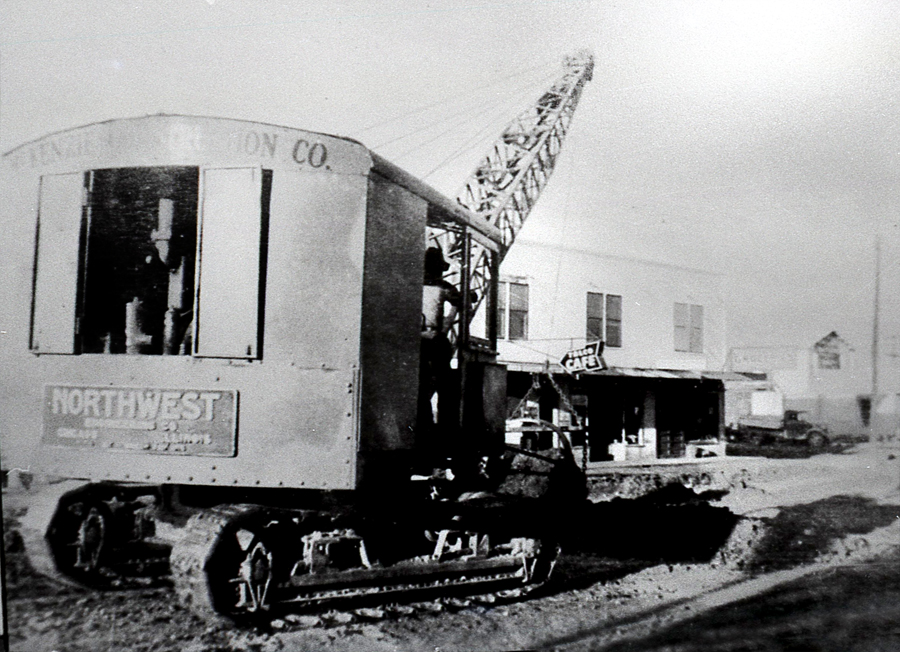
A $186,000 school bond had passed and an ambitious building program began. In 1939, a school facility that was the envy of surrounding communities opened.
The tax rate was $1 per $100 evaluation and the district claimed an $8.5 million tax base, with nearly $5 million held by two oil producers — $2.5 million for W.B. Hinton and $2.3 million to Humble.
Wildcatters Jno. B. Stephens and R. L. Peveto, who’d put together the leases for the discovery well, held $55,610 and $61,930 respectively.
In October of 1938, total monthly payroll for the school district was $4,510.79 with salaries ranging from $300 monthly for the superintendent to $65 monthly for teachers in the black school.
Teachers were single women — getting married meant getting fired, said the minutes from June 24, 1937.
Black schools met for six months; white schools for nine.
In August 1937, the district bought 63 ricks of firewood for $75.
Driller Mike Langley left his job with Hinton Production and went to work for Byrd and Frost, the company that later sold to American Petrofiha.
“Oilfield work wasn’t all that dangerous for a good crew,” Mr. Hearron said, “but there were careless crews.”
Mr. Langley went with Byrd and Frost after their driller was killed when he was knocked out of the derrick. Langley picked his men carefully and in April 1944, he hired Mr. Hearron.
“Mike Langley was a hookin bull,” Mr. Hearron said. “He didn’t holler and swear – you’d never hear him raise his voice, but when he spoke, he meant business. He was as good a man as you could hope to work for.”
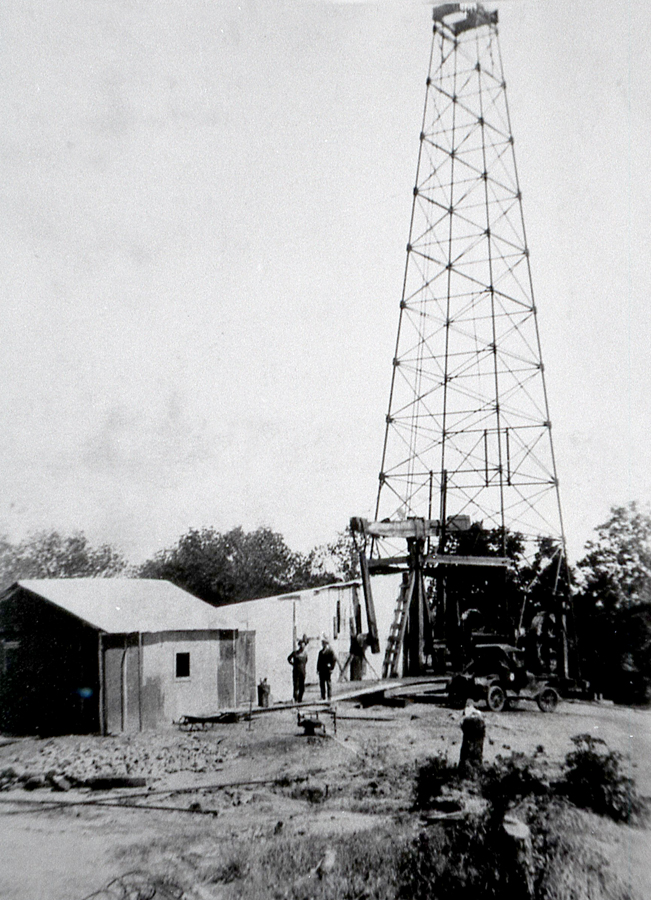
Mr. Hearron went from roustabout to pumper.
“Man, I was sittin’ on top of the world with my feet hanging off.”
Between 1939 and 1953, Nora and Mr. Hearron had six more children, bought six acres of land and built a home, settled in making mortgage payments and a living.
Byrd and Rost sold out to Three Slates Oil which sold out to Delhi-Taylor, which sold to Tenneco. All the while, Mr. Hearron stayed on as a pumper.
He was one day short of making 20 years when he was laid off.
” I like to have had a spell,” Mrs. Hearron remembered, it was 1964. They still had children at home and a mortgage at the bank.
Mr. Hearron found work with Johnson and Owens, working again as a pumper and stayed another 22 years.
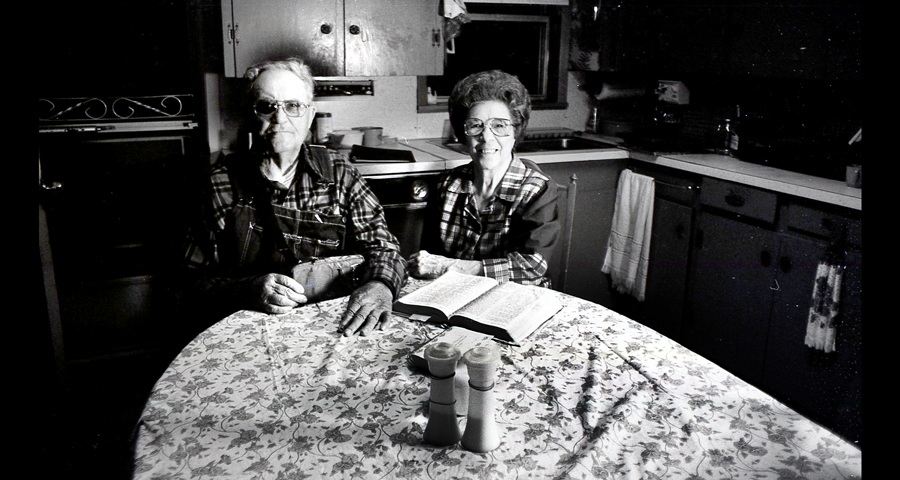
Afternoon had passed into evening, and still we sat at the kitchen table of the Hearron house located on their six acres north of town, just out of reach of the high-water mark for the Sulphur River’s spring and fall floods.
Mr. Hearron was in high spirits recalling the old days.
Their children and grandchildren and great-grandchildren had scattered across country, working as builders and teachers and such.
But first son James and his wife Grace live here.
Grace Hearron got up and flipped off the home-movie camera with a story she’d been meaning to get on tape for a long time and record.