Gum-chewing mule enjoys visitors, musician’s intelligent conversation
From The East Texas Journal, July 2008
By Hudson Old, Publisher
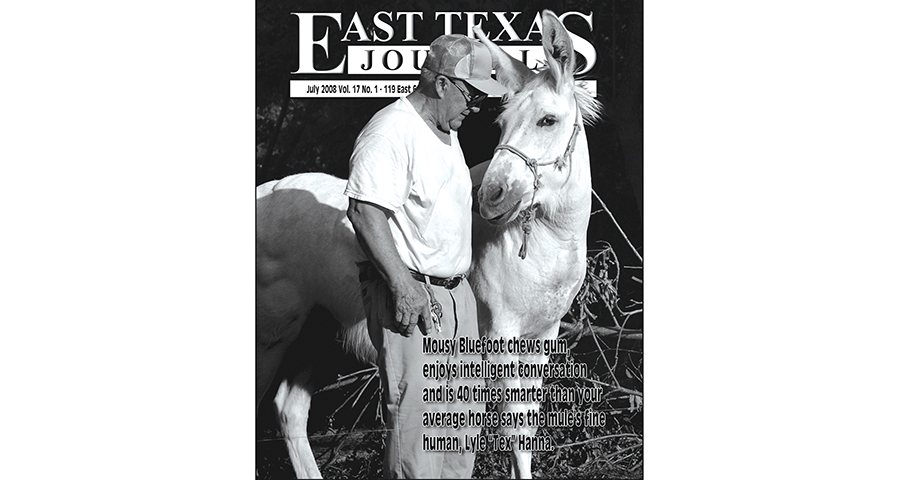
His mule’s name is Mousy Bluefoot and it’s a good listener.
One time Lyle “Tex” Hanna jammed so hard on a harmonica at the Missouri State Fair June Carter declared he was needed in Nashville.
Fifty-nine years have passed.
The Hannas were musical. Tex’s granddaddy had a Walker Hound named Banjo.
His brother Wallace played blue grass guitar on the porch of country stores at places so small the map missed them.
Somewhere in there his daddy went to Texas and his mama expressed Christian concern that going to Nashville with June Carter and getting on the radio could be spiritually dangerous for a 10-year-old.
“Mama was a Pentecostal preacher,” Tex said, speaking to the white mule with big eyes and a long twist in ears tuned to his story.
“One difference in a mule and a horse,” Tex said, “a mule will chew bubble gum.”
Down by the river one time back in Missouri Tex watched Banjo fight a big wolf.
“Banjo was the old man in Grandpa’s pack of hounds,” Tex said. “There was a bounty on wolves.”
When the hounds struck a trail and lit out on the day of the fight at the river Banjo didn’t run with the pack. He sat still and alert and sniffed the air and looked away from the direction the dogs had gone. After a bit he struck out at an easy trot, heading for the river.
“Banjo was guessing where he thought that wolf was gonna cross,” Tex said.
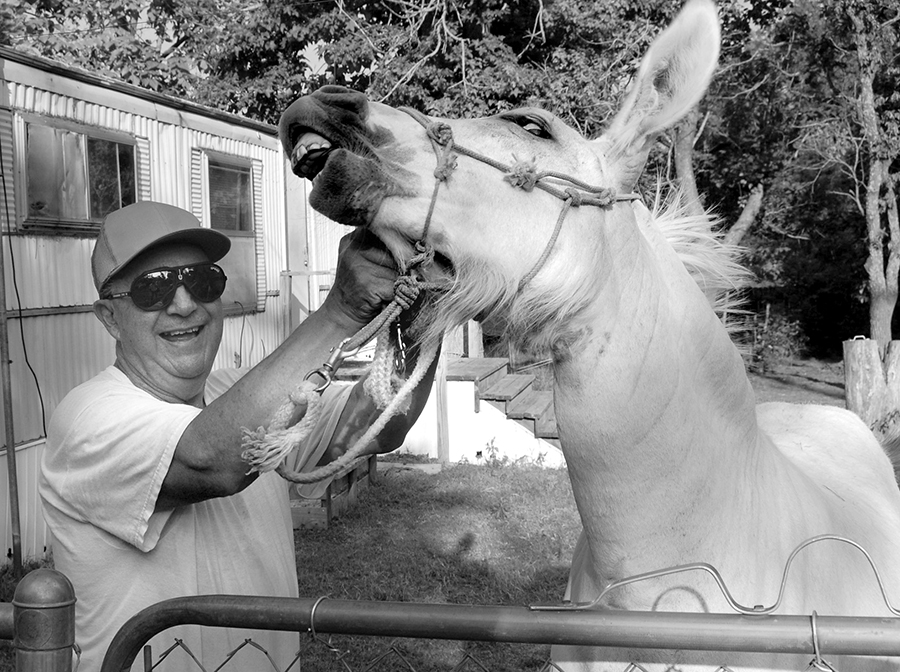
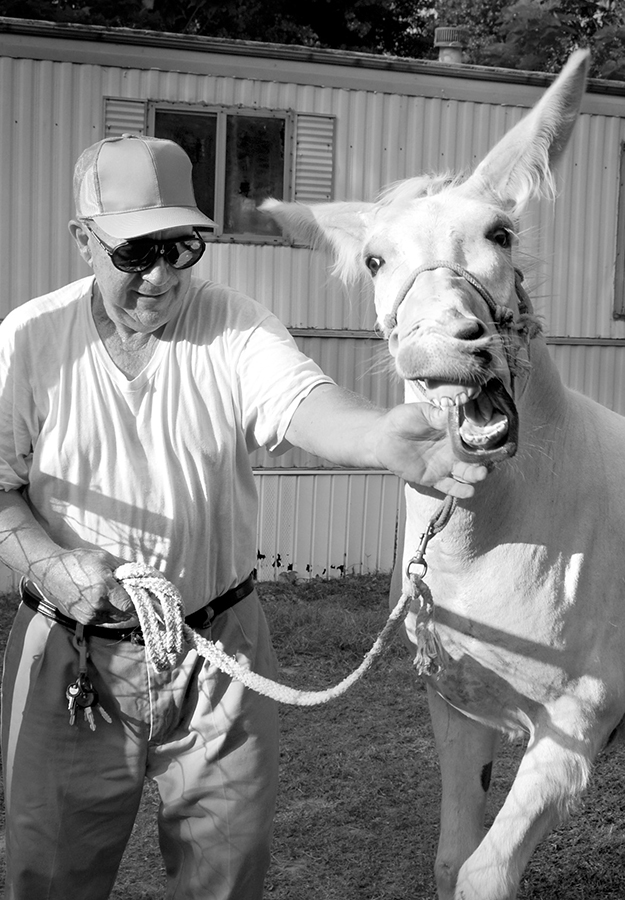
Mousy Bluefoot looked like a small mule until Lyle snapped a lead rope on his halter to pose him for photographs. The mule stretched back, leaning into a lop-sided tug of war. His neck swelled and he planted his back hooves. Muscles bloomed down his length, sleek and heavy and he sat back on his haunches, big head twisting and tossing like a leaping bass shaking a lure.
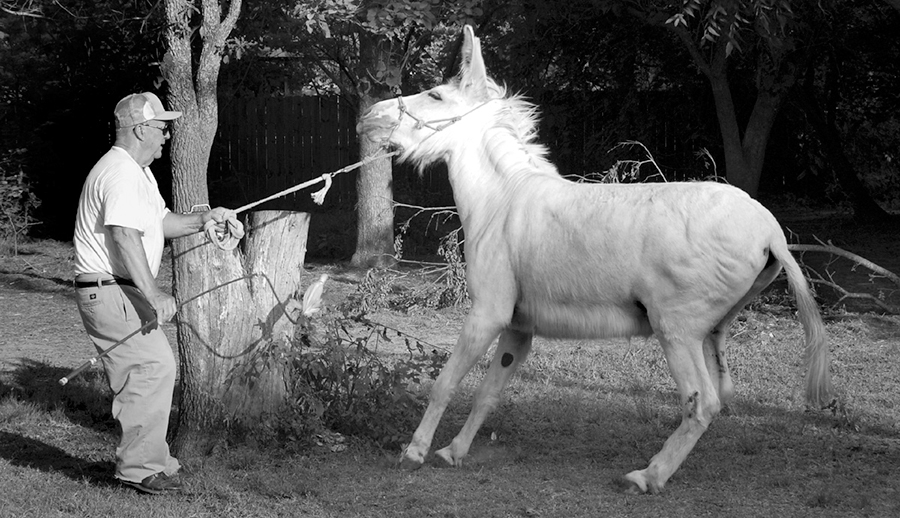
“Look at you showing off,” Tex grinned for his mule, held tight to the tether and moved lighter and easier than you’d expect. He let his mule pull them back beneath the big pecan shading half the lot where mosquitos hummed in the air around an old house trailer.
The mosquitos are constant through summer and late in the afternoon when they get thickest Tex puts on a long sleeve shirt to protect his arms.
“You don’t wanna catch that West Nile Virus,” he said. “It takes three years to get over.”
Tex takes vitamins.
A mule, Tex said, is tougher than a horse and 20 times smarter. A mule has a nose as good as a hound and so can smell hogs on the wind, which is why it’s better to hunt hogs off a mule than a horse.
“You can talk to a horse but it takes longer,” Tex said. “It doesn’t take but a handful of shells to break a mule to the sound of a shotgun with three inch magnum shells.”
That’s the best shell for hogs.
“With a mule, you shoot then you talk to him about it. Pretty soon, he realizes a shotgun’s just something that makes a big noise. A mule wants to understand new things. Horses hunt things to get upset about.”
You could shoot up a box of shells and talk to a horse about it all day long and the next day he might not remember the day before.
“A mule remembers,” Tex said.
Mules think there’s nobody smarter than them, which makes them easier to manipulate.
“Always treat your mule like he’s the star of the show,” Tex said.
Mousy Bluefoot is a rare white mule and rarer still, a “henny.” Instead of a big jack donkey mating a mare horse, Mousy came from a Mexican jenny matched with a fine stallion. The conception rate’s not as good, Tex said, but when you do get a henny it’s 20 times smarter than a mule which is already 20 times smarter than a horse.
More than a good listener, in Tex’s eyes Mousy Bluefoot is an exceptional animal.
Back in the day, June Carter had been a rising star and after Alta Hanna forbid Lyle going on the road at 10 he started playing country store boardwalks with his brother. Wallace sang harmony while Tex sang and played the harmonica and the guitar at the same time.
“There were only a few of us who could play the guitar and the harmonica at the same time,” he said. “The others are dead. I may be the last one.”
The storekeepers paid the brothers and when Wallace began soliciting sponsors for a radio show, merchants who wanted to hear their names on the radio paid up. Reconsidering her thoughts about music and radio, mama joined the band.
“People heard us on the radio and merchants started passing the hat to have us come to town and play on Saturdays,” Lyle said. “We’d advertise it on our radio show and draw them a crowd.”
They had some success.
“We played downtown in Lebanon, Missouri,” he said. “And smaller places down in the Arkansas hills.”
But their success wasn’t large enough to live by music alone.
So his grandfather sometimes hunted wolves.
“There was a bounty on wolves,” Tex reminded his mule.
Banjo was getting old and Tex followed him down to the river that day. The dog settled and waited in ambush.
“That wolf never saw him coming,” Tex said.
But it was a big wolf, an old dog and a long fight.
By the time the rest of the pack arrived Banjo was down, ripped and torn.
“The wolf would have killed him on the spot if they hadn’t gotten there when they did,” Tex said. Banjo struggled and staggered and barely made it home. His grandpa said the dog might die. Tex nursed him back to life.
Alta stayed behind when Tex’s dad came to Texas hunting work.
“He built cabinets,” Tex said.
He sent back word he’d found work near Dallas. Some days Alta thought she might take the boys and move to Texas. Other days she thought it best to stay put in Missouri.
“Mama was notional,” Tex said.
Tex came to Texas anyway and found his father building cabinets for mansions.
Just because he’d never seen one didn’t mean Tex didn’t know all about mansions. He knew the Bible story of mansions in heaven, built on streets of gold.
“The gold in heaven is so pure it’s clear,” Tex said, swatting a mosquito. Mousy Bluefoot swelled and jerked the lead and rolled his eyes when Tex swatted, then relaxed and gave Tex a big soft lipped wet-mule-muzzle kiss on a bare arm.
Another difference in horses and mules – if a good horse is plowing and gets too hot, he’s apt as not to just keep plowing until he melts down.
“If it was hot summertime and you had a mule pulling a cart down the road, if he got too hot he’d stop in the shade to cool down and might make a traffic jam,” Tex said.
Chewing gum helps clean Mousy Bluefoot’s teeth.
“He’s got a big mouth so I give him three or four sticks,” Tex said. He pre-chews it and the mule likes sugar added.
“The way a mule likes gum best, you chew it ’til it’s soft then use your fingers to knead in some sugar,” he said.
Tex got into the military by the usual route for his generation.
He was drafted.
The family band dissolved during his service years.
“My brother got married and moved on, had kids,” Tex said.
After the service Tex went to Dallas where he hooked up with a Bohemian builder, Carl Hutto.
“Mr. Hutto had all the work his crews could do building mansions out on White Rock Lake,” Tex said.
It doesn’t matter what mansions cost. What matters is building them beautifully, building them to endure. Mansions require fine painting and choice colors.
“One day Mr. Hutto told me to build a door,” Tex said. “I spent two days on it. It was nine feet nine inches tall and it weighed two hundred pounds. I made it from solid stock wood and wood panels. Everything was full mortise, everything flush in wood with the finest finish. I used a Welsh lock and inset four ball bearing hinges so it swung with a touch. That’s the right way to make a door for a mansion.”
The falling value of the dollar, ethanol, the war on terror and rising fuel costs have impacted Tex.
He’s riding his bicycle more and more and when the weather cools he’ll be training Mousy Bluefoot to pull the donkey cart he designed. (Hot as it is now, a mule could stall out in traffic.)
Tex hired a neighboring welder to fabricate the cam-operated brakes and other steel components of the cart designed.
“I can’t weld anymore since I got my pacemaker,” Tex said. “You can get a pacemaker it’s okay to weld with but that’s $20,000 more.”
The Veteran’s Administration upon which Tex depends for what medical care he might need must not spring for those.
The donkey cart’s wrecking yard saddle seat sits on springs on a cargo box that opens into a wooden trunk. There’s a “Slow Moving Vehicle” emblem painted on the trunk. He selected the finest acrylic latex at Wal-Mart and had it custom mixed to the choicest shade of his favorite color.
The cart is turquoise.
He used the same paint and the same brush to put a new finish on his 1979 Mustang being used as storage while Tex is completing repairs on its alternator. With fuel prices being what they are he’s put a pad lock on the gas-cap door.
The trunk beneath the donkey cart’s single spring seat rides a 4×4 axle.
“I kept it as light as practical but I built it to outlast my mule,” Tex said. “A mule lives a lot longer than a horse.”
The neighboring welder fabricated brackets to mount wrecking yard Buick hubs with sealed bearings on the 4×4 axle.
Sealed bearings prevent contamination of lubricants that minimize wear. It’s okay to run wheels with sealed bearings right through a mud hole.
“I mounted GM donut wheels on the hubs,” Tex said. “There’s so many old GM wheels in wrecking yards if I have a flat I can throw it away and get a new tire wheel and all for $5.”
Tex made money building mansions in Dallas and for a while lived in a cabin near Winnsboro where a man taught him about mules. Hearing of mansions being built in Tyler, Tex went there and found Randy Cape, Cape Oil Company.
Mr. Cape was building a mansion on a hill on the city’s south side, overlooking the town. Tex built the staircase first, then stayed on working until the mansion was finished. While they were building Tex lived in the kitchen.
Another thing about mansions — the owner can always sell.
“People who buy mansions don’t ever run out of money, even if gas is high,” Tex said, swatting a mosquito.
Also, mansions are best situated when located on hills overlooking towns. Or White Rock Lake.
There aren’t as many mosquitos up where every breath of wind stirred sweeps the air clean.
“The higher you get, the less mosquitos will bother you,” Tex said. “If you get that West Nile Virus it takes three years to get over it.”
Evenings, after the sun’s sunk enough for the trees to cast shade over the trailer, Tex likes going inside and sitting in his easy chair and remembering things.
He thinks about the time, some years ago, that he’d hoped his radio interview on a station over in Cass County might jack up his musical career. At the time, some of the people who liked hearing Tex chow down on a harmonica also liked AC / DC, a classic 80’s hard-rock band bordering on metal. As far as Tex knew, nobody else had ever put a harmonica out in front of an AC-DC cut. But Tex did and that’s how he opened the show on the Cass County radio station that day.
Time’s ticking on 20 years since he came to Morris County where he’s settled with his mule in the rental trailer on the oil top just down off the highway where a Baptist church stands.
“Time’s Ticking On” – that’s the name Tex gave one of his original songs. He wrote it sitting in the easy chair in the trailer in the cool of the evening.
He’s made some music in the trailer, all right.
“I’m Crying on Your Pillow,” recorded right there, features Billy Harrell playing pedal steel guitar. Billy’s from Cason.
Half Indian and half Irish, his father was a virtuoso on a fiddle, Tex said.
“He bought Billy a piano and by the time he was five he could play anything he heard,” Tex said. “He learned all Fats Domino’s music and played during Fats break between shows when they’d have concerts that lasted all day long out in Hollywood.”
Billy’s 74 has had a stroke, and he’s back home in Cason, a shell of an old railroad town on the Morris-Titus County line.
It may be that the last music Billy ever recorded was done at Tex’s place and that’s quite a thing, to have another man’s music so close at hand after he doesn’t play anymore.
Beyond the common sense of long-sleeve protection against the summer threat of West Nile Virus, Tex came up with a batting helmet to wear when he rides the bike he’ll be using about town until the weather cools and he trains his mule for the cart.
Telemarketers found his track phone number and gobbled up his minutes with second notices about the expired warranty on his 29-year-old turquoise Ford.
Like some horses, it was impossible to have a meaningful conversation with the recorded car warranty telemarketing messages.
Tex changed his number.
He’s mounted two flashlights on his bicycle’s handle bars and lights running like miniature electric barber poles in test tubes on the yoke of the back wheel. It’s no common bike, but a Touring Huffy with 17 gears, he said. He’s installed a rabbit’s foot and a laundry bag in which he carries vitamins.
In recording “Time’s Ticking On,” he employed sticks, tapping a two-tone rhythm backdrop.
“Listen to it,” he said. “It’s like the ticking of a clock.”
The ladies who walk the oil top road most late afternoons bring carrots to his mule and feed him over the fence.
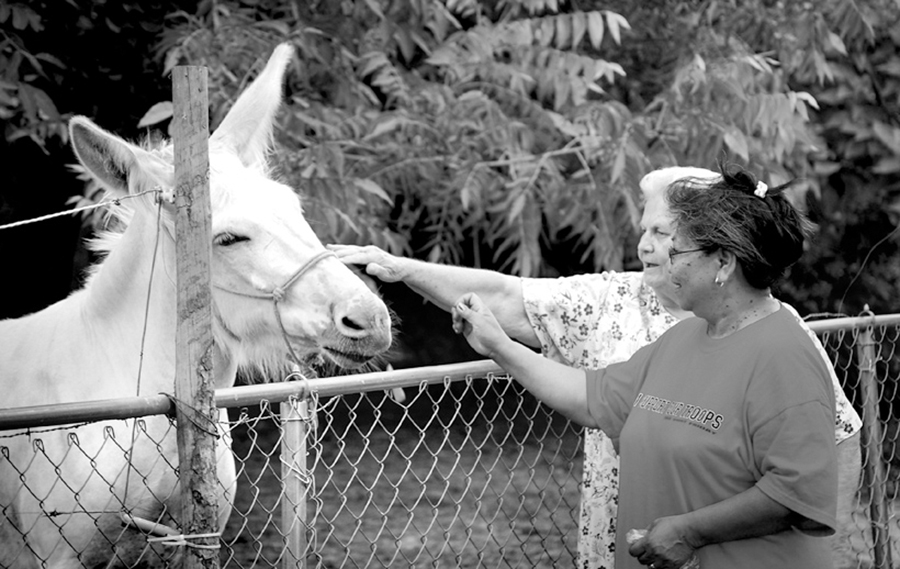
Mules can tell time.
When it’s the right time of day for the ladies to come with carrots, Mousy Bluefoot gets frisky. He trots the worn track along his fence and brays, showing off. Full of himself, he flares his nostrils and sucks in air searching for the scent of his fans.
“A mule’s got a fine nose,” Tex said.
For the moment, Tex plays a borrowed guitar and on Monday evenings he sometimes goes down to Brahma Mart. It’s a convenience store where musicians gather to play to fans in the Bullpen Deli. Tex takes his harmonica and the borrowed guitar.
“I’m the only one,” he said, “who plays a guitar and a harmonica at the same time.”