Local railway’s lasting legacy lives on
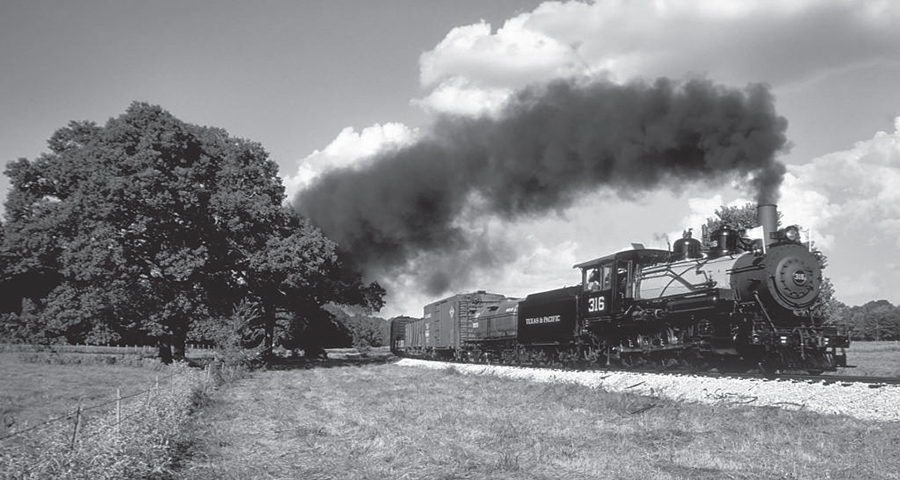
Above photo, at over 100 years old, Engine 316 is still in active service on the Texas State Railroad line.
From The East Texas Journal, March 2012
Commerce and industry are the necessary lifeblood of cities. Rivers, railways, and roads are the arteries feeding communities. The Paris and Mt. Pleasant Railroad, known as the ‘Ma and Pa’ Railway, taken from the M and P of the namesake towns, laid track at a time when the automobile was just beginning to achieve popularity because of its affordable price and convenience. The advantage to rail travel was the consistency of travel in inclement weather. The convenience of the contemporary roadways took several decades to catch up with the stretch of railways. During this lag, the rail was the most efficient means of travel and shipping.
Similar to how cities used to spring up alongside waterways for the convenience of ports and transit, railways and roadways have become just as important to the flow of industry, commerce, and populace. Small towns and communities sprung up along the route of the Paris and Mt. Pleasant Railroad.
The Paris and Mt. Pleasant Railroad was completed in two parts. Construction of section one from Paris to Bogata began in 1909 and was completed in 1910. Section two, from Bogata to Mt. Pleasant, began in 1912 and was completed in 1913.
As the Paris and Mt. Pleasant Railroad began construction in 1909, the town of Talco underwent a drastic decision in order to prevent being bypassed from the rail-line. In 1910, J. V. Moore and E. S. Lilienstern, along with Charles Lide and Henry Wilson were key promoters of the sale of city lots near the railroad. Businesses began to relocate in 1912 and by 1914, the town of Talco had successfully repositioned itself alongside the railroad, ensuring the added commerce from the rail depot.
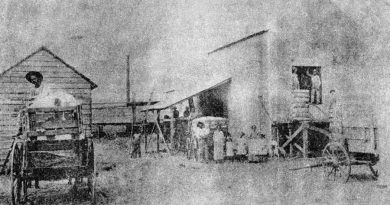
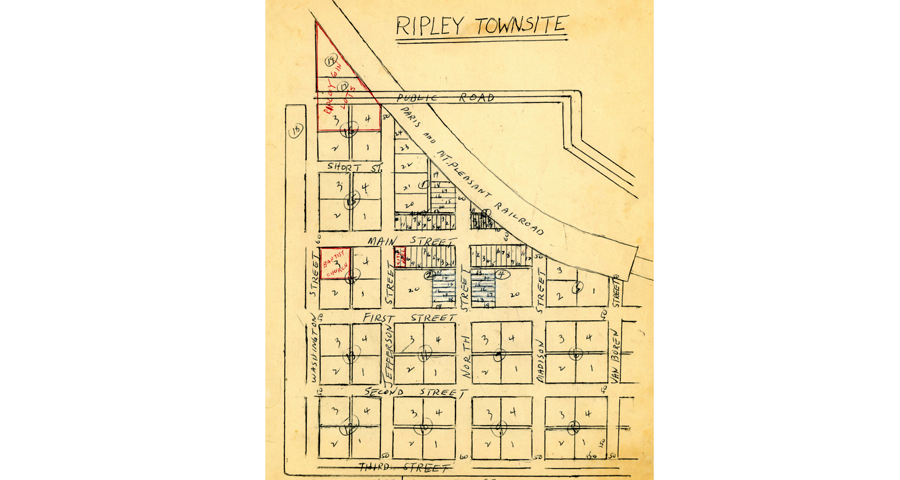
J. V. Moore, along with Eugune Lilienstern, H. A. Wilson, and W. V. Mason purchased land along the rail-route, founding the Ripley Community in 1912. Unlike the success of Talco the Ripley community did not see the same growth with the planting of the seeds of a community. The Ripley community, at its height “had two stores, three blacksmith shops, a gin, and probably a mill,” according to Traylor Russell. After World War I, the community declined and was officially dissolved completely in 1984.
J. V. (John Vincent) Moore bought and relocated a hardware store from Jefferson to Mt. Pleasant around 1879. After selling his ownership of the hardware shop in 1896, he began working as a salesman for Avery & Sons Implement Company selling farm supplies across Southern Oklahoma and Eastern Texas.
By 1906, J. V. resigned from his salesman position and acquired over 12,500 acres of timberland in Titus County which he sold to Hoffman Heading & Stave Company’s A. C. Hoffman in 1908.
J. V. Moore was one of the purchasers of “one of the largest business transactions of the year at Mount Pleasant, Texas,” as reported by Fuel Magazine in April 1907. D. A. Cook sold his interest in the Cookville Coal and Lumber Company for $100,000 to J. V. Moore, L. C. Libby, S. C. Tabb, August Eickhoff, Frank Fose, A. R. Bledsoe, W. C. Hayes, and George W. Coker, continuing the operation of the Cookville Coal and Lumber Company and founding the L. C. Libby Brick and Coal Company.
J. V. was elected mayor for three separate terms: 1909, 1911, and 1923. He was even given the moniker “Mr. Mt. Pleasant” because of the extensive work he did to publicize and expand the town during his terms as mayor as well as his work to modernize the sewer and water system.
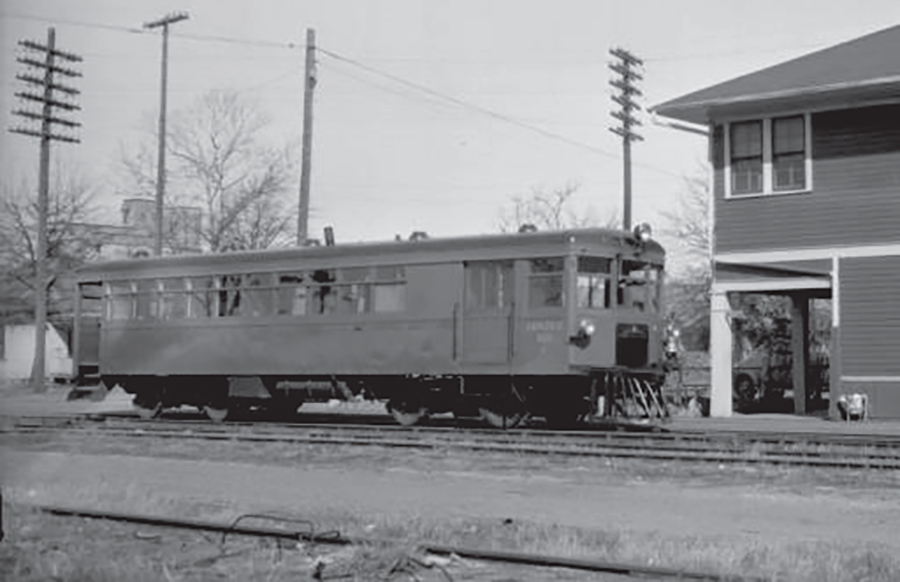
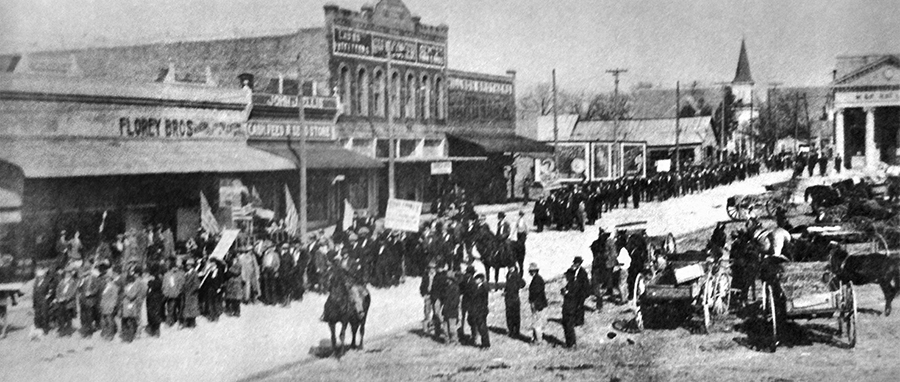
He was the presiding mayor during the 1909 Texas State Confederate reunion, pronouncing “We are arranging for the most gifted orators of the Southland for the occasion. Transportation will be furnished all old veterans and their wives to and from Dellwood Park at all times. Command us, and we and ours are yours. We have most any kind of transportation facilities in our city: Street cars, automobiles, and vehicles of all kinds, at any and all hours, day or night. There are also plenty of hotels, restaurants and rooming houses in the city and at the park for any others besides veterans who may wish to come to Mount Pleasant on this occasion. We bid you all come,” as printed on the event program. The reunion had such a massive turnout, “about 200 veterans and wives arrived this evening… Five hundred more are expected tonight and on Thursday early morning trains,” reported the July 28, 1909 Dallas Morning News. So many veterans and visitors arrived as to exhaust the city’s food supplies within the few days of celebration. It was also at this reunion that the motorized trolley was overburdened by some 60 adult men, resulting in the motor burning out. The trolley was pulled by mules until it was retired over two decades later.
Moving the headquarters of his Heading & Stave Mills and cooperage from Dexter, Missouri to Titus County, August Hoffman understood the need to acquire the timberland and the freedom to transport his resources through the areas surrounding his operation center. In 1906, Hoffman had purchased right-of-way to construct a tram railway from White Oak Creek to his Mt. Pleasant facility in order to accommodate a steady supply of timber to his heading factory.
Following his purchase of timberland from J. V. Moore, August Hoffman continued to secure control of the timberlands near his Heading & Stave Mill. By 1911, he had successfully “acquired all rights to White Oak and Red Oak timber in Hopkins, Delta, and Lamar counties,” writes D. H. Hare. The mill was located just across the South Sulphur River, near the Adonia Church, near Sulphur Bluff.
In 1912 Hoffman sold four miles of his track to the Paris and Mt. Pleasant Railroad as it laid track from Bagota, through the Ripley Community and into Mt. Pleasant. As of June 30, 1918, the stretch of track was recorded as being 51.455 miles long.
In 1916 the Paris and Mt. Pleasant Railroad “owned three locomotives, twenty-eight freight cars, and four passenger cars, and received $33,833 in passenger revenue, $130,154 in freight revenue, and $2,287 in other revenue,” according to Chris Cravens’ Paris and Mount Pleasant Railroad Handbook of Texas. R. F. Scott specifies in 1918 there were ten box cars, one caboose, four flat cars, three passenger cars, one mail car, two outfit cars and the three locomotives.
From February 26, 1920, to January 1, 1931, the Paris and Mt. Pleasant Railroad was in receivership, a form of bankruptcy where a company can reorganize its structure and management in order to avoid liquidation. A trustee is placed in charge of the structure of the company in order to aid with this restructuring.
Percy Jones became president of the Paris and Mt. Pleasant Railroad in 1926. He began investing in land adjacent to the railroad in hopes of expansion of surrounding communities and industries. The discovery of oil in Talco in 1936 made him quite wealthy. He is known for his philanthropy and was a frequent anonymous benefactor and member of the Episcopal Church.
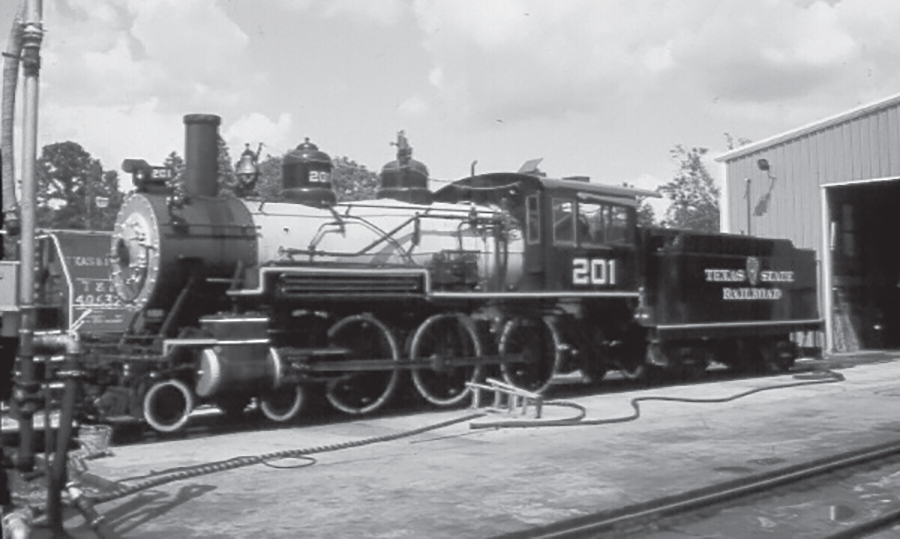
In 1949, the Texas & Pacific Railroad sold their aged Engine 316 to the Paris and Mt. Pleasant Railroad, which by this time was a Texas & Pacific subsidiary company. The 316 locomotive was saved from the “scrapper’s torch” by an anonymous purchaser who donated the engine to the city of Abilene. This engine is still in operation today on the Texas State Railroad, along with its sister engine 201 from the old ‘Ma and Pa’ line, which was refurbished in 2006.
The Texas Power and Light Company purchased the rail line in 1952. The remaining sections of the Paris and Mt. Pleasant Railroad were abandoned following an accident where coal cars fell through the trestles over the Sulphur River around 1954.
J. H. Fitzgerald, of Paris was the master mechanic for the ‘Ma and Pa’ Railroad for a solid 19 years before retirement in 1955, just before the Paris and Mt. Pleasant Railroad was abandoned and decommissioned in 1956.
The ‘Ma and Pa’ Railroad essentially nurtured the growth and in some cases gave birth to some of the communities in this region. As the railway became defunct by the improved roadways and interstate systems for automobile traffic, the railway system simplified the routes, pruning the sections that were not essential to a profitable enterprise. The Paris and Mt. Pleasant Railroad may no longer exist in its original form, but the tracks laid by its route can be seen in the stretch of communities that still exist along highway 271 from Mt. Pleasant to Paris.