Hero’s death marked passage of a family whose fortunes mirrored Cookville, Texas rise and fall
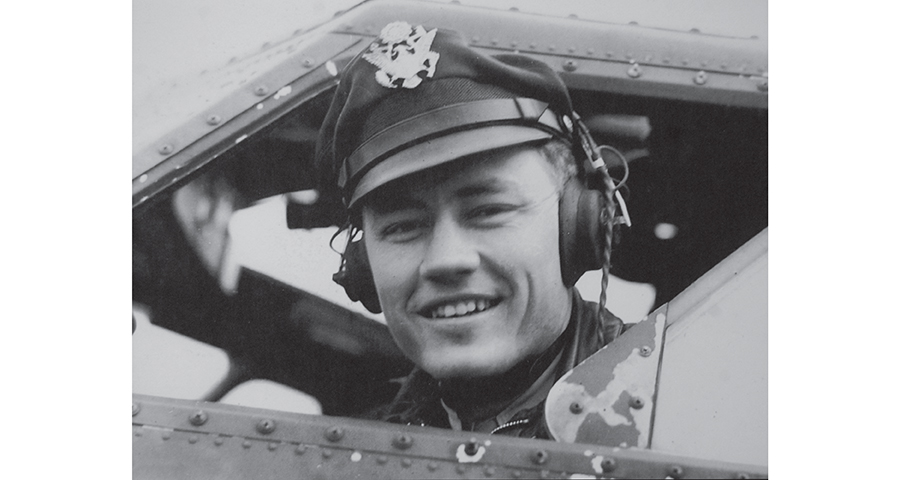
Above Photo, a Cookville native, Thomas Witt was an Army Air Force Major flying missions from a base in England when he was decorated for valor. His war record was a story seldom spoken before his nephew found declassified war records.
From The East Texas Journal, March 2012
By Hudson Old, Journal Publisher
Cookville, Texas – Isabelle Smith sanded around the child’s handprint in the ancient varnish on the door frame. It’s a subtle shape of small fingers and palm, a thing seen only in the exacting light of a narrow angle. Years would pass before she learned the rest of the story and understood why the family had preserved the handprint of a child “helping” the painters nearly a century before.
Against her father’s common-sense advice, Isabelle persuaded him to partner with her to buy the old home where Fred and Birdie Witt raised the three of their five children who survived to adulthood.
Isabelle lived in the Metroplex when her father, Tom Traylor, retired from the Dallas Times Herald and bought a farm north of Mt. Pleasant in Titus County’s old Greenhill community. He was a friend of Fred and Birdie’s son, Thomas Witt, a World War II veteran who’d returned to Cookville after retiring from the military.
His sister, Mary Lou Witt, was the last of the family to live in the home their parents built in 1905. After coming home, Major Witt moved into a home next door, at the edge of the family’s old pecan grove.
“When I brought friends for the weekend to visit my father’s farm at Greenhill, we rode horses borrowed from Major Witt,” Isabelle said. Isabelle got her first horse when she was six. While living and working in Dallas, she stabled her horses in Plano.
“Major Witt and I shared a love of horses,” she said. Shortly before he died, Isabelle and her father visited the major at a veteran’s hospital. Mary Lou had died nearly two years earlier and the home where the Major had grown up had been vacant since. “He told us the house was for sale. He had a Tennessee Walker named Comet that I loved and when he offered to sell me the horse I jumped at the chance.
“He was chivalrous, gracious,” she said. “He wanted me to have his last horse because he knew I’d care for him.”
After buying the Witt home, initially as a weekend retreat, she spent years restoring it.
Listen.
Fred Witt was one of 12 children born to George Washington Witt and Louisa Cook-Witt, the daughter of Andrew Barney Cook.
Originally called Clay Hill when the post office opened here in 1870, ten years later the name was changed to Cookville in honor of Andrew B. Cook who in 1867 had opened a general store on the road between Omaha and Mt. Pleasant.
On April 17, 1872, the daughter of the man named as the town’s founding father married George Washington Witt, a man likely born here even before her father opened his general store.
Born in Texas in 1853, George Washington Witt was listed in the 1860 census as a member of his parents’ Titus County household.
In the 1880 census G. W. Witt is shown as a farmer living in Cookville. His granddaughter, Mary Lou Witt, spoke of an old newspaper clipping referencing his brick kiln here. Fred, the second of George Washington and Louisa Witt’s children, was born here in 1876.
The narrow gauge East Line and Red River Railroad came through in the late 1870’s. By the mid 1880’s the growing town was a major shipping and supply center for cotton growers in eastern Titus and western Morris Counties, says the Handbook of Texas.
In days when the community had been a center of agrarian commerce, days long since gone, Fred Witt was an agent at the depot in Cookville. He went on to become a successful cotton farmer and merchant.
The population swelled to about 600 before a sharp decline in the 1890’s. The town’s growth resumed with the turn of the century. By 1914 there was a bank and a telephone company. Fred Witt’s Hardware anchored one end of the row of stores of a growing business district.
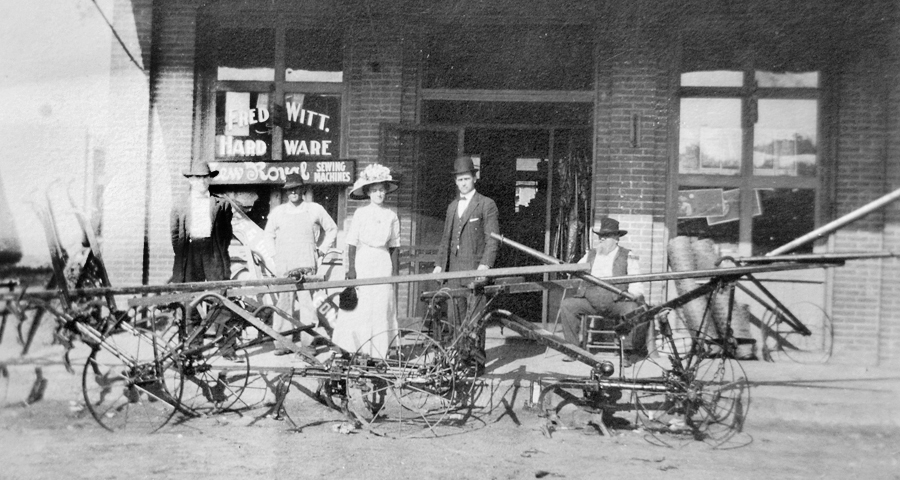
“His store burned,” said his grand daughter, Ann Holland, whose childhood memories of the Witt home go back to the 1950’s and 60’s.
“It was a wonderful place to visit,” she said. “There was an old barn with a hay loft where my brother and I played with cousins. We gathered eggs from the chicken coop and there was a garden in the summer. There was a well on the back porch.”
After her grandparents were gone, her Aunt Mary Lou Witt lived alone in the home for years. Ann’s mother, Evelyn, was one of the three surviving Witt children.
Fred Junior was stillborn.
Lillian, the first of the children, was 2 years old when the Witts built their new home in 1905. On
August 23 of that year, Fred Witt dressed in a pin-striped shirt. He wore a separate collar that covered the strings of a perfectly knotted bow tie. Two-year-old Lillian was dressed that day in a ruffled gown. Father and daughter posed for a portrait at Praytor’s Studio in Mt. Pleasant.
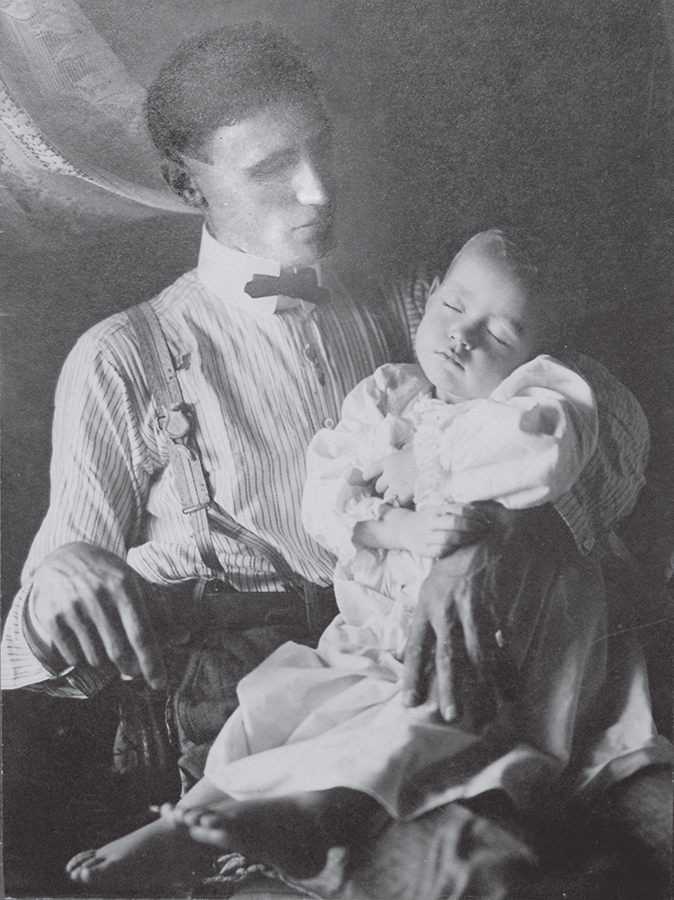
In a picture radiating stillness, the child seems to be sleeping in her father’s arms. She died two days later.
Though she doesn’t recall it as a thing spoken of, looking back through the bottleneck of time and into the childhood years that Ann came to know her grandparents, she senses the life of a once prominent man and a once-prominent family whose fortunes had declined.
The portrait of father and child was among photos she found on a day that she returned to the home after the death of Mary Lou Witt. But for dust on ancient furnishings, the home that had been vacant for two years seemed just as it might have been left.
A notation on the back of a photograph of the town’s cotton gin says that it burned after midnight, July 4, 1916. Fred Witt’s inscription made notation of the year’s cotton crop.
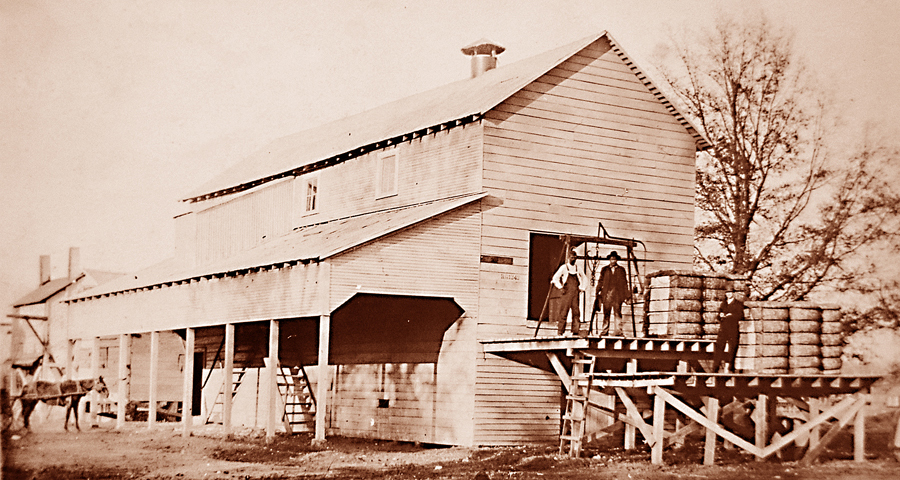
In another shot he’s posing with his wife in front of the family hardware store.
“I was living in Dallas when Aunt Mary Lou died,” said Ann. “When my sister-in-law and I drove out to see the old home place we found a box of old photographs and letters that she had collected and saved.”
One letter addressed to Ann’s parents was written by her grandfather in late November, 1940.
“I have just gotten through killing a pig,” Fred Witt wrote that day. “We are expecting you all to enjoy back bones and spare ribs with us on Thanksgiving. Thomas may be here, but I doubt it.”
Researching in cyberspace, Ann’s brother, Tom Newsom, found the family’s only known military document referencing the military record of the son Mr. Witt hoped would be there that Thanksgiving. Now declassified, it’s a narrative account of the mission for which U. S. Army Air Force Major Thomas Witt received a Silver Star for gallantry.
“He stayed in the military after World War II, so he was seldom here when we visited,” Ann said. “He was part mystery, part hero. There was a picture in his military uniform – he looked like a movie star. He was handsome.”
Zip forward 40 years. A decade ago, Isabelle Smith moved to the Witt home that by then had been her weekend get-away for years.
“I wish the Major could have been here when I came with my horses,” she said. “I wish he could have seen what we’ve done with the home where he grew up. I wish he’d watched as we were working on the family’s old barn.”
The memories of Major Witt recalled by Isabelle and his niece contrast with whispered community memories of a saltier gent.
“He could be rough but he was as tender hearted as he was tough,” said Billy Craig, owner of a Mt. Pleasant garage Major Witt patronized in his last years here. “He knew things about everything.
“His heath was failing and he and Miss Barbara (his wife) came in one day pulling a trailer with a horse he was taking to a man in New Mexico. He was sick and we tried to talk him into going back home. He was just as determined to deliver the horse. The trailer had a partition, so he put the horse on one side. He had Miss Barbara drive and he crawled in the other side, stretched out to rest and that’s how they pulled out.”
The records Tom Newsom found verified the misty recollection he shared with Ann of their uncle as a war hero.
As Hollywood’s most accurate depiction of life for American airmen based at Thurleigh, England during World War II, the 1949 movie Twelve O’clock High was once used by the Air Force College as a training film.
Thurleigh was the field Group Operations Officer Major Witt and his pilot were trying to get back to on the mission for which he was awarded the Silver Star. They didn’t make it.
“That base in England they flew out of – they had an orchestra and ball room dances,” Mr. Craig said. “They boxed and wrestled and played golf and had baseball and basketball leagues. Then they’d go off on these missions – he told about coming back from a mission on one engine. The plane got shot up because their bomb release mechanism failed and they’d had to fly back over their target and release it manually. They got turned toward home. Their tail gunner had gotten shot to pieces – everybody was all jumpy and jittery – Mr. Witt needed ‘em settled down so they started singing ‘Amazing Grace’ and he broke out a flask of vodka in case it was their last chance to have a drink together.”
That fits with the declassified narrative his nephew found, a story of a squadron all but lost in dense clouds from a mission’s outset.
“Despite poor weather conditions, Major Witt skillfully accomplished a rendezvous and led the formation to the target area. In a determined attempt to bomb visually, he made three runs over the target. On the third run they got a sighting only to have the bomb-sight mechanism fail. Ignoring anti-aircraft fire, Major Witt returned to the target and used the emergency release switch to place an excellent bombing pattern”
The target was a submarine base. Bombs away they turned for home.
“With the hydraulic and electrical systems damaged and the number two engine out, Major Witt relinquished the lead.”
Short on fuel and short of the base, they altered course for Attlebridge. They landed with no brakes at the first airfield they saw. His Silver Star citation says it was the only mission in the war during which a target was attacked four times by a lead bomber.
One day, at the end of another of days of work in the city stringing through long career years, Isabelle Smith was crawling with Metroplex traffic slow streaming toward home. She was a consultant specializing in business insurance and the flow of her thoughts turned as she studied the string of tail lights ahead, stretching to infinity.
The edges of a year of work had begun dissolving. Frank Weaver had come in from the Cleveland Clinic to put together a three-tiered plan pulling together and marketing the Dallas medical community. He died suddenly and he died young.
“He was brilliant,” she said. “We’d put together the framework he envisioned.”
Studying tail lights, his unexpected death seemed a natural ending for her time in the city. Thinking of the Witt home she’d come to love during years of restoration, it was a prime time for a new start.
When Ann Holland left Dallas after 40 years in real estate, she pulled up short of Cookville. She stopped near the lakes, hanging her realtor’s shingle with Century 21 Butler Real Estate Service. Located just south of Mt. Vernon in Franklin County on FM 115, the firm is noted for working the gated communities on Lake Cypress Springs.
As the incoming president of Mt. Vernon’s Rotary Club when Isabelle Smith was the incoming president in Mt. Pleasant they met. As it had been with Ann’s uncle, they were instant friends.
“She was interested in our family’s history,” Ann said, and Isabelle had found the right contact to learn more of the Witt family story.
The date on the back of the sleeping child’s portrait in her father’s arms spoke across a century to explain the hand print on the door frame. Photos of Witt’s Hardware, the cotton gin and the railroad depot described the old town.
Major Witt’s nephew’s research revealed the storied past Major Witt never mentioned.
Isabelle Smith is now retired. She and her husband, Buster, raise Missouri Fox Trotters, horses bred for their gait.
The sign they put on the front lawn acknowledges the Witt family’s building what today continues as the Pecan Hill Horse Farm.