Lament for a Lady: The Obituary or Caddo Lake and Other Fairey Tales
From East Texas Journal, October 2013
By Hudson Old, Journal publisher

CADDO LAKE — Jack Canson’s tale is strange even by the standards of tales told here.
The Cypress River Basin is the smallest of any in Texas but it feeds Caddo Lake, the largest natural lake in the South.
At the mouth of the lake, 12-mile bayou flows into the Red River. In the days when ships coming into the Gulf Coast port at New Orleans churned up the Mississippi and took a turn at the Red, they brought the industrial age wending through the swamps, then upstream to Jefferson.
“Steam engines chuffing, rattling and hammering the syncopated rhythms of the rising industrial age in Northeast Texas were new sounds that made their way into music,” Mr. Canson said, opening a story emerging from the shore of a lake described by writer Margaret McClung as “the brooding and majestic silence of Caddo.”
It was John Tennison, a physician, who researched oral histories from the 1930’s searching for the origins of “Boogie Woogie piano” that led Mr. Canson still further back through time to the 1852 arrival of paddle wheelers at Swanson’s landing on the upstream reaches of the lake.
“The ships brought the locomotives, the rails, the cars and the slave gangs who built the railroad from Swanson’s landing to Marshall,” he said. Over the next 70 years, the bass figures of Boogie Woogie came through the fingers of rail-gang musicians as “African American piano players first began to play the piano like a drum and make it sound like a train,” Mr. Canson said.
The left hand playing low notes on the keyboard likewise found new rhythms.
“The 8-beats-to-the-bar of classic Boogie Woogie is associated with two rotations of a steam engine driver wheel,” Mr. Canson said.
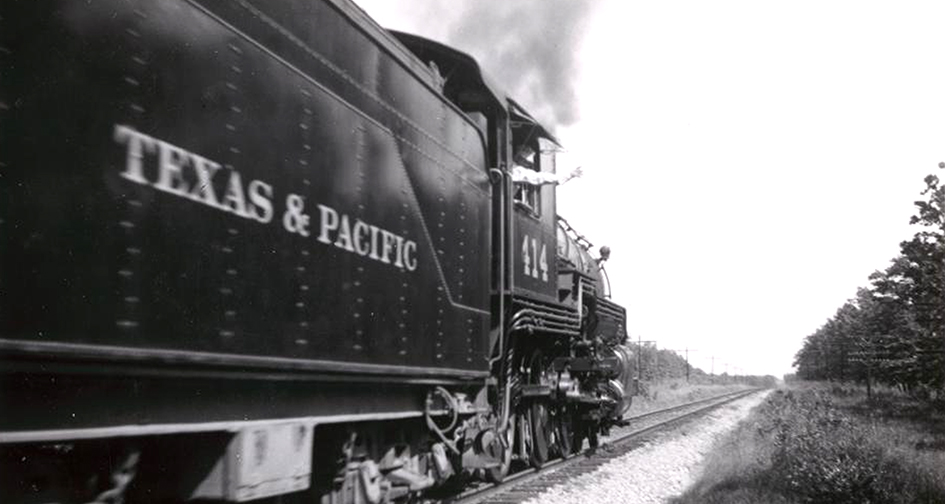
In 1872 the Texas and Pacific Railroad moved its headquarters to Marshall.
“The earliest bass figures are named after stops on the T&P out of Marshall,” Mr. Canson said. “There’s the ‘Tyler Tap,’ ‘the Big Sandy,’ ‘the Waskom’ and the most primitive of all the bass lines is known as ‘the Marshall.’”
During the administrations of Texas Governors Dolph Briscoe and Bill Clements, Mr. Canson’s firm handled communications for the Texas Drive Friendly campaign. He created the “You Could Learn a Lot From a Dummy” national seatbelt campaign. He was a screenwriter for 15 motion pictures, “working primarily for the legendary low-budget feature king, Roger Corman.”
Back in his native East Texas, Jack and his wife Nancy have just wrapped up a 10-year run handling public relations for the Caddo Lake Institute. Teamed as Canson & Canson, they’re presently working on a documentary film about Caddo.
As a researcher drawn to the lake, the roots of his tale reach across oceans.
“Nobody knows for sure, but there are African words that might be pre-cursers to the term ‘Boogie Woogie,’” he said. “There’s the Hausa word ‘Boog’ and the Mandingo word ‘Booga,’ both meaning ‘to beat,’ as in beating a drum. The West African word ‘Bogi’ means ‘to dance.’”
Pulitzer Prize winner August Wilson put it to words in The Piano Lesson.
“See that?” he asked. “See what I’m doing? That’s what you call the boogie woogie. See now . . . you can dance to that. It’ll hold you up. Whatever kind of dance you wanna do, you can dance to that right there.”
The relationship between music and the building of transportation system coming ashore in the bayou goes back to railroad and logging camp “overseers who kept a piano in the barrel house to keep the laborers from drifting away in search of diversion elsewhere,” Mr. Canson said. “Musicians entertaining in railroad and logging camps were free to experiment in the barrel house. They didn’t refine an existing style. It was a gradual development of an entirely new way of playing the piano, stylistically different from Ragtime and Jazz.”
A barrel house was just that – a shack where barrels were assembled and stored.
Get this: if you’re starting to think Jack Canson’s got this story down, then Rock and Roll owes its soul to railroad gang camps fanning through time and space across East Texas, back when.
“They called it blues. They called it Boogie Woogie. Then they changed the name of it to Rock and Roll,” said Jerry Lee Lewis.