
Indian fights, outlaws and lynching are Cason, Texas frontier legacy
From East Texas Journal, April 1996
By HUDSON OLD
Journal Publisher
Conventional wisdom is that the first child born in Cason was the daughter of a Cason, but the White family could argue the point. Whites, Wardlows, Bicknells and Russells were among those here as long as two generations when the town began.
Thomas Minter’s masters thesis points out that James Wardlow from Tennessee arrived in 1836, the year Texas won independence from Mexico.
William White arrived about the same time, as did J. F. Box, who was killed by Indians when his wife and daughter were captured.
“A few years later came the Donaldsons, Fombys, Bicknells, Blevins and Russells,” he wrote. They were plantation people of the old colonies, in addition to genuine frontier families.
Professor Minter explains that when the frontier families came, the state had officially shucked its Mexican forefathers, but East Texas was an area of dispute, being claimed by the Republic of Texas and Governor Pope, of Arkansas, who claimed the area for the United States.
During the Republic Days, the wise early settler hedged his bets and paid property taxes to both Red River County, Republic of Texas; and Miller County, Arkansas.
Many Indians earned their livelihood hunting the deeply forested bottomland along Swanno (also seen spelled as Swananno) Creek, a Cypress Creek tributary that cuts through the country a mile west of the town today. Swanno, it’s said, meant “Good Water.”
Archeological records indicate Caddo Indian occupation as much as a couple of thousand years before Ona Cason wiggled into the world at the town named for her family. The Indians expressed their stand on the issue of who had right to live here early on.
In addition to killing Mr. Box and kidnapping his family, Indians attacked the home of one Ensign B. Smith, killing his family. Mr. Smith, who had married a Mexican woman and received a 4,500-acre land grant along Cypress Creek, sold his land to John Spearman and moved to the town of Jefferson.
The creek that the Indians called Good Water also became home for Kendall Lewis, who took an Indian bride and built a trading post at Gooche spring, northwest of present-day Cason, Texas about five miles.
The Lewis homesite, excavated over twenty years by Bill Anderson, yielded trading beads and Spanish coins among Indian artifacts.
Titus County was carved from Red River County, and in 1841, Maribu Lamar became president of the Republic of Texas.
While Sam Houston, the first Texas governor, was known as a friend to the Indians, Lamar’s stated policy was to drive them from the land, push them into Oklahoma.
In the same year, Indians massacred another Titus County pioneer family, that of Ambrose Ripley. The Republic sent the cavalry to the aid of Titus County. Lewis and his wife left for Oklahoma Indian territory.
In 1875, Franklin County was cut from Titus County’s western side, and Morris County was sliced off its eastern side.
Cason came to life as a town, almost overnight, three years later.

Professor Minter, a Cason native, wrote his thesis on the history of Morris County while working on his Masters degree at East Texas State in 1952.
Before deeding 30 acres for the townsite and building a depot here for the railroad, the family of J.W. Cason lived at the Titus County town of Snow Hill, “a lusty village with plenty of action and excitement, for it is said that there was not a building in the town which was not scarred by buckshot and pistol shots,” Professor Minter said.
William Augusta Old was among the dead, killed by a shotgun blast on the town’s church steps in 1860.
By the mid to late 1870s, the East Line and Red River Railroad was making its way west from the riverport town of Jefferson. Originally, it was thought the train would come through Daingerfield, Snow Hill and Mt. Pleasant. But when the route was revealed, it went from Daingerfield to Pittsburg.
Snow Hill merchant J.W. Cason, “a very wealthy man,” according to Titus County historian Traylor Russell, bought 30 acres of land and began laying out the townsite.
“J.W. Cason died as a result of his activities in laying out the town site, but his sons, William and James, carried out the contract with the railroad company,” Professor Minter said.
The contract called for Cason to give to the railroad every other town lot and provide labor and materials for the first railroad depot.
The town immediately flourished. Its founding fathers brought with them the frontier heart of Snow Hill. The community from which Cason sprang settled back into the earth, a few old graves now on a hillside overlooking Boggy Creek Bottom.
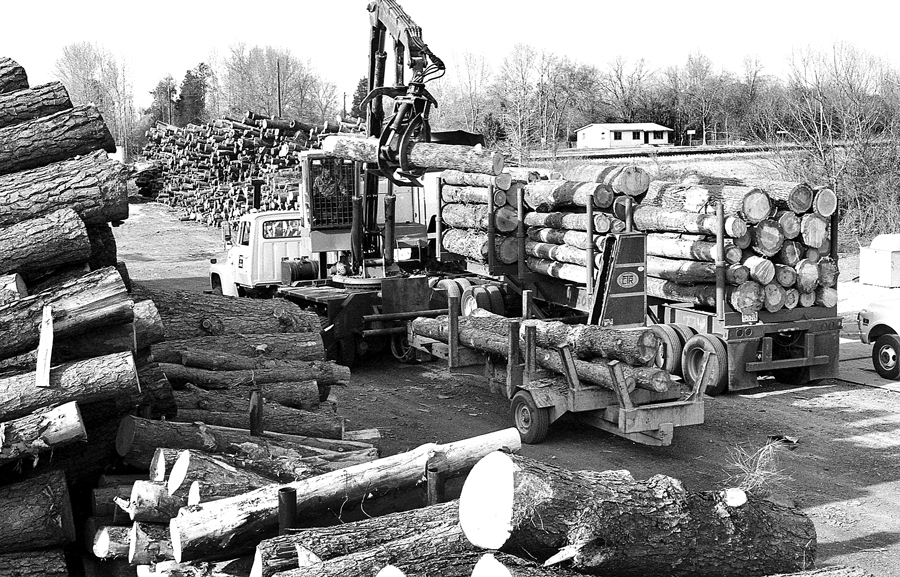
The railroad’s continual expansions brought tie hewers here to harvest the forested bottoms of Big Cypress and Swanno Creeks.
“My grandfather said there were tie camps all up and down the line,” Dud White said in 1995.
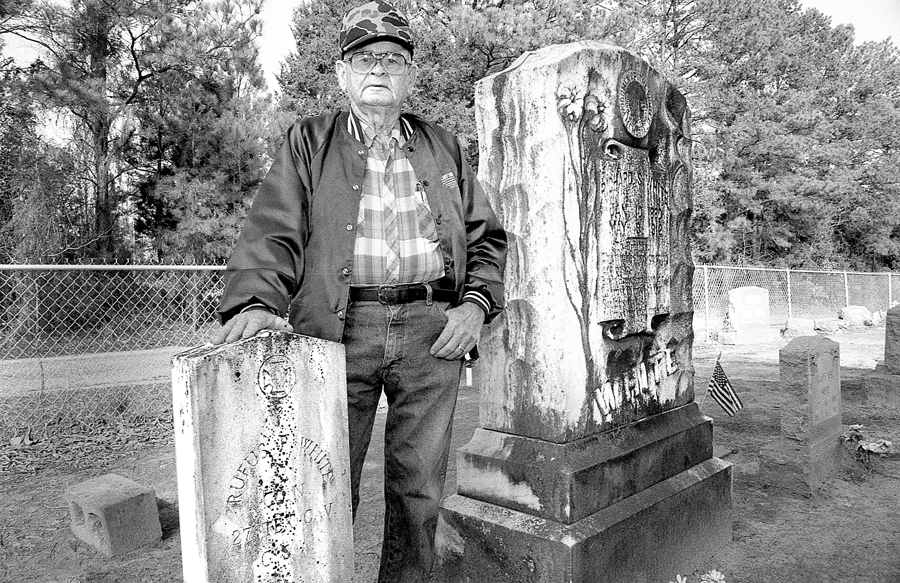
The grandfather is Rufus White, son of William White. It’s William White who gave name to the survey in which the town grew. J.W. Cason’s son bought a 254-acre tract in the White survey from Mr. Wardlow.
“Cason earned a reputation as being a very rough and tough town,” Mr. Russell wrote, adding that this was the result of all the saloons built to serve the woodcutters.
In fact, agreed Professor Minter, the town was so rough that the activities of a band of local outlaws here was the beginning of the end of a period of general lawlessness that followed the Civil War.
Among the sources Professor Minter cited for his scholarly work are minutes of the September 5, 1881 Morris County Commissioner’s court, which allowed for the digging of James Donaldson’s grave.
James Donaldson, the professor’s footnotes say, was lynched by a mob of Titus County men, and few, if any Morris County residents were involved.
But there’s little doubt that local officers were aware of the contemplated lynching and were conveniently absent when the mob arrived at the jail, Professor Minter wrote.
James Donaldson, Morris County citizens noted, came from a fine family that lived near Cason, and had done nothing more than fall in with Ab Stevens and his band of Titus County outlaws, then make the mistake of bringing them to Cason.
“One day during the summer of 1881,” Professor Minter’s story goes, “Stevens and his band invaded the town of Cason where they took over the local saloon, created general havoc and terrorized local citizens.
“The group was composed of Mr. Donaldson, Quill F. Manos, presumably a Mexican; Sim Yelverton, a quarterbreed Cherokee Indian who lived near White Oak Creek; Granville Goode, an Indian; and at times other Indians from the Oklahoma Territory. After shooting up the saloon in typical wild-western fashion, Goode mounted his horse and rode up and down the railroad right of way shooting stray hogs.”
A witness would later testify to the Morris County Commissioner’s Court, that for a man in his cups, the Indian Goode was an incredible marksman.
Morris County had had enough.
The citizens were “thoroughly aroused by the activities of Stevens and his gang who had been stealing all the good horses in Morris and Titus Counties,” Professor Minter said, basing his story on personal interviews dating back to the 1930s.
Morris County Sheriff Reese Ragland called out every able-bodied man who could muster a gun to search for the outlaws in the creek bottoms near Cason.
A posse from Titus County joined the hunt.
Somewhere in a brush thicket on Cypress Creek south of Cason, the posse located the gang’s hideout.
“The thicket was surrounded and stormed by the posse,” but the outlaws apparently shot their way out.
Meanwhile, Stevens had sent Donaldson and Goode to Daingerfield for supplies.
Two members of the Morris County posse, John C. Conly and J.A. McGregor came upon them through the woods.
“In the ensuing battle, McGregor killed Goode, but Donaldson escaped on horseback,” Professor Minter wrote.
With information supplied by an informer, McGregor several days later set up an ambush at the home where Donaldson went each day for his noon meal.
When Donaldson arrived, he refused to surrender even though McGregor had the drop on him, the Professor said.
“For God’s sake, Jim, put up your hands,” McGregor said. “I don’t want to kill you.”
Better for Donaldson had he fought.
“It was reported that Donaldson retained counsel and paid his fee with a stolen horse,” Professor Minter recorded. “And furthermore, his lawyer while intoxicated had made his boast about town that he would clear his client in court. A night or two later, sometime during the latter part of August, 1881, a mob broke into the jail, carried Donadson a short distance, and lynched him on the Daingerfield-Cason Road near the place where Goode had been killed a few days earlier.
“This drastic action on the part of the citizens definitely put a stop to organized banditry and horse stealing in the county. The incident fairly well marks the end of a long period of violence and lawlessness which followed in the wake of the Civil War.”
So it was that he didn’t settle in Cason, but where William White bought land and built his family home became Cason.
He sent his son, Rufus, to fight for the Confederacy.
Dud White, recalled his grandfather’s war stories.
His skull was broken with a saber. He survived surgery and was imprisoned in Pennsylvania.
Rufus told Dud that the surgeons had patched his skull with a metal disk made from a flattened silver dollar.
The story matched the round bump in the back of his grandfather’s head.
By 1879, the community was being covered by the Morris County Banner, published at Daingerfield.
In the 1960s, Traylor Russell reprinted in his History of Titus County, a number of articles clipped by the Cason family through the years.
In February, 1879, the railroad, and the Cason and Turner families gave land for a church and school.
In the Banner’s August 11, 1879 edition, it was noted that “Cason and Brother” got the wood (fuel) contract for the East Line from Sulphur Springs to Jefferson.
“Judge Mosley failed to take up his school on the 9th owing to other business,” and the paper noted that “the train run (sic) over two of J.L. Jeter’s hogs this a.m.”
The Banner described the town at length in the mid 1880s, praising Cason’s attributes, but criticizing its school.
“The town is eight miles from the county seat and much shipping is done,” the Banner said, “in all there being 500 bales of cotton per year besides grain and hides.
“But the public spirit of the people in education matters is not what it should be.
“The business interest include dry goods stores, drugs, grocerys (sic) saloons, blacksmith, wagon shop, grist mill, lumber yard, boarding houses, express office, physicians and an immigration agent, Mr. William M. Cason, who invites correspondence.”
Dud White said his family, and others here, fell on financial hard times in the fall and winter of 1929.
“George White, my father, and Fletcher Russell bought fifteen hundred bushels of sweet potatoes that year for $1.25 per bushel,” Dud said, and they wound up giving most of them away to keep them from rotting.
Dud’s brother, Clovis White planted potatoes once in the depression years “and they wouldn’t bring enough to pay the freight to Greenville,” said his widow, Annie Claire Minter-White.
The Minter family came to Cason in 1901, said Martha Minter-Robinson, daughter of Thomas Minter.
It was Professor Thomas Minter’s father, Tom Minter, who came here a Georgia immigrant at the turn of the century, stepping off the train in spats and a derby hat.
“Will Becknell,” said Martha Minter-Robinson, “said he was a dude.”
For a while, he operated a soft drink bottling company in Cason, remembered Mr. White.
Until 1946, business partners George White and Fletcher Russell operated a cotton gin at Cason. When it closed, Buddy Fielder bought the boilers to run his sawmill.
By 1952, the year Professor Minter was writing his master’s thesis, Cason was in decline, he observed. Family farms were changing, better cars and better roads lured townsfolk away to neighboring retailers.
In 1993, after the drug store closed for the last time, the block long row of brick buildings that was once the business district mysteriously burned.