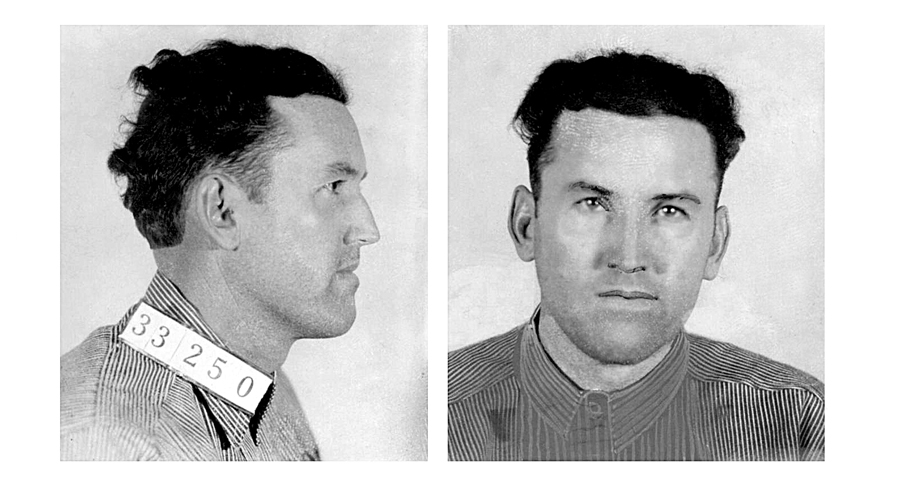
Julius Daniel “Kinky” Bohannon and escapees storm prison walls of McAlester Oklahoma State Penitentiary
July 2, on a hot afternoon in 1934 the newspapers said the cops were hot on heels of the robbers who held up the bank in Naples until they abandoned their get-away car and melted into the bottom between White Oak Creek and the Sulphur River, north of Mt. Pleasant.
As dusk turned to night, the home-grown outlaws were on the verge of becoming an historical footnote from the gangster age.
Two weeks later, U.S. Attorney General Homer S. Cummings announced that the Naples bank job would be the first in the nation to be prosecuted under a new law making bank robbery a federal offense. Part of the legislation funded hiring 450 new federal officers “to be put in the field since a large part of the current force is presently concentrated in the hunt for the John Dillinger gang.”
Dillinger was a living legend, a pop culture icon whose gang robbed 24 banks, four police stations and courted a press that cast them as Robin Hood figures.
The bank cashier said one of the hold-up men at Naples claimed to have been Dillinger, “but the cashier said he knew he was not,” reported the July 6, 1934 Hopkins County Echo.
Life for the local robbers unraveled in short order, as reported by the Echo four days after the hold up.
“A man identified as one of two robbers who looted the Morris County National Bank was under arrest today, taken in a raid on his home in White Oak bottoms near Sulphur River,” the story said. Authorities withheld his identity “until the search for another suspect is finished.”
It took three months for the law to catch up with Julius Daniel “Kinky” Bohannon. Time and again for the next 23 years, until he was pardoned, his name made headlines.
He made front page of the May 14, 1936 New York Times the day after he was identified as one of three master minds leading the broad daylight mass escape from the state prison at McAlester, Oklahoma.
Ten were gunned down; another 14 made it out.
“Twenty four convicts escaped from the State Penitentiary today, used a foreman as a shield, then killed him and dumped his body from an automobile while ten of their band were being shot down by guards,” said the Associated Press news service report published by the Times.
Bohannon was charged with the guard’s killing. In the years since, Oklahoma historians have questioned whether the guard was killed by the escapees or by guards opening fire from the prison walls.
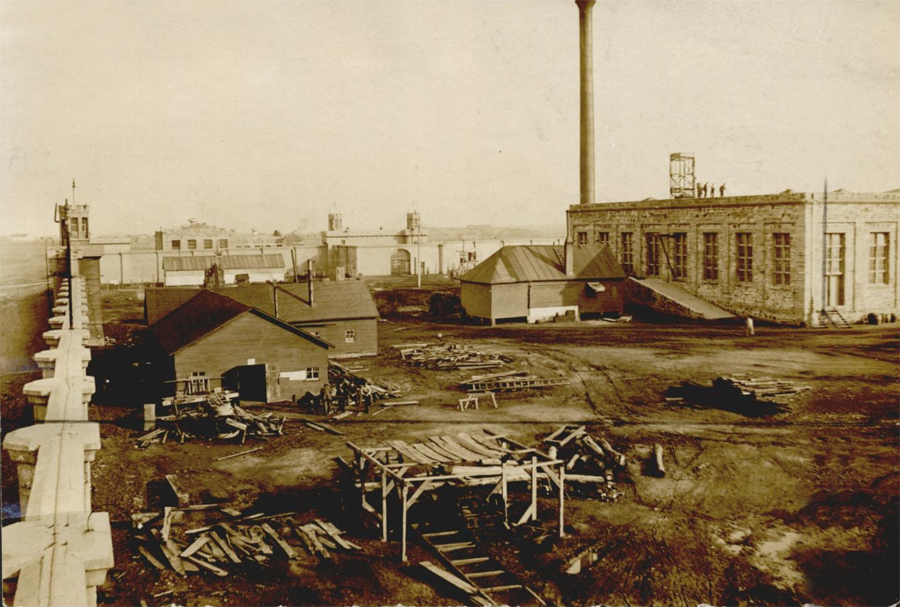
“Six of the escaping prisoners were captured unhurt,” the initial account said. “Five others got away in the motor car, taking two guards as hostages.” One convict escaped in an ice truck. Authorities were uncertain whether the last two were in the get-away car.
“The leaders got away,” the news read. “When the guns of the near-by penitentiary guards finally got into action, convicts racing to escape on foot were mowed down.”
It was the only of Bohannon’s three prison escapes that was violent.
Notorious Oklahoma outlaw Ray Terrill, “one-time associate of the Kimes brothers who terrorized the Southwest several years ago,” was among the wounded when prison guards opened fire.
Ray Terrill had done two years for bank burglary in Muskogee before his first prison break in early March of 1923. Three weeks later, he was identified as one of the Al Spencer gang that gunned down two lawmen shooting their way out of a March 26 bank robbery in Mannford.
Terrill’s criminal career became legend while he was serving time at McAlester, where stories of his getting away with $20,000 stolen from the Katy Limited near Okesa on August 23, 1923, went down as “the last recorded bank robbery in Oklahoma History.”
He died in prison, his last attempted escape coming during the noon hour breakout that made national news.
It began in the brick yard where “dangerous inmates” were assigned work at McAlester. The plan was as desperate as it was brazen and had been in the works for weeks. A hundred prisoners who might have joined in the mass rush made no such attempt. The odds of escaping alive in a daylight jailbreak across and open prison yard were too slim. The consequences of capture were too severe.
“The convicts drew knives and seized C.D. Powell, foreman of the prison brick yard,” AP reported. “Using him to shield themselves, they forced guards on the prison wall to throw down their arms.”
Two days later, Oklahoma Governor E.W. Marland denounced the prison guards for surrendering their weapons.
“In my opinion,” said the Governor, after hearing at Tulsa the Board of Affairs report, “any man working as a guard in the penitentiary should as a first qualification be willing to sacrifice his life to preserve the discipline of the prison.”
C.D. Powell was one of four guards seized in the opening moment, records say. Along with Powell, Tuck Cope, W.W. Gossett and Victor Conn were forced to the foot of the nearest guard tower.
“The convicts, led by Julius Bohannon, Claud Beavers and William Anderson were brandishing prison-made dirks,” reads an “End of Watch” account of Powell’s death. “Threatening to kill the hostages, they demanded the guards on the tower throw down their keys and weapons, then piled into a commandeered automobile and drove through the gate with half a dozen prisoners hanging onto the running boards.
“As the car began moving, other officers opened fire. Tuck Cope was wounded in the neck, Gossett in the stomach and Powell was fatally hit in the head. Although there was some question whether it was his shot or one from the guards that killed Charles Powell, Julius Bohannon was charged with the murder.”
Of the 1936 escapees, all but Bohannon were captured within days. At large for nearly three months, Bohannon was captured after coming to reunite with family in Morris County, reported the July 31, 1936 Naples Monitor. The full front page story can be found at the Omaha Museum, open Thursdays.
“Naples was thrown into a fever of excitement Thursday just afternoon when the report was spread over town that escaped convict Julius Bohannon had been in Naples, having come here to get his wife and one of his two children,” the newspaper said.
“Julius, I can’t go,” a witness told authorities Mrs. Bohannon said when her husband arrived to meet her at a home near Rocky Branch, in the northern part of Morris County.
“Sheriff Ben Garrett was notified within a very few minutes,” the story continued, “and it was stated that he left immediately while Mrs. Garrett made calls notifying officers in near-by towns.”
Those responding in short order included Sheriff Garrett and W.A. Stout of Morris County, Bowie County Sheriff Henry Brooks and two deputies and Titus County lawman John Tigert.
An informant told authorities where they’d find Bohannon.
There was a brief struggle; Mrs. Bohannon’s presence stopped Bohannon’s resistance short of the day two Oklahoma lawmen died when Bohannon was the wrong man at the wrong place at the wrong time.
He wasn’t the man McCurtain County Oklahoma authorities were searching for when they went looking for the daughter “of a local farmer” on August 8, 1934.
The farmer hadn’t seen his daughter in three days, not since the end of Sunday church services after which the “pretty, slender girl of 16” left with two brothers who’d said they would give her a ride home. Learning that the brothers were staying with a family in the Oak Hill community on Little River, north of Idabel, the farmer called authorities.
Deputy Emery Jasper Whitten, Constable William Wilmoth and Sheriff Bud Stewart went to the home where a son of the family told them that the women were down by a spring, washing clothes.
The boy took the sheriff to the spring. The two officers went to the house – Bohannon let them think what he found they believed that he was one of the two brothers who’d picked up the girl at church. The ruse didn’t last.
Bohannon pulled a revolver and shot Deputy Whitten at point blank range when he was told he’d have to come into town for further questioning. Constable Wilmoth reached for his sidearm too late. Bohannon shot him three times.
Both officers died.
Bohannon’s escape that day was short lived. Tried and convicted, he was sentenced to life.
Returned to McAlester after his capture in Morris County ended the first of his three escapes, he drew another 99 years for the killing of the prison guard. Additionally, he was given four and a half years in solitary confinement.
In his next two escapes, he simply disappeared.
“U.S. Charges Are Planned for Bohannon,” said the front page of the November 3, 1947 story of his capture in Alabama following his second escape.
Again tipped off by an informant, FBI agents closed in on Bohannon “deep in the Cajun country north of Mobile,” where he had been operating a tavern. Booked into the local jail, he was being held for possible federal grand jury indictment.
“In McAlester, Warden Clarence P. Burford said Bohannon will be placed in solitary confinement on the top tier of cells,” if government prosecutors passed on federal charges in favor of returning him to Oklahoma.
Eight years passed.
“Trusty Bohannon Makes Good His Third Prison Escape,” said the Sapula Oklahoma Herald’s January 10, 1955 edition.
“Bohannon Believed in Southeast Texas,” said the next day’s United Press News Service, reporting from Beaumont. A 42 year old man told police that two men had “jumped into his car while he stopped at a Baytown stop light Saturday night.
“He said both had guns and forced him into the car’s trunk. He heard one man call the other ‘Kinky,’ Bohannon’s nickname.
“He said the men stopped at several taverns and let him out of the trunk to drive. He escaped when they fell asleep.”
The Associated Press wrote a more detailed account of the same story.
“Bohannon Still Evades Capture; Manhunt Spreads to Louisiana Area,” said the El Reno, Oklahoma Daily Tribune.
“The search for the Oklahoma prison escapee who has boasted he will not be taken alive centered in southeast Texas and southwest Louisiana today after the discovery an abandoned burned car,” said the AP account. The Baytown man, said AP, had identified one of his kidnappers from a photograph as “Julius Bohannon.”
The witness said the two men had robbed him of $90 and forced him into the trunk of the 1950, two-door sedan found burned on a farm road near Mauriceville, 10 miles north of Orange, Texas near the Louisiana line.
“A trusty at the Oklahoma state prison, Bohannon fled Saturday night when he was allowed outside the main prison walls to operate a movie projector in the trusty building,” AP reported. The second man was believed to have been a waiting accomplice who’d helped make good the escape.
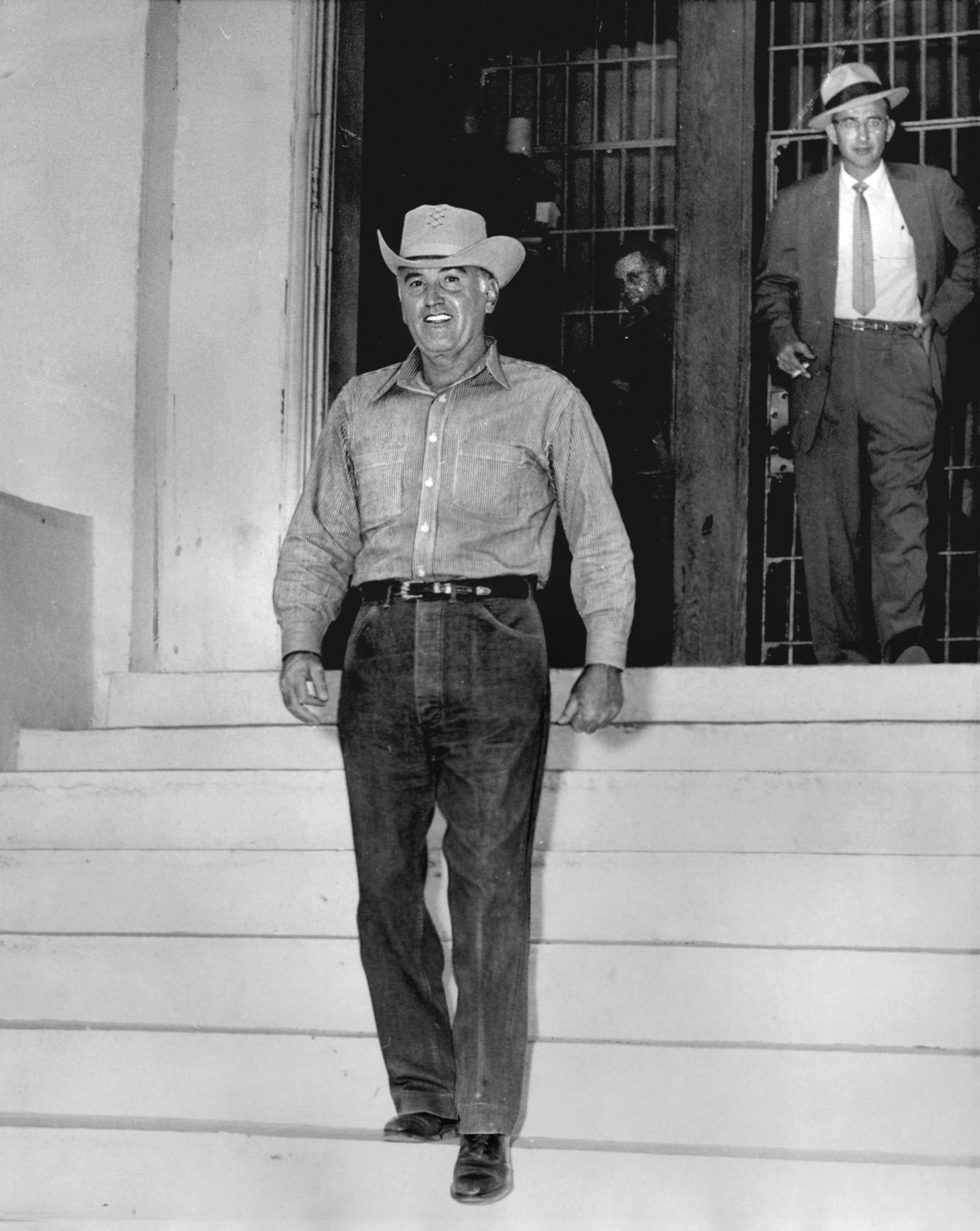
Dateline, Tahlequah, Oklahoma, January 20 – Julius Bohannon was captured in a small farmhouse here Thursday, shivering with cold and complaining about bad breaks since his escape 12 days ago.
“His arrested ended an all-night manhunt by more than 50 heavily-armed officers that began Wednesday night after dogs barked at a tramp about 100 miles northeast of the McAlester prison. Officers from neighboring counties surrounded the area and began a methodical house to house search.”
Two state troopers crawled into a deserted farmhouse where they found a man in a bedroom, “flashed a sawed-off shotgun in his face and asked who he was.
“I’m the man you’re looking for,” he answered.
They said he refused to say where he’d been, apologized for his haggard appearance and thanked them “for the nice way you’ve treated me.”
The state legislature appointed a special committee to begin “a probe of the State Prison to investigate the recent escape of Julius Bohannon,” the Supula Oklahoma Daily Herald reported after his capture. “If there’s any crookedness, we’ll find it,” said Representative Joe Chambers, which seems to have ended the matter.
In December, 1957, Bohannon was again made a prison trusty “on the honor farm near Stringtown.”
In January, the parole board voted unanimously to recommend parole if he continued as a “model prisoner.”
He was given a new suit of clothes and $5 when he was released in May, 1958.
He died in Titus County in 1983.