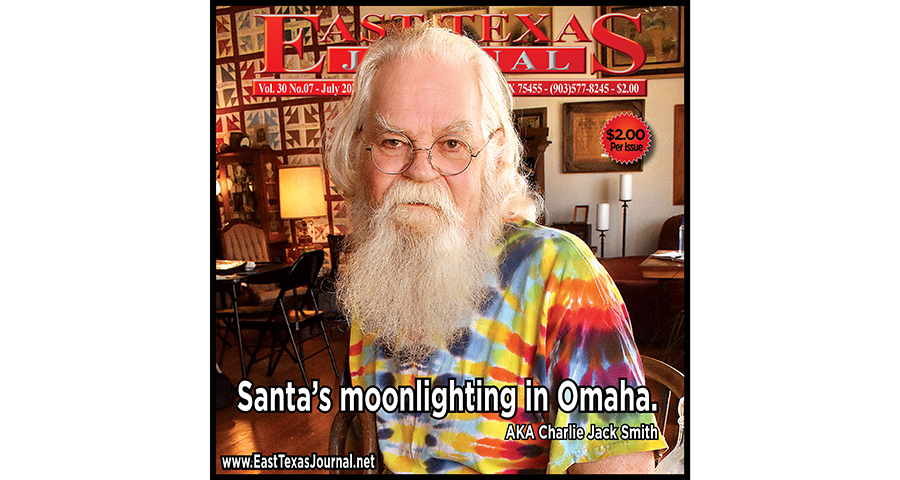
Omaha, Texas Museum: A possum that’s going to be eaten should be taken alive
From The East Texas Journal, July 2022
By HUDSON OLD, Publisher
OMAHA, TEXAS – The two strangers who came in the museum had brought home and buried her ashes where she wanted, among family, said Charlie Jack. She was a Farrier.
He surmised that neither man was immediate family, but more distant kin, one from Seattle and the other from Oklahoma, relatives who’d needed make travel schedules match before bringing her home.
There’d been no rush about it.
“They said she died three years ago,” said Charlie Jack, who went into high gear when her kinsmen came in, knowing he knew things about the family they wouldn’t know about themselves.
He was in high school when somebody first called him Charlie Jack, “and it stuck.” That was the 70’s, when across from old city hall where the museum is now there was a pool hall where Charlie Jack polished his game.
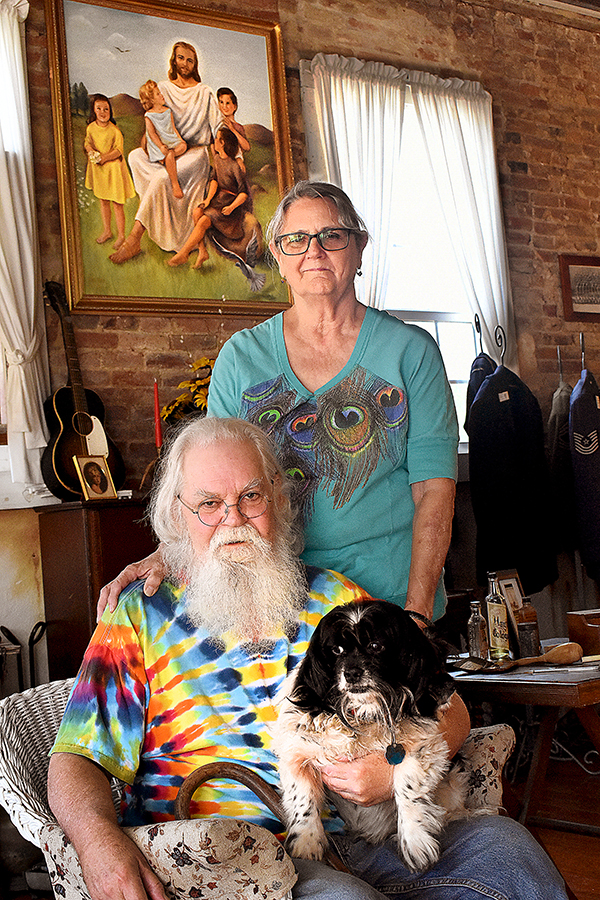
That was then and this is now, when for a few hours once a week Mr. and Mrs. Charlie Jack and Brenda Smith open the museum.
The Farrier kinsmen picked the right day.
On the table in the museum’s working living room, where Charlie Jack and Brenda sort through decades deciding what to frame when they change out wall hangers, there was a century-old edition of the newspaper they needed to see.
Before Ma Bell began printing phone books, when telephone companies were local, on the front page of a 1918 edition of the Omaha Breeze they printed the names and numbers of everybody in the Omaha telephone exchange.
Grady Farrier’s number was the single digit “1.”
In the era of sharecroppers and family farms, the Farriers were bankers and merchants as well, an extended family that reigned over the business district.
There was a Dr. Farrier who practiced here.
There was the Farrier Brothers Store. Farrier mercantile handled fabrics from New York.
“Farrier and May Motors was across the street,” said Charlie Jack, “next to the pool hall.”
Farrier’s peach orchards stretched from the edge of town to White Oak Creek, said Tommy G. Heard, a dubious claim. Time nurtures memories; things seem bigger than they might have been.
“Peaches all the way from here to the creek?” I wondered. “How far is that?”
Catching my doubt, Tommy G. said, “Four miles.”
He had a witness to boot.
“The summer of ’42 we made a bumper crop,” said Jerry Williams, 93, a 6-foot-something slab of museum regular who picked peaches in Farrier’s Orchards that year — and there was this.
“We,” he’d said, a mindset that filters the all-inclusive town story as filtered through the museum.
The chamber of commerce board meets at the museum and two groups of Bunco ladies play cards here.
“Our Bunco ladies are generous,” said Charlie Jack. “They keep us afloat.”
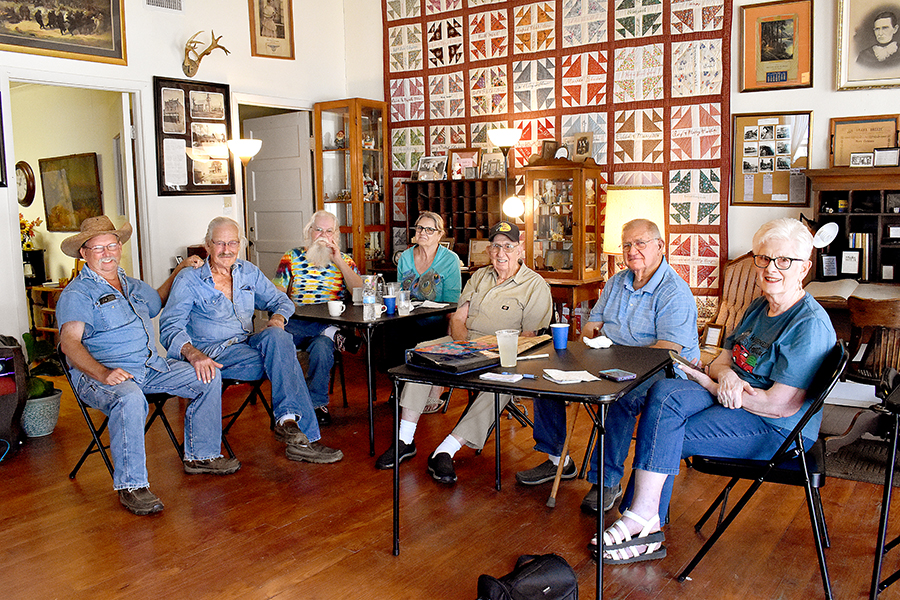
It’s a venue for birthdays. The Republican women and a Bible class meet at the museum and on the north wall, hanging above the rack of military dress uniforms of soldiers whose stories they know, there’s a pastoral painting of children with God on earth, the Christ in green grass beneath blue heavens.
It’s signed oil, but the signature’s no help in solving one of the few mysteries left around here. The signature doesn’t connect with local names, “so nobody really knows who she was,” said Charlie Jack, but the painting was once given to the church in honor of a Farrier matriarch, with the stipulation that it would always remain in the church.
So when the church closed, it came here and that’s where they hung it.
The shaggy dog with the run of the place is also Charlie.
“No relation,” Charlie Jack said.
The “peach shed” was a long building with a rail siding for the train to pull alongside a loading dock. That long tall structure was the ice tower with a chute for pouring ice into the refrigerator cars.
“We shipped more peaches than anywhere that summer,” said Mr. Williams, speaking from the longest memory in the room of a harvest that made work for everybody.
The pickers brought the peaches to the shed where shoals of workers graded them.
“My mother worked wrapping the number one’s in newspaper,” Charlie Jack said.
Besides peach picking, Mr. Williams ran the projector at Lyric Theater.
Mr. Williams is retired from the now-abandoned Texas & Northern (T&N) railroad, a short-line connecting the Kansas City Southern to Lone Star Steel, where making oilfield pipe outpaid peach picking.
The steel plant changed the world with union-scale wages for thousands of men for thirty years. In the 80’s it began cutting back from thousands to hundreds of jobs. It closed two years ago and it looks like forever this time, nobody anywhere beyond the guard at the gate.
They’re selling off land.
Besides running railroads and working at the Lyric Theater, Mr. Williams worked at the newspaper.
He’s the great grandson of Publisher W.C. Williams, who began printing The Breeze in 1889. In the next generation, when Jerry Williams’s grandmother died, Vida Farrier came over from the Farrier Brothers Store to run the linotype.
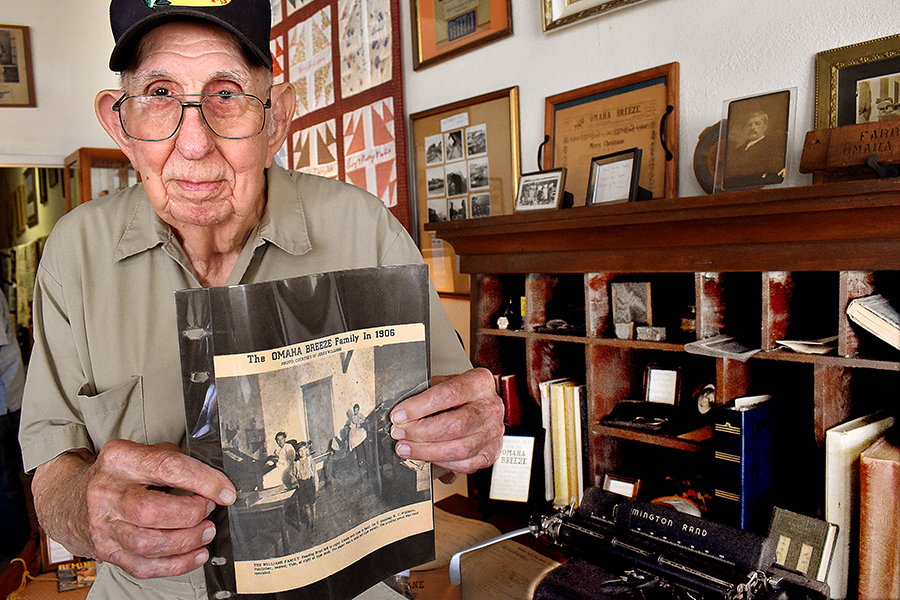
In the museum, they’ve put the newsroom typewriter on her desk and beside it there’s a picture with Mr. Williams grandfather as a boy young enough to seem out of place in the photographer’s shot of the newspaper office.
Looks like somebody told him to stand there, a kid about the right age to be taught to fire up the lead pot. Clued by address changes, Charlie Jack thinks the newspaper office burned twice before it closed, which was in 1956 when Mr. Williams’s grandfather died.
Printing involved molten lead and “hot type” printed on sheets fed into a flat-bed press. They sometimes shared and traded borrowed typefaces with the Cross family that printed the Times in Mt. Pleasant.
To get in the newspaper business, “you started out folding papers,” Mr. Williams said. “Everybody folded papers on press day.”
A subscription to The Breeze was a dollar a year.
“Or he’d take a live possum in trade,” said Mr. Williams.
A possum that’s going to be eaten has to be taken alive.
Possum payments were left in a catch pen outside the office. Possums can be baked or prepared like a classic roast, slow cooked with carrots, onions and potatoes steeped in the natural broth.
Possums are the only American marsupials.
A possum will eat anything, including carrion.
If you plan to eat one, the reason for starting with a live possum, “You need to feed it table scraps for about a week to purge it,” explained Charlie Jack, whose peach wrapping mother, Lura, was one of the two women activists prevailing on the city council to let them have the old city hall as a museum.
There’s no deed.
It’s an agreement noted in the council minutes.
“It was just going to fall down,” said Marilyn Smith. “What got us started, I read in the Texarkana paper that jailers at the prison in Bowie County had a work program for prisoners for public projects.”
The prisoners liked coming to Omaha because, besides getting out of jail cells for the day, Marilyn baked cakes for them.
They fixed the roof and sanded the painted over floor down to raw wood with fine-grit paper. The longer it took, the more cake they got.
There was no rush.
The floor gleams.
Acting on a tip from Ronnie Amerson, The Journal investigated on a morning word had gotten out that Marilyn and Brenda had made two freezers of ice cream – one strawberry, the other vanilla — which contributed to the day’s gathering for the museum’s 10 a.m. to 2 p.m. Thursday-only hours.
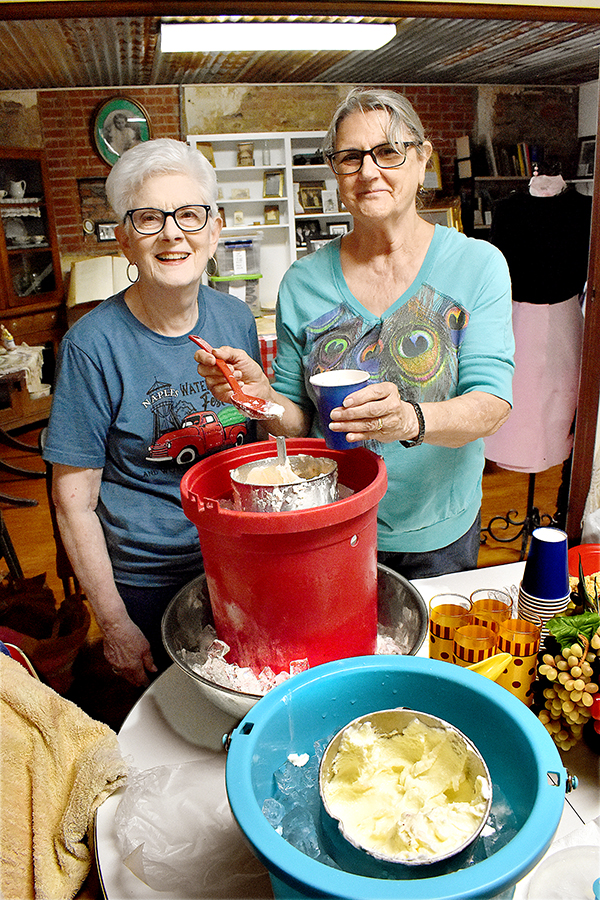
It was like walking into a script.
“They didn’t like the old jail,” Charlie Jack cut in when Marilyn said the prisoners liked coming to Omaha. They shied away from the museum’s back room, he said, where the jail cell is. Marilyn nodded.
What’s not to like about the manufactured jail cell, it’s as long as two bunks, half again as wide and just tall enough for a man to stand. There’s a door and a floor-level slot big enough to push a plate through.
That’s it.
Museum visitors can think about it while they’re looking at it, there in the back room the prisoners didn’t like. There wasn’t a Texas Jail Standards Commission when Omaha bought it.
Omaha was intolerant of drunks in the days when merchant-sponsored Saturday drawings for cash packed the town with farmers, when the Palace Saloon above D.M. Ragland’s store was advertised as “A Resort for Gentlemen.”
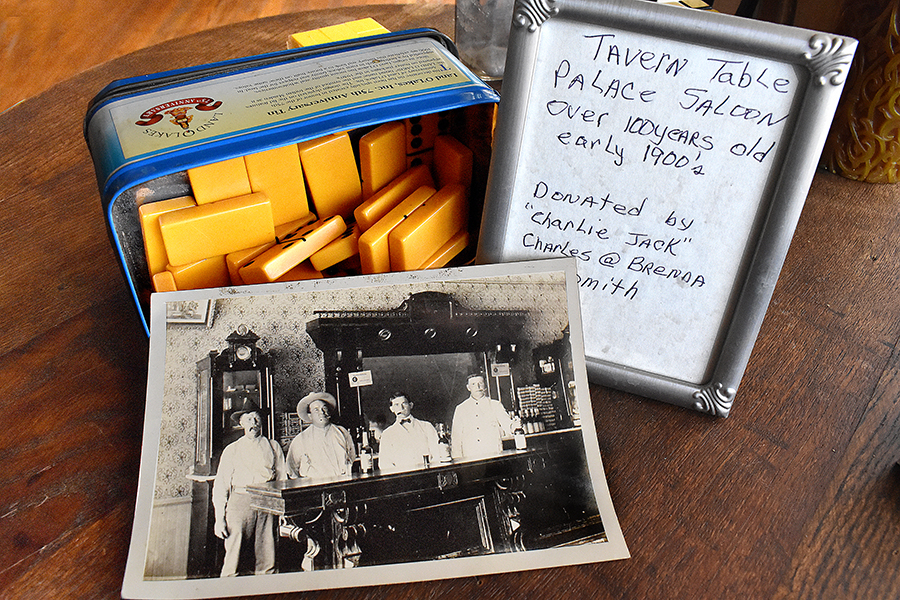
The sign on the wall said, “I solicit the patronage of Gentlemen who take an occasional drink and appreciate high class and good polite attention for which my place is noted. The trade of habitual booze fighters is not solicited. – W.L. Coffey.”
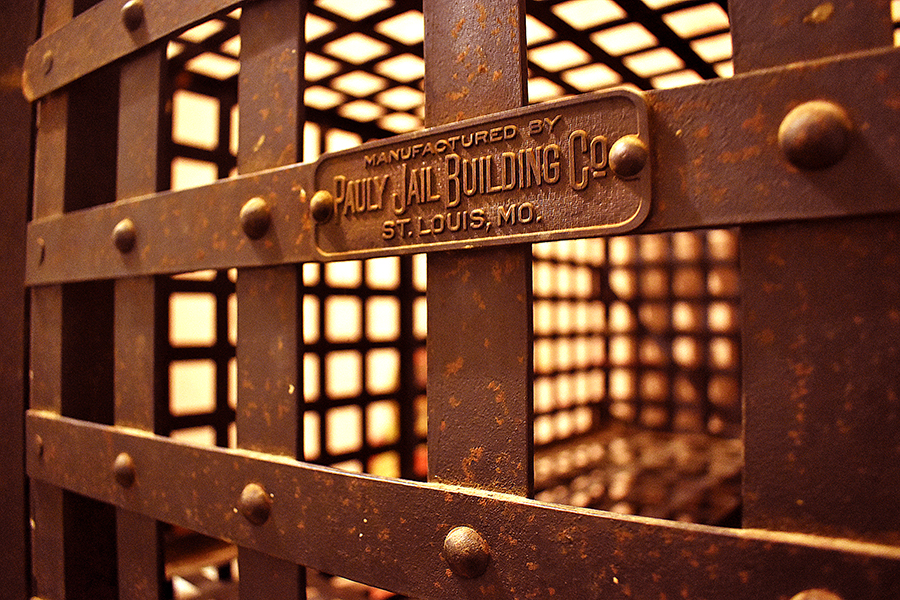
Before establishing the Pauly Jail Building Company in Saint Louis in 1856, the Pauly men were steamboat blacksmiths on the Mississippi River. They developed the “double-ribbed bar” and “tool resisting steel.”
Though famous for their “Rotary Jail” design, the basic single-cell model delivered to Omaha was of a design that could be mounted on a flatbed wagon to transport prisoners, or moved with ease to provide a shameful deterrent to their weekly crime spree of drunkenness.
On Saturdays, it was moved out on the street, where everybody could see. Passing boys chunked at the prisoners through the steel-mesh walls, Charlie Jack said. Capacity was however many men were packed in.
“Trade Day, Saturday, September 19.
“G.W. Heard wants to Gin Your Cotton,” says a framed ad from The Breeze headlined, “Bring Your Cotton and Buy Your Fall Merchandise in Omaha.”
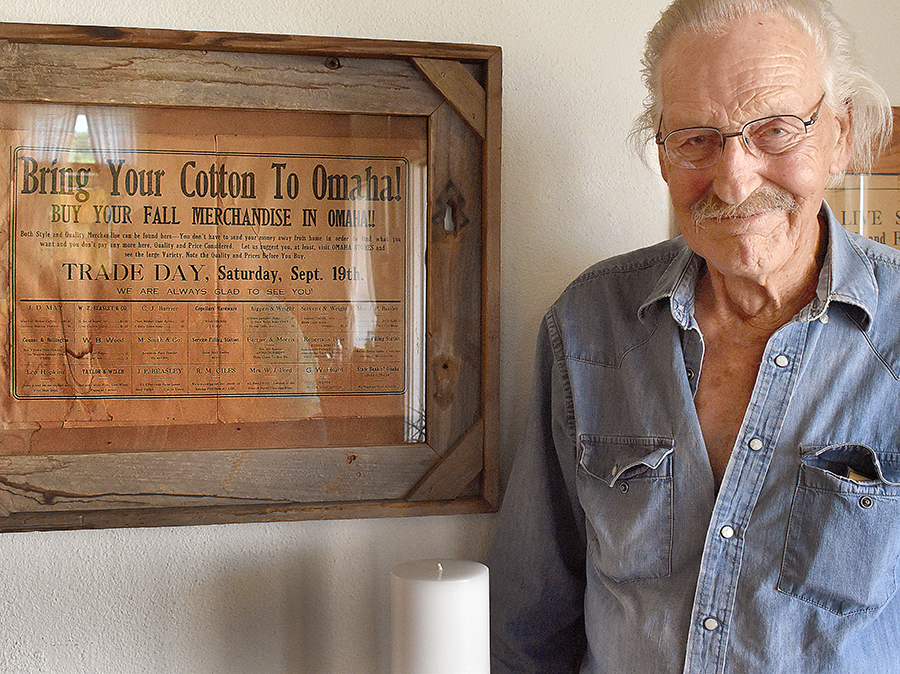
“We’d come early and stay all day,” Tommy Heard said. “Everything stayed open ’til ten on Saturday night. Kids ran the streets ’til we dropped and made pallets and slept in piles in the back of the wagon on the way home.”
Four miles down the Bankhead Highway, toward the river, M.N. Heard Dry Goods opened in Naples.
“Men couldn’t go up on the second floor because that’s where the ladies things were,” Tommy said. “Menswear was downstairs.”
As a matter of protocol, Meta Baker, a cousin to the Heard family, was the only employee who worked upstairs, he said.
Before World War II, Tommy’s dad moved the family to Goose Greek, down by Baytown, and through the war they stayed down on The Gulf while his father worked building an oil refinery when America was racing to increase fuel production during World War II.
National defense deal.
They came home after the war and Tommy’s father raised goats and traded until he went to the steel mill.
Like his Uncle M.N. in Naples, other Heard men escaped the farm as merchants.
In summers, Tommy shipped out for Baytown where an uncle had Jack Heard’s New & Used, mostly furniture but really anything, whatever might be bought and sold.
“Every summer, he’d have an old bicycle for me to fix,” Tommy said. “I’d walk to Western Auto, charge anything I needed to the store and that was how I got a bicycle to ride all over town. He’d sell it after I left.”
The summer Tommy was old enough to drive, he learned to drive the store truck.
At the port of Houston, there was an auction where buyers bought box car loads in lots.
“Uncle Jack always made friends,” said Tommy, and he wasn’t big enough to play the Houston auction until one day somebody made note and word rippled through the gallery of big buyers after he slipped from his pocket a Star of David he’d found in the pocket of something he’d bought.
“After that, they’d back off and let him buy a single car,” he said.
.There’s a massive oak desk in the back room where the Pauly Jail Cell is, and on the desk is a ledger the size of a courthouse book of deeds.
It’s from Farrier’s State Bank of Omaha and it’s filled with names and loan amounts, brief entries with as many as four and five to the page, most of the lines being lists of collateral from mules and equipment, everything from the chickens of sharecroppers who had no land to hock to the names of farms of those who did.
The Breeze says one time H.M. Farrier, J.B. Farrier, Dr. R.C. Farrier, J.B. Farrier and G.W. Heard, the gin owner, went to a meeting in Greenville where delegations from every county between Texarkana and Greenville appointed a group to hunt down the military convoy surveying a route for a national highway to be built by the federal government.
Up until then, road building was a local affair. Connecting cities along its way, the new road was to run coast to coast.
The government, reported The Breeze, was being unduly influenced by business interests in Lamar County to re-consider the “originally-designated route of the Bankhead Highway,” putting it through Paris.
In 1917 Congress created a national highway department. In 1918, accompanied by engineers needed to make river crossings, a convoy left Washington scouting the best route to San Diego, provided it dipped down South to Alabama, as directed by the Bankhead Bill written by Alabama Senator John Bankhead.
For the first time, the Fed unleashed money for road building to the states, provided they had a state highway department and some state money.
Streams of cash followed the surveyors.
Omaha businessmen prevailed upon the county court at Daingerfield “to proceed at once taking steps to gravel the Bankhead nine inches thick and twelve feet wide through Omaha, as soon as the gravel may be secured,” The Breeze reported. “It’s a mighty fine time right now while so many teams and farmers will be idle and needing the work.”
One week, the bank bought a front page ad to make sure people understood the highway “means more than a trunk-line railroad to Omaha.”
There’s a life-size cardboard cutout portrait of the town’s most legendary, somewhat fabled son, Randy Moore, the baseball major league Texan who put his hometown on America’s sports pages.
In days when Thanksgiving tradition included Tommy G’s stories of fish fries and squirrel stews at multi-family hunting camps on White Oak, “Big Randy would come over and buy a couple of hundred quail from my wife’s uncle when he brought Casey Stengel home with him to hunt.”
When he came home to stay, Randy Moore went into banking.
When Trixie Farrier reeled him in, “Big Randy married as much money as he ever made,” but he made it with more people watching between 1927 and 1937 with the Boston Braves, Chicago White Sox, Saint Louis Cardinals and Brooklyn Dodgers, as everybody already knows.
Fewer people know about the stock certificates given to the museum.
The Omaha Cotton Oil Company issued $15,000 in Capital Stock in 1904; the town became a hub for blind people coming to work at the Omaha Broom Manufacturing company backed with $4,000 in stock in 1929.
Recently, a woman brought in a check for $500 and said she wanted to support the museum, “like a church,” Charlie Jack said.