Farmers sons marched to war
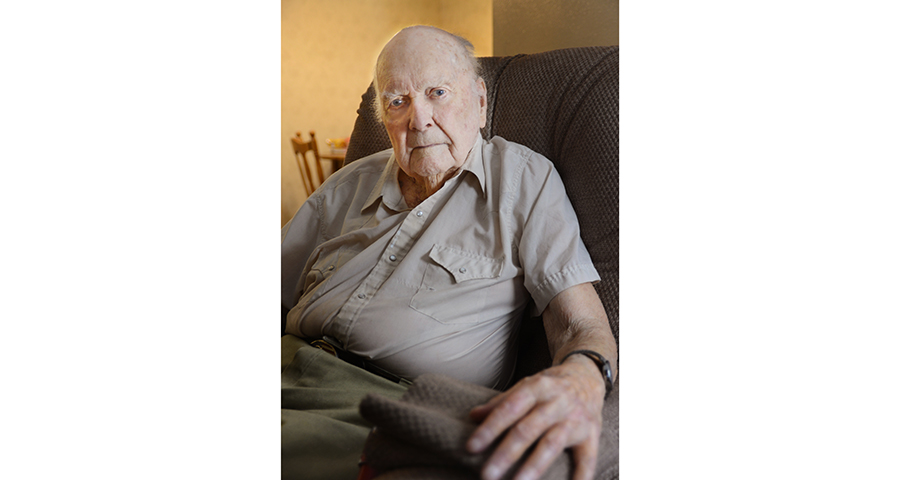
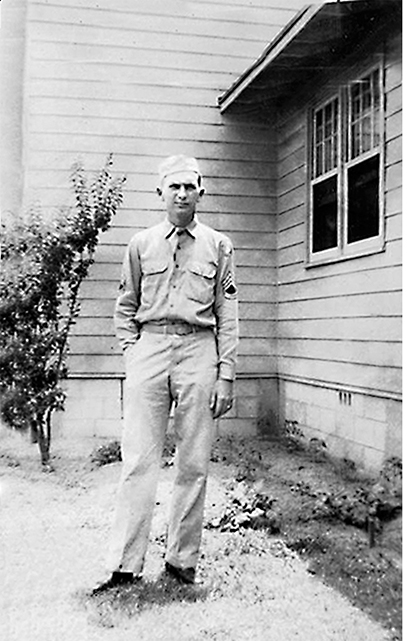
Above photo, meat wasn’t a staple when Alfred Cox was one of 13 children growing up on Titus County tenant farms where he remembers garden vegetable stews were regular fare. On high occasions, 15 diners shared three chickens.
From The East Texas Journal, June 2020
By HUDSON OLD, Journal Publisher
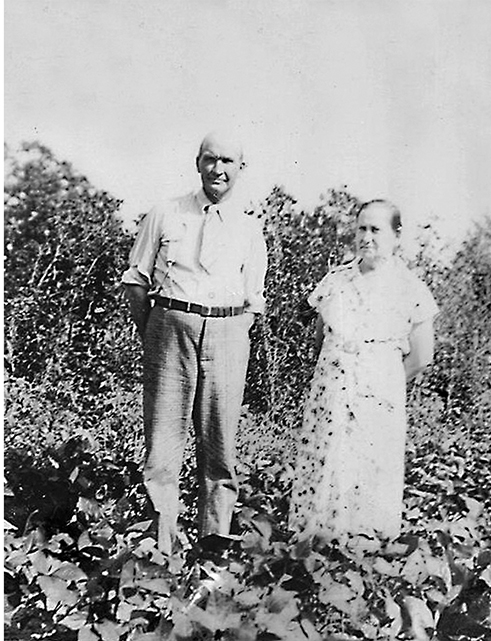
There’s more to the William Columbus Cox family than it looked like when there were 15 of them packed into tenant shacks on Titus County sharecropping farms. Born in 1880, William Columbus “Bill” Cox was 12 when he left Georgia walking, following a wagon train to Texas.
His first wife died shortly after their first daughter was born. She was 4 when he married Mary Louise Wilson, daughter of “Tie” Wilson of Cookville, well known as a man cutting and hewing cross ties for the railroad.
Among Bill and Mary Louise’s first Titus County native-born generation, their son Butler was a member of an army anti-espionage group working state-side in World War II.
“They never knew where they were going,” said Butler’s son, Kenneth. “He’d get orders to a train depot where they assembled. They’d switch trains multiple times before arriving at some airfield, typically in the middle of the night.
“They’d present orders to the guard telling him to bring out the commander and then lock the base down. Then they’d go to work inspecting planes, looking for bad wiring, loose bolts, bad hydraulic connections. They’d turn in their reports and pull out.”
Butler had been trained as an Airframe and Power Plant mechanic. He was born in 1917, when Bill Cox was growing cotton on a farm lost during the Cotton Depression. In the 1920’s, the price of cotton fell from more or less 30 cents to more or less a nickel a pound. Farmers figuring on 30-cent cotton when they borrowed to buy land went belly up.
So did Mt. Pleasant’s Merchant’s and Planter’s Bank.
Bill Cox worked on as a sharecropper leasing land “on thirds and fourths,” said James Alfred Cox, a son born in 1922. Under those terms, the land owner collected a third of grain crops and a quarter of the cotton crops of his tenants.
One of four sons serving in World War II, Alfred Cox had seven brothers and five sisters.
They moved a lot, following whatever opportunity Bill Cox could find on places mostly along or north of today’s U.S. 67. Alfred was born at Oak Grove, not far from the old church converted to the art society center on FM 1402.
“We grew up all over,” he said. When he wasn’t in the family fields he made cash working for neighbors. By his teenage years, he was employed at Butternut Bakery, after he’d saved enough to buy a second hand Model A Ford.
Alfred is 98. He’s outlived his brothers, sisters, his wife and their only son.
Working the 13-hour 5 p.m. to 6 a.m. Monday-Saturday shift at the bakery, he made pastries. Fifty cents an hour beat farm wages. By the time he went into the service at 20, he’d made so much money he’d bought a four-door, 1933 Ford Coupe.
“One of those with suicide doors,” he said. (Rather than hinged on the center post, suicide doors were hinged at the back, a design making it possible to blow one off if opened at road speed.)
World War II made him a world traveler shipping out from New York’s Staten Island and going ashore on the Mediterranian Coast, not far from Algiers, a port city going back three hundred years before Christ, when Rome was a world power and this was their toe-hold on the African continent.
While there, his unit slept in fear. At night, the city was blacked out so its lights wouldn’t give German bombers an easy target.
They camped in the desert outside of town, slept on the ground.
“They’d just about beat the Germans but they filled our heads with stories about poison tarantulas and stinging lizards,” he said. Fear was more useful after they crossed the sea, invaded Italy where he cooked with a gun on his shoulder.
He was there in 1944, when the volcano that buried Pompeii in 79 AD erupted. A shade under 2,000 years later, Alfred Cox saw Mt. Vesuvius come uncorked again.
People died, buried in ash.
“Before it blew, we watched German planes dropping bombs in the crater,” he said, and he wondered then if that made it blow.
He still wonders.
By the time Mt. Vesuvius blew, Alfred was a seasoned soldier.
Born in 1925, his brother Myrdth Fred got into the war that year. Fred Cox was an infantry rifleman. Both he and Alfred liberated France, following the June 6, 1944 Allied invasion at Normandy. By the winter of 1945, Alfred had marched to the edge of Germany, an advance delayed by the Battle of the Bulge, the last great German offensive.
Fred’s war ended after he was wounded in France. He was awarded a combat infantry badge and a purple heart.
After the war, he came back to Mt. Pleasant and opened a garage with his younger brother Kenneth, not to be confused with his nephew Kenneth, known as Ken, the son of Butler. Born in 1927, Kenneth Cox joined the service in 1945 and was shipped to Europe after the German surrender.
Fred died young, at a veteran’s hospital in Dallas.
Butler’s son, Ken, was born in 1945 at Hunter Field, an air base in Savanah.
Back in Titus County, as a boy Butler Cox had first worked at Hogue Pottery in Winfield, and then in the Titus County oilfield before becoming the first of brothers to join the service. Only because of a twist of fate did he live to have a son.
He was trained to maintain and repair B-17’s, the American Flying Fortress. While in school in New York, he met Helen Carstarphen, a woman with standing to be a Daughter of the American Revolution. She was of straight line descent from a Scottish surgeon who’d fought the English back in Europe, then escaped to take refuge in the New World where he surfaced only after the American European ended English rule.
Butler had taken leave for the wedding when his unit shipped out. All were lost at sea.
“That was my mother’s story of how she saved his life,” said Ken.
After the war, Butler and Helen went to New York where Butler worked for Capital Airlines, which later merged with United Airlines.
“They went to New York because there wasn’t much call for large aircraft mechanics in Titus County,” Ken said. They moved back to Texas after he found suitable work in Fort Worth.
Ken grew up in the Metroplex and was working as a bowling alley mechanic when he decided to see if he might follow Butler’s career path.
“I signed up for airplane mechanics at a school in Arlington,” he said, and showed promise as a welder before learning the Air Force would train him. In 1964, his military aptitude test made him a prime candidate for the Air Force electronics school. In the last days before satellite communications, he went to work for the military setting up microwave communication towers.
After 9-11, he re-enlisted. During the Gulf War era, he served with a Contingency and Wartime Mobility Airfield Operations Management team. His unit bounced around, working from Europe to South America, on islands off the coast of Saudi Arabia.
“There were a lot of things going on,” he said.
He said that as a soldier, his Uncle Alfred marched all the way up the Italian boot, that he was in Naples, Rome, then France and Germany, that he was awarded the American Theater Campaign Medal with four Bronze Stars, that he earned a Good Conduct Medal, a Victory Medal and a Meritorious Unit Medal.
“I had to research the archives to find all that,” he said. “Uncle Alfred doesn’t say much about it. If you ask, he’ll just tell you he did what he was supposed to do.”
Alfred came home, worked concrete some. He married Doris Newman, daughter of Lester Newman.
“Her Newmans were one of the families in the wagon train my daddy followed to Texas,” Alfred said.
They married in 1950. They moved to Longview where he partnered up and went into the monument business.
One of his brothers, Clifton, had weak eyes.
“For a while, Clifton had a café in Mt. Pleasant,” he said. “He had what we called a goggle eye.”
The monument business was good and by the time Alfred began losing his eyesight, they had a nice home in Longview Heights. He could see well enough for the close quarter work of setting monuments but he gave up driving nearly 40 years ago.
So he hired a driver and he kept working, setting monuments in cemeteries as far away as the Metroplex and the Texas coast, in Arkansas and Louisiana.
“We got work everywhere because we made a reputation for good work,” he said.
He sold out to his partner. He bought a service station that he ran for a while with the son he outlived. He and Doris came back to Titus County and bought a place in the country.
They were married for 53 years, too short a time.
At 98, he can tell you their time together wasn’t enough.
“It was so peaceful,” he said.