National championship Coach Robert Caskey had game day with Don Meredith
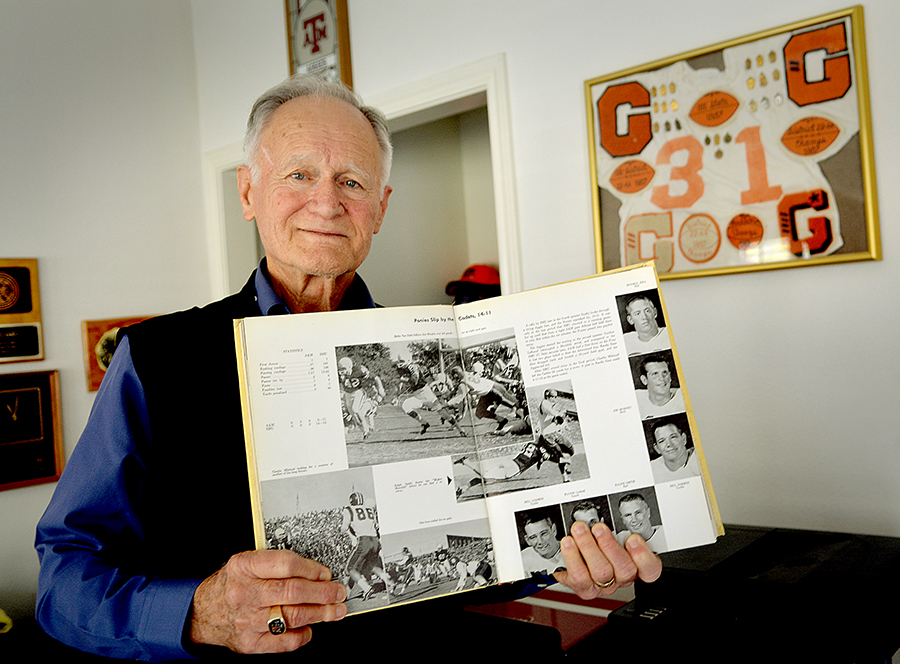
Above photo’ the centerfold shot of his Aggie Yearbook featured Robert Caskey’s A&M roommate tackling SMU quarterback Don Meredith at the line. After A&M, Mr. Caskey became a coach and award winning writer for his Texas Coach Magazine story, “What it means to be called ‘Coach.’” Coach Caskey retired in Franklin County.
From the East Texas Journal, November 2017
By Hudson Old, Journal Publisher
Backdrop: A century before Robert Caskey came of age in Gonzales, his hometown was etched in Texas lore. In September 1835, a citizen militia confronted a company of 150 Mexican Army regulars who’d come demanding surrender of the town’s cannon. Instead, the locals loaded the cannon with chains and scrap iron, touched the wick and fired the shot that began the revolution. By then they’d had time to make and run up the first Texas fag, a picture of a cannon inscribed with the invitation, “Come and Take It.”
So the Mexicans did.
For the length of the war, the Texans didn’t win a battle until the last one at San Jacinto.
The way it was in his day boys in Gonzales grew into unquestioning patriots. In their junior year, when they turned 17, they enlisted in the National Guard. They drilled weekly. Each summer they went for two weeks of war games at Fort Hood.
“We owed Uncle Sam time,” Mr. Caskey said.
So he was seasoned in military protocol when he marched off to Texas A&M as a cadet at an all male military institute known also for rigid discipline in academic pursuits.
MT. VERNON, TEXAS – Robert Caskey was a Texas A&M defensive back and an offensive “blocking back” when hometown legend Don Meredith played quarterback and defensive safety at SMU, when everybody played both sides of the ball.
Later on, Mr. Caskey earned a gold National Championship ring at the end of his single season as a college coach. Meanwhile, Dallas Cowboy quarterback turned Monday night Football color commentator Don Meredith became an American icon.
“I got to play against him as a sophomore at A&M when he was a senior at SMU,” Coach Caskey said. The Aggie game strategy was direct, as was everybody’s. “The only way anybody could beat SMU was to stop Don Meredith.”
“It wasn’t the same game then,” Coach Caskey said. A dedicated ref was assigned to either bench to enforce the “Substitution Rule.”
“We lined up and the ref made note of everybody starting the quarter,” he said. “If you started the quarter, you could come out once and go back in. If you didn’t start the quarter, if you came out you couldn’t come back in until the start of the next quarter.”
The Substitution Rule generated a nearly universal game plan involving mass substitutions.
“Nine or ten minutes into the quarter, the starters usually came out for a breather and the second team went in,” he said.
Now a retired school administrator, Coach Caskey lives south of town, in the general direction of Scroggins.
During the 1950’s high school era that Coach Caskey played on championship teams in four sports for the Gonzales Apaches, Don Meredith was calling plays in the Mt. Vernon Tiger huddle.
It was a simpler time, before play diagrams turned into calculus.
Long-ago Mt. Vernon offensive back Dalton Banks remembers a high school night Meredith called his number.
“Dalton,” the play caller said, “go south up the middle and don’t slow down ‘til you get home to Scroggins.”
The running game was the game.
Texas coaching legend Darrell Royal summed it up in the early 60’s.
“Three things can happen when you pass,” he said, “and two of them are bad.”
“Even after I got to A&M, 90 percent of the game was on the ground,” Coach Caskey said. “Everybody ran the same sweep behind inside blocks of your wingback and right end. The left guard pulled to the right to lead the play and everybody coming out of the backfield – including the quarterback — blocked outside to open a hole for the running back.”
In high school, he was an All State running back in 1957, the year the Gonzales Apaches finally got past Lockhart for a district title, then went on to win the state championship.
“It was all the better because for two consecutive years we’d gone nine and one losing our last game to Lockhart for the district championship,” he said. Only the district championship team advanced to the playoffs.
The patriot underpinning he brought from Gonzales was honed by the richness of tradition at A&M.
The only privilege he enjoyed as a freshman was being allowed to wear jeans and loafers on campus, a right reserved for the football team.
“We were all cadets and everybody else had to wear their Class A uniform,” he said.
Freshmen were wholly subservient.
He was not excused from coming to attention and saluting when meeting an upper classmen.
“You saluted and addressed him as Sir and Mister and called him by name,” Coach Caskey said. “If you didn’t know him you offered a handshake and if he took it you introduced yourself. If he answered and introduced himself, you asked where he was from.”
There were 8,000 to 9,000 cadets on campus; forgetting the name or hometown of an upper classman was an instant opening for a command to drop to the ground for push-ups. Freshmen routinely served as couriers, porters or valets shining boots in the dorm.
Not everybody could stick it out.
“I can’t explain how much respect I always had for freshmen,” he said, “because as an upper classmen I knew what they were going through. At night I remember hearing guys packing up and going, dragging army trunks down the hall on their way out the door.”
Degree in hand, in 1962 he took his first job as an assistant coach. He worked three years in San Antonio and three years in Temple. Over and above classroom pay, coaches typically earned another $500 to $1,000 a year. After school and practice, they did laundry. They came early and worked late.
Six years in, he got a head-coaching job at Ganado, a 2A school south of Victoria on the Texas Coast.
“My first year we won the first district football championship in forever,” he said. “The next two years we tied for it and both years lost a coin flip to see who advanced.”
His record brought him to the attention of Texas A&I Hall of Fame Football Coach Gil Steinke, a Ganado alum who hired Coach Caskey as his line coach.
They won a national championship, an irony in the sense that it provided a springboard for Coach Caskey to hang up his whistle and return to Gonzales as the assistant superintendent.
“Career wise, there was more opportunity in administration,” he said.
The next year he was again in San Antonio where he’d been known as a coach before returning as a high school principal.
He retired as a school principal in Daingerfield and moved to Franklin County in the 1990’s.
When A&M played LSU his junior year, he played against Heisman Trophy winner Billy Cannon.
“On the defensive side of the ball that afternoon, I never touched him,” he said.
Of all the stories, a spring afternoon in the dorm at A&M sticks out as the most poignant.
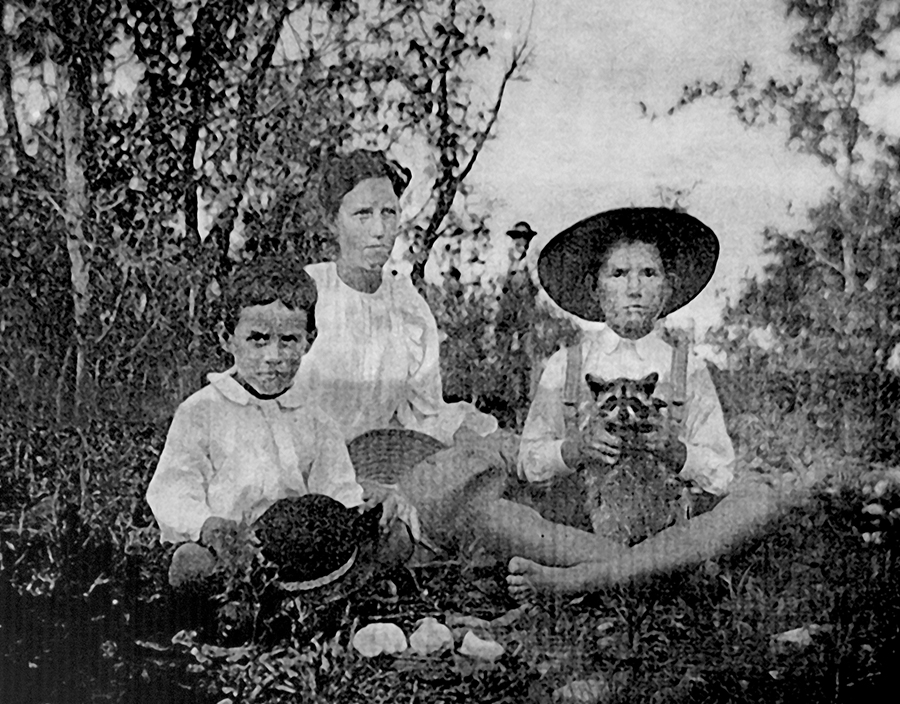
His daddy had told him about his great Uncle, James “Pinky” Wilson, the Aggie who wrote Aggie War Hymn.
A legend in College Station, while hunkered down in a battlefield trench in France on the front line of World War I, he wrote the lyrics to a song he called “Goodbye to Texas University” on the back of a letter from home.
After the war he returned to A&M and in 1919 organized the “Cast Iron Quartet,” which frequently performed the song subsequently picked up by the cadet corps yell leaders as the school’s unofficial fight song.
It’s been unofficial ever since.
“Hullabaloo Cuneck! Cuneck!”
Whatever the opening line means, no Aggie needs hear more to break into the lyrics and follow the melody.
“I’d always wondered if my dad was kidding about him being my great uncle,” Mr. Caskey said. “I was in my dorm room – it was a spring Saturday. Somebody knocked on my door and when I opened it there he was. I couldn’t have been more star struck – I wanted to introduce him to everybody but . . . it was a Saturday after the season, a free day and everybody was out.”