Coffee Culture
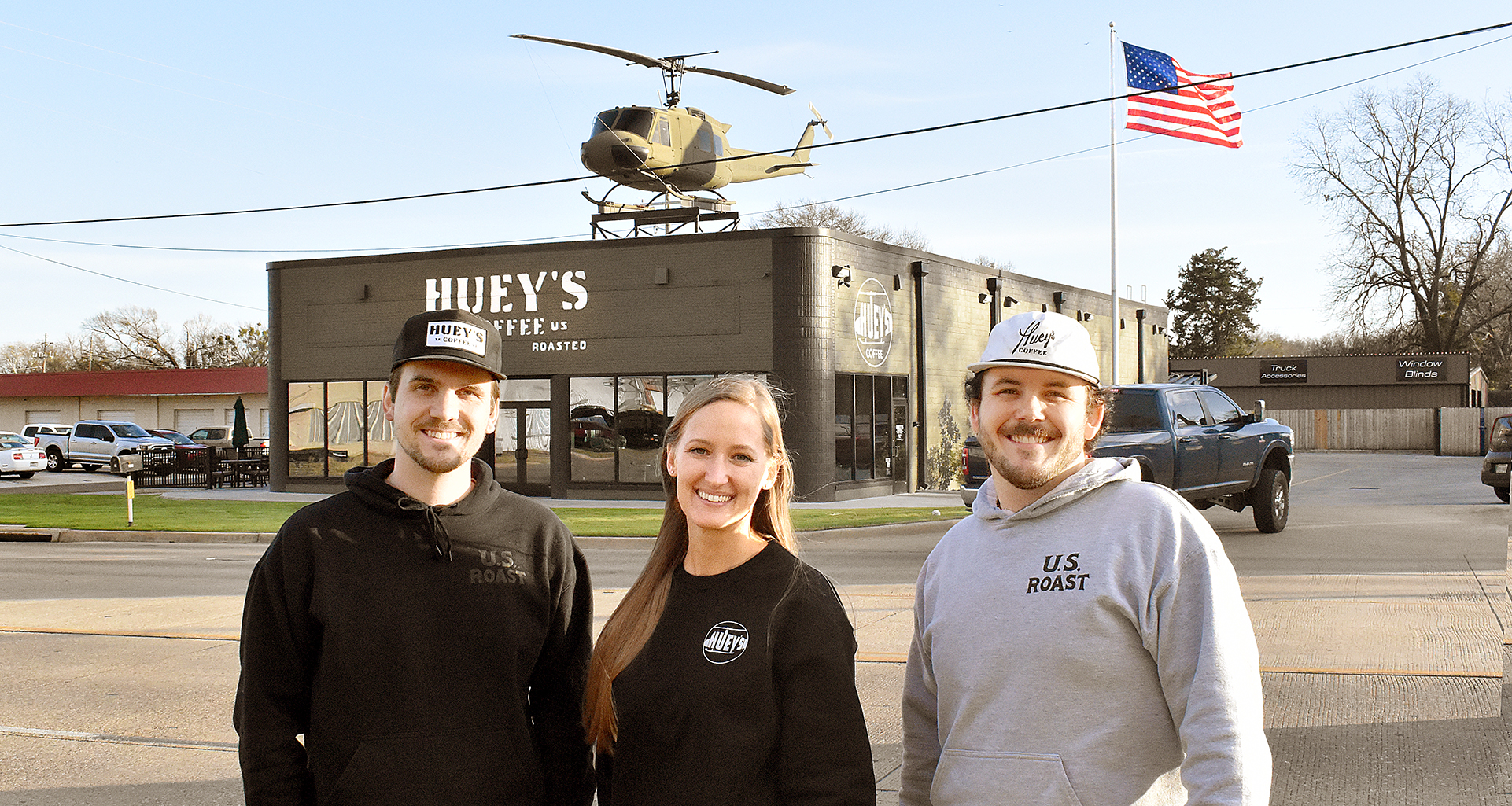
Above photo, the helicopter atop Huey’s Coffee made Joe Dalby’s one-time Mt. Pleasant Studebaker dealership a U.S. 67 a landmark restoration. Its rounded corners are characteristic of Mid-Century Modern architecture of the 1930’s. From left are Huey’s COO Sam Burrow, Operations Manager Jennifer Maguire and CEO Will Burrow.

Special to the Journal
MT. PLEASANT, TX-We open on the helicopter.
The aircraft sitting atop a squat, olive-drab building in Mount Pleasant is, technically, a Bell UH-1 Iroquois. More specifically, the one perched on the coffee-shop roof is a UH-1H variant—the last of the Hueys. The airship’s original Army designation was HU-1 (thus “Huey”), but the military loves doing perfectly unnecessary things, like renaming Helicopter, Utility to Utility Helicopter. The nickname stuck; the formal name didn’t.
The Army frequently assigns Native American names to its non-fixed-wing aircraft—Black Hawk, Chinook, Apache—but few people have ever heard of the Iroquois. Almost everyone knows the Huey. Vietnam movies turned its chop-chopping blades into shorthand for the war itself.
Before you ever read the mission statement for this chain of East Texas coffee emporiums (and one in Ohio—we’ll get to that), the branding washes over you. Hot coffee. An iconic ’60s- and ’70s-era flying machine. OD green everywhere. The idea… lands.
Walking inside, I look up and wonder whether the helicopter was airworthy when it arrived or needed a final nudge to claim its new lease on life. You can see it from US 67. I haven’t met Huey’s owner, Scott Glover—and won’t for this story; he’s an extremely busy guy—but anyone who crowns a military-themed coffee shop with an actual helicopter has wandered past eccentricity and into a private conversation with his own better angels.
The results are tangible. The Apache Frappé (white chocolate, vanilla, and cherry blended with espresso and whole milk). And by the end of this year, ten Huey’s locations—twice as many stores as Starbucks had when it was four and a half years old.
The coffee served at Huey’s is roasted just down the road, and many of the people handing it to you are local college students, reminiscent of Starbucks in its infancy. Back in the nineties. Brothers Will and Sam Burrows, who run regional coffee supplier US Roast (also owned by Glover), pitched him on a chain of coffee shops during the pandemic. Glover green-lit the idea, hired operations manager Jennifer Maguire, and built the first Huey’s in his front yard. (He does things like that.) The building was trucked to Gilmer, and the first Huey’s opened in May of 2022.
Glover lured Maguire away from a hospital job as a patient advocate. Now she’s advocating for entire communities. Her title understates her role, which she describes as investing in the towns where Huey’s operates. During our interview, Maguire wanted to be sure I understood the philosophy: Huey’s takes care of its employees, who in turn take care of the customers. “Coffee is a luxury,” she said. “Nobody has to stop in here and buy it from us.”
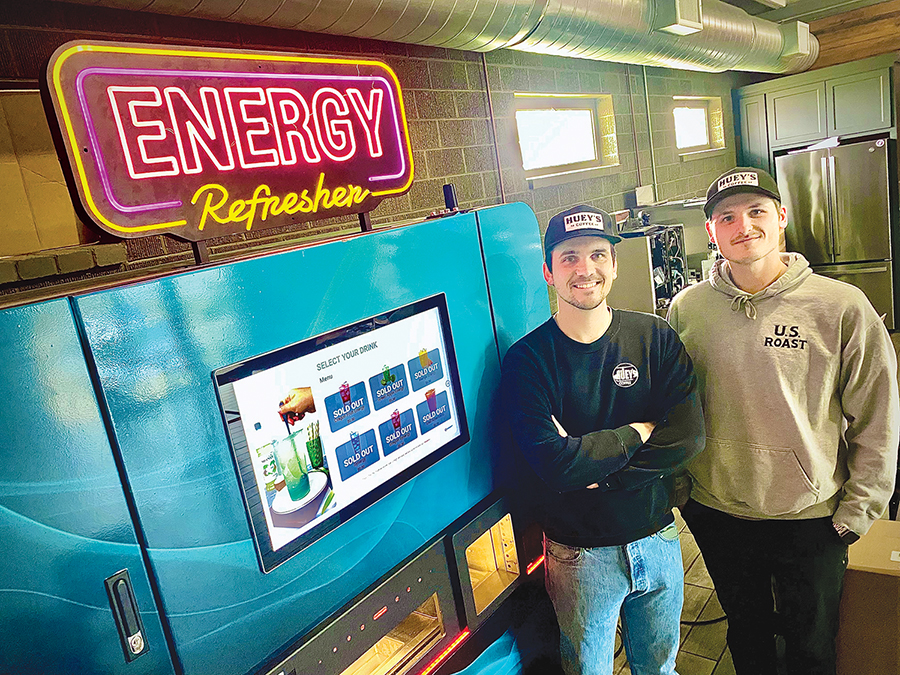
I’ve seen the strategy before; I just haven’t seen it often enough. A business doing right by its community, its employees, and its customers. That approach usually leads to money. I suspect Maguire will be able to retire early. She won’t—but she could.
Huey’s feels like a big brand, writ small—almost as if a giant corporation had decided to test a new, zeitgeisty concept in Mount Pleasant instead of Manhattan or the Mission District. A sneak attack before the rest of the world noticed. The store in Urbana, Ohio, also wears its own helicopter. Urbana is roughly the size of Mount Pleasant and serves as the maintenance base for the Huey’s and dozens of other aircraft owned by Glover’s Mid-America Flight Museum, which is headquartered in Mount Pleasant.
Maguire patrols the Geezerplex locations in a company pickup, keeping pilot stores running, paperwork current, and barista tempers in check. When we spoke, she was headed out the door to the newest Huey’s in Paris, Texas, which will be open by the time you read this.
“Coming soon to a city near you?” I asked. “I could see one of these places in Times Square.”
Maguire offered a polite frown that somehow doubled as a smile. “We’ll be up and running in Marshall before summer and are looking at ten stores in operation by the end of the year.”
Selling coffee is one of those businesses everyone assumes is a gold mine, and it certainly can be—if you know what you’re doing. Everybody’s favorite coffee monger moves roughly $35 billion a year through 40,000 stores. But nobody in small-town America has enough fingers and toes to count the number of independent coffee bars that have come and gone from their town squares over the past decade. Like any food-service business, selling coffee is hard.
Branding isn’t an idea. It isn’t even necessarily a way to sell things. Branding is a conversation. Huey’s engages its patrons in a way that turns customers into friends, and friends into what marketers—inelegantly—call stark-raving fans. You can’t buy that kind of loyalty with advertising. Read the mission statement again. It’s all there.
Maguire, 34, is a busy career woman. Huey’s would earn A-plus grades from most secret shoppers, a level of execution that requires more work than many managers are willing—or able—to put in. The coffee is consistently excellent. The baristas are genuinely friendly (as employees tend to be when they’re paid what they’re worth). And the place hums with community—like a McDonald’s with a pulse.
People linger longer at Huey’s than in most coffee shops. You can feel the mission statement working just beneath the surface: less phone-surfing, more human interaction. The rich, just-this-side-of-muddy-in-a-good-way coffee comes with an uncomplicated menu of genuinely good food. There’s more happening here than pleasantries, in a space that feels almost defiantly anti-internet.
Is the world ready for this?
I hope so.
This place is great.