Cajun immigrant adds Atchafalaya holiday tradition to home at Nelta, Texas
From The East Texas Journal, December 2013 EditiBy Hudson Old, Publisher
NELTA,TEXAS –Back on the Atchafalaya, Louisiana, the Gremillion family Christmas tradition included the butchering of three suckling pigs dressed with the head on, eyes and ears removed, skull cleaned. They saved and washed the stomach, stuffed it with dirty rice.
Scalded and scraped, the pigs were baked in a steaming pit, smoked in their skin.
“The fat under the skin gives the meat flavor,” said Peter Gremillion.
Toward the end, the pre-cooked dirty rice sewn into the stomach was put back in the body cavity. Cherries went in the eye sockets, an apple in the mouth, then served with a carrot for a tail.
They smoked three because Peter Gremillion’s father had become wealthy during the war. The first two were gifts for the Christmas dinner tables of neighbors, the third was theirs.
They were prosperous people in part because of what they knew of living from the land.
They butchered beef sold in their country store five miles south of Simsport on Louisiana Highway 1. His mother ran the business when his father left for WWII.
Before he hit his teens, Peter and his brothers knew how to kill a hog, render lard, make bacon and preserve hams. He learned to use the heart, lungs, liver and kidneys as ingredients in sausage, boudin and hog-head cheese.
“You’ve gotta be careful with hog liver,” he said. “It’s strong.”
Back on the bayou, a cast-iron skillet was a playtime essential during crawfish season.
“You know how it is with boys playing,” he said. “We were always hungry.
“The way you make an oven in the bank of a ditch to bake crawfish, you dig a little cave in the side of the bank. Then you get a long stick and poke a little chimney hole about as big as your thumb down into the cave. Then you build a hot stick fire in the cave, arrange your crawdads on top of the bank around the chimney hole, then turn the skillet upside down over your crawfish.”
The way his father became wealthy when he was called into service and left Avoyells Parish for war overseas, he never spent his pay. He came home in one piece and used his savings to buy a 400 acre plantation.
“My four brothers are still down there,” Mr. Gremillion said. He said they now have 800 acres. “They grow corn, soybeans and run some cattle.”
A Cajun with a mind for numbers, in the 60’s Mr. Gremillion earned his bachelors in mathematics at the University of Southwest Louisiana in Lafayette. He studied physics, minored in history and signed up for both of the new computer science classes as electives.
The potential for machines that could file, sort, search and analyze data using mathematical calculations made as much common sense as building a creek-bank oven with a skillet.
“It looked to me like something that should catch on,” Mr. Gremillion remembers, so he went to California because that’s where the computer work went.
Coming of age at the height of the Cold War, the earliest commercially-produced Main Frame computers were the direct-line descendants of a team of World War II Navy engineers who designed machines that helped make calculations in breaking German and Japanese codes.
One was Seymour Cray, who built prototype “naval tactical data systems” before moving into private-sector production with Control Data Corporation. Developed in 1960, the CDC-160 was arguably the first commercially-produced computer.
In the 1960’s, America was in the midst of a space race with the Soviets. Arriving in Sunnyvale, California in 1966, Mr. Gremillion went to work for a new division of Lockheed, testing, installing, trouble-shooting and training operators using the CDC-160 as tracking stations for satellites.
From Lockheed he moved to a company manufacturing auto, radio and television parts that was branching into satellite construction.
Business boomed – California put computers in hospitals, banks, warehouses – “You name it,” Mr. Gremillion said. The Silicon Valley was being born.
“There were so many new people coming I went to work in real estate as a sideline,” he said, inadvertently contributing to the overcrowding of California.
It was the 1980’s, and while California was getting crowded, the family dairy farms along the edge of the Blackland Prairie of northern Hopkins County were dying off. In 1987, Mr. Gremillion bought an abandoned dairy farm near the ghost town of Nelta.
Nelta, Texas is on Farm Road 71 fourteen miles northeast of Sulphur Springs in northeastern Hopkins County. It was first settled by Howard Hargrave in 1843. A post office called Pleasant Hill was opened by Daniel Hudson in 1849 and closed in 1866. Another post office named Nelta was granted in 1884. By 1892 the community had a mill and cotton gin, a general store, a physician, a barber, and a population of twenty-five, Says the Texas State Historical Association.
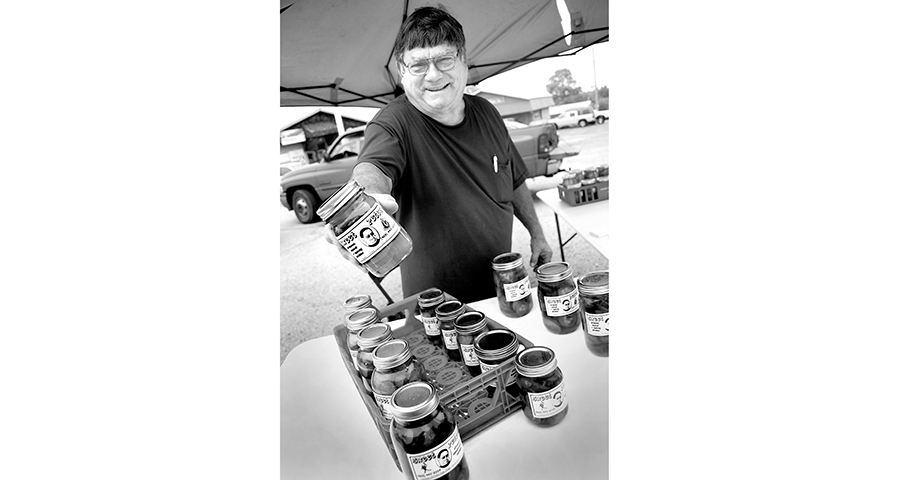
He ran cattle and made hay. He spent most of the summers of the next 20 years trucking, hauling hay from the coal mine reclamation meadows at Winfield to cattlemen across East Texas. He works farmer’s markets, selling honey and pickles he made.
“I stay busy,” he said.
Since selling out his cattle in years of back to back drought, he worries less about his fence rows. He carries a single-blade Case folding knife he picked from the gravel on the shoulder of the highway.
It was probably passing traffic that broke the handles off his knife, but the blade’s good and the hinge works well.
It’s a fine knife, well made.
A length of tulle used like bunting veils a string of white Christmas lights strung from the mantle above the hearth in the living room.
“The lights make me think of snow,” Denise Gremillion said. Three trees are arranged with a small Santa in the middle, Nutcrackers on either side, and two stockings are hung. She made a wreath.
There’s a garland about the curio with her doll collection.
The scent of heavy spices radiates from the kitchen where he’s making 27 pounds of sausage.
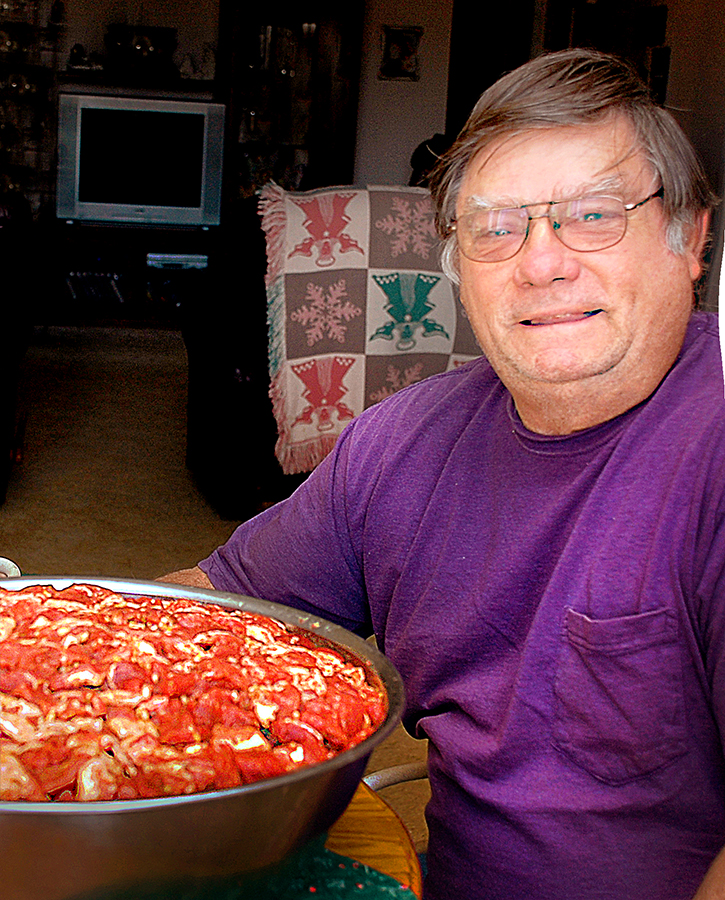
“Pork butts were on sale,” he said with the satisfaction of a man who found a great deal. After deboning and cutting the meat into thumb-sized chunks, he begins each of the next three mornings mixing and folding in his spices, adding water for moisture as he works the meat.
He gets his sausage casings from a Mennonite in Wood County.
Mrs. Gremillion has set out her crystal on the dining room table.
She has arranged the pictures unboxed for the season on her grandmother’s sewing machine. The first photo was taken of her with her sisters and Santa. The next is her children with Santa. The third is Gremillion grandchildren with Santa.
Satisfied with the progress of his sausage, Mr. Gremillion returned the meat to the stainless steel bowl, covered it again with the cellophane he’s saved since unwrapping the roasts when he got them home.
He was mildly concerned about the grinder he’d be using the next day, when he cased his sausage.
“A sausage grinder’s harder to sharpen than scissors,” he said. “It’s got to be just so-so.” Otherwise, it clogs and clogging interrupts the seamless flow of grinding that accounts for the texture of the meat, which is a critical thing.
This needs to be right.
“Our daughter Charlene,” he said, “she’s coming in from California. I’ll probably have to make more sausage when she’s gone, because she’s probably going to take all she can get back.”
Thinking of that, he smiled, forgetting for a moment his concerns about his grinder.