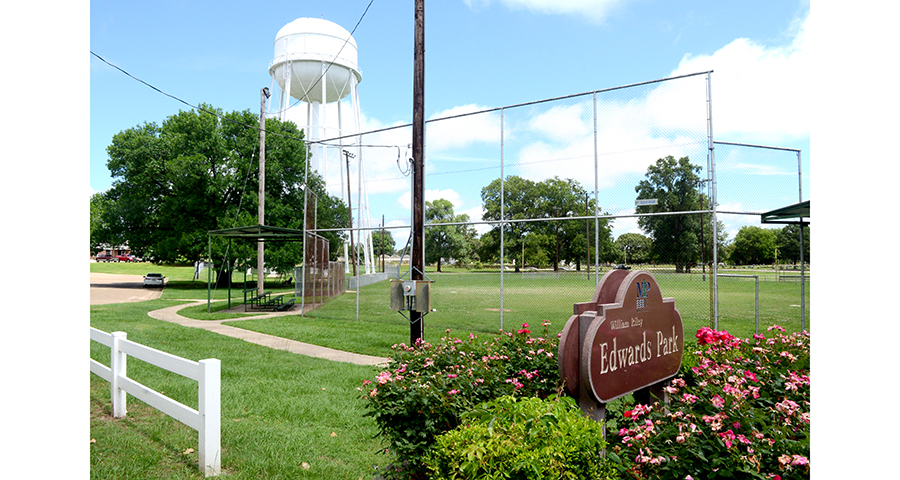
Mt. Pleasant, Texas CCC Camp built at Edwards Park donated by the Sheriff Colonel Bill Edwards who brought an end to outlaw era after Civil War
Frome The East Texas Journal, November 2013
By Hudson old, Journal Publisher
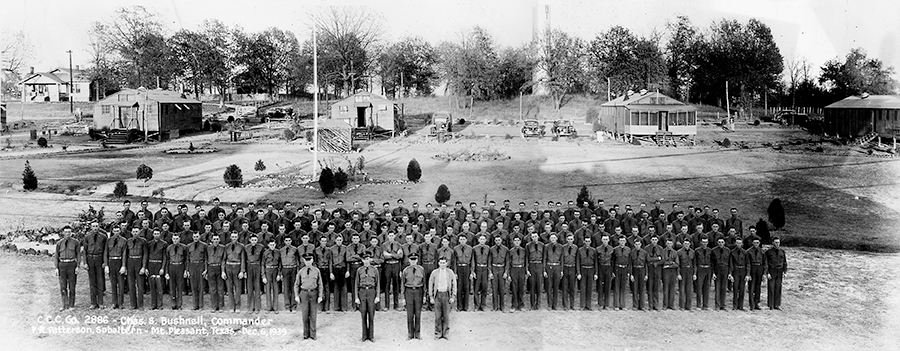
The only lawman to hang outlaws in Titus County gave the city land for its first public park, land that became the site of Mt. Pleasant’s CCC camp in 1935.
Born in 1837 in Tennessee, Colonel Bill Edwards rose through the ranks during his service in the Confederacy and came to East Texas shortly after the close of the war.
He worked as Sheriff Jim Brown’s deputy until being appointed sheriff after Brown resigned in 1871 during the rise of lawlessness and local outlaws following the war.
Colonel Edwards was voted out of office in the wake of a shootout and lynching near Cason. His long-standing nemesis that day was a native of Titus County, Abb Stephens.
Ten years earlier, on May 3, 1872, Sheriff Edwards hanged an outlaw named James Rowland who was tried and convicted for the murder of an unknown foot peddler.
Historian Traylor Russell attributed the rise of lawlessness in Titus County to yet another native, Ben F. Bickerstaff.
“During the years following the Civil War, Ben Bickerstaff along with Cullen Baker, Bob Lee and others created in Northeast Texas what the newspapers came to call ‘The New Rebellion,’” Mr. Russell wrote.
In 1867 at Sulphur Springs, the band captured a military supply train bringing supplies to Union troops occupying East Texas during the decade of Reconstruction that ended in 1875. In 1868 they killed five Union soldiers in a battle near Sulphur Springs. Federal re-enforcements streamed in for occupying forces headquartered at Jefferson and companies of additional soldiers were stationed in Clarksville, Sulphur Springs and Mt. Pleasant.
Born at Snow Hill in 1850, Abb Stephens was the son of Josh Stephens, an attorney who moved his practice to Mt. Pleasant after the war.
Sheriff Edwards was in office when Abb went to work at the Cleland and Smart Saloon.
“He had a past record of drunkenness and fighting and was considered a troublemaker,” said Russell, a consideration proven true when he was charged with the bar-room murder of two men named Jones and Barnett.
He was never tried and it was said that the killing launched his flight from Sheriff Edwards and Titus County and marked the beginning of his days as an outlaw working largely across the Red River in Oklahoma, the leader of a mixed gang of Indians, a childhood friend named Jim Donaldson and a freed slave whose name was never recorded and who escaped the shootout that ended Abb’s days in Titus County.
Robbers and horse thieves, his band operated mostly in Oklahoma and fled often to refuge in the remote area of Titus County where the town of Cason came to life with the coming of the railroad in 1879.
Given the limited manpower of his office, Sheriff Edwards organized gathering places for vigilantes he could summon to form a posse to pursue law breakers, which was what happened following a day of violence at Cason.
“Abb Stephens Trees Cason,” Russell titled his account.
“When outlaws through the influence of whiskey and general meanness caused the good merchants of a town to close their businesses, go home, blow out the lamps, pull down the shades and get out their Winchesters, it was said that the outlaws had ‘treed the town,’” Mr. Russell said. “Abb Stephens and his gang treed Cason about 1881.”
As related by Judge R.T. Wilkinson, one morning Stephens and three members of his gang rode into Cason and occupied one of the saloons, drinking until inspired to fire off pistols and have horse races along boardwalks through the afternoon. Merchants shuttered the windows, locked the doors and went home but the outlaws wouldn’t allow the saloon keeper to close and remained there into the evening.
As told by Judge Wilkerson, someone rode into Mt. Pleasant and alerted Sheriff Edwards who gathered his vigilantes at the home of Judge Wilkinson’s father, a physician who’d once settled and practiced in the old ghost town of Snow Hill, a one-time place many believe to have been the first town in Titus County.
Sheriff Edwards, Russell said, knew exactly what he was riding into.
“He and Abb had had differences, and Abb had already sent word that he was going to kill the sheriff at his first chance,” Mr. Russell said.
They overtook Abb’s gang the next day, on the road into Daingerfield. Jim Donaldson was captured and an Indian was killed in the shootout. Abb and the liberated slave escaped in the forest. In the shootout on the road, Judge Wilkinson said Abb put two bullets through the sheriff’s coat, but missed the man.
Mr. Donaldson was jailed in Daingerfield. The next morning more members of Sheriff Edwards’s vigilante committee returned, took Donaldson from the jail and hanged him.
Abb became something of a legend – some said he was still operating in Indian Territory. Others said he’d ridden out for New Mexico but he was never again reported as being seen in Titus County.
Green Dickson ended Sheriff Edwards’s career as a lawman, defeating him in the election of 1882.