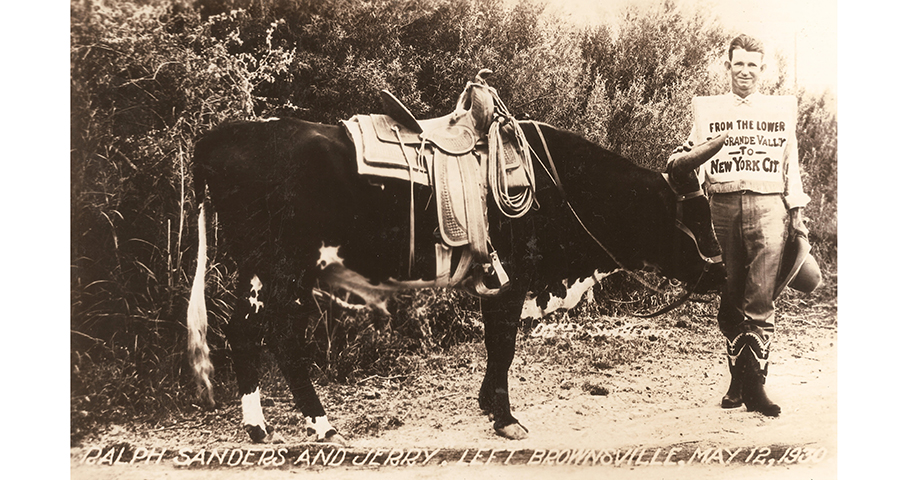
Ralph Sanders bull ride from Brownsville, Texas to the Brooklyn Bridge
From East Texas Journal, February 2025
By Hudson Old, Journal Publisher
Editor’s Note: This story began with Harold Sanders 2012 interviews with Doris Johnson and Harold Sanders.
SOUTH TEXAS — When his parents came home to the family land in Titus County after a time along the Texas border, Ralph and Mattie Sanders stayed on in San Benito with their two baby girls. He worked for the highway department before deciding to ride away.
“He always wanted to do things nobody else had ever done,” said his daughter, Doris Johnson.
Cash broke four days before he left the valley bound for New York riding a Mexican bull, Ralph Sanders shorted himself on his last check to buy a $95 saddle.
“I didn’t have a penny but I had $132.24 due me from the highway department,” he wrote after the trip, some 90 years ago now. “So I started out to borrow on it at a discount. I was lucky and got $124.”
It was an era of daring stunts and publicity hustles to turn a dime.
Particularly in the months he took riding up the length of Texas, the lusty press in the Lone Star state reported minutia down to Ralph’s account of searching Mexico for just the right bull to train for his ride to New York.
Even south of the border media made note of an epic journey beginning at 10 a.m. March 12, 1930 at the “Gateway Bridge” over the Rio Grande.
“On Sunday, May 11, 1930 I hired a Mexican with a truck for $4 to haul my bull to Brownsville,” he said. Mattie and the girls were in the San Benito contingency that went to see him off.
“My daddy was as tough as he was wild,” Mrs. Johnson said. “My mama loved him and she put up with his crazy ideas as long as he lived.”
Mattie was a Titus County girl and four months later she left San Benito to catch up with Ralph on a good day in Waco. Ralph and Jerry the Bull were booked for a $50 appearance at a tire dealership.
From Waco, Mattie and the girls came home to family in Mt. Pleasant, Texas.

“A railroad engineer from Saint Louis first brought our line of the Sanders family here when the Cotton Belt came through,” said Ralph’s nephew, Titus County cattleman Harold Sanders. “He laid the route of the track coming up from south of Tyler.”
It was in the 1870’s. The Cotton Belt began when the Saint Louis Southwestern Railway connected a series of short lines first named the Tyler Tap.
Mr. Sanders the railroad man came from Saint Louis.
“I’ve heard it told that besides overseeing the job he owned something more than a hundred head of mules and horses they used to pull fresnos when they were building the railroad,” Harold said. His great grandfather married, bought land and settled here for a time.
Ralph’s father was Charlie, one of the railroad man’s three sons. There were also Leslie and Clyde Sanders.
Written with long-hand pencil, Ralph Sanders began his account of his ride to New York describing a day he was working on a lonely stretch of road in the desolate quiet of a thinly-populated place 10 miles from Raymondville. It was November 16, 1929, a shade over two weeks after a news glitch about the Wall Street market crash.
Historians cite the market crash triggering the Great Depression as the end of the Roaring 20’s. In the decade of near-global prosperity following World War I, everything seemed to be feasible through modern technology. It was a new era of affordable automobiles, moving pictures and radio. Entertainment boomed. Practicality gave way to frivolity.
Flappers were born, dancing in speak easys turned to jazz halls. Vaudeville actors moved to the silver screen. Barnstormers and circuses traipsed the land. From Lindberg to flag pole sitters, publicity stunts were a rage. Starting in the world’s great cities, from New York to London and Paris — everywhere but on a peaceful road in South Texas the world had gone crazy looking for fun.
“My daddy was all for fun,” Mrs. Johnson said. “He was lively.”
As Ralph explained it, that day he was working on the road into Raymondville, “It suddenly came to my mind to ride a bull to New York City.”
Among Raymondville’s distinctions was its status as the destination of a politician who had pushed a peanut into town with his nose after losing both a bet and an election. The same man had later gained larger fame by pushing the same peanut up Pike’s Peak the same way.
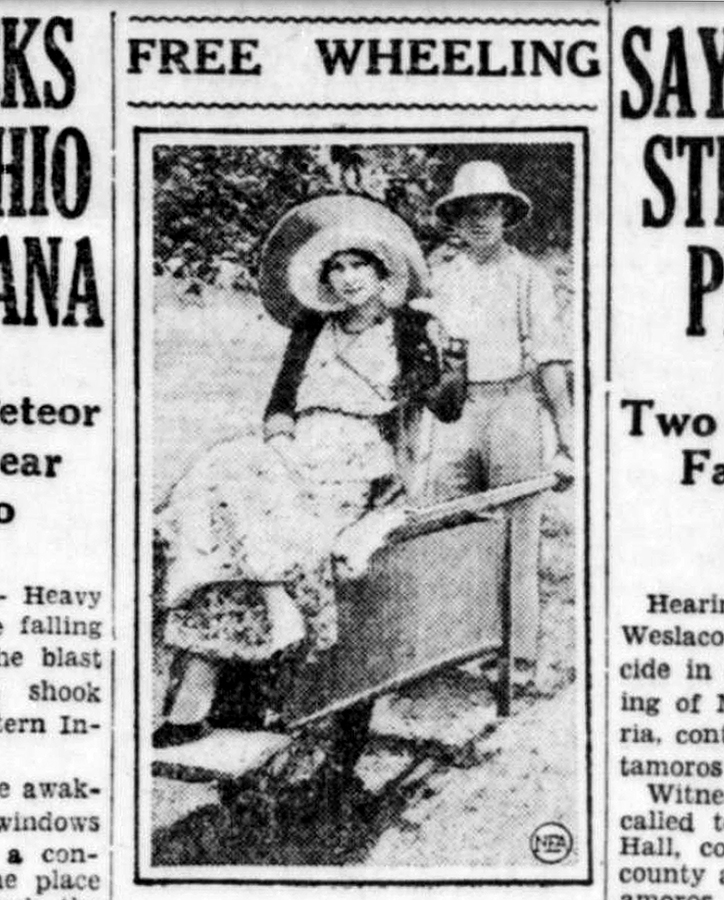
The Brownsville to New’ York wheelbarrow was given its first try-out Tuesday morning, and Walter Hofer said that it was as easy as walking. “We plan to leave Wednesday afternoon,” he explained. “We hope to make about ten miles a day. and reach New York about Christmas.” He predicted that he could push a wheelbarrow faster than the bull could walk, and would not take as much time to get to New York as the bull did.
Expenses will be paid by selling postal cards and advertising the itinerary includes Corpus Christi, San Antonio, Austin, Houston, Dallas, Fort Worth, and then on to New York via Tulsa, St. Louis and Philadelphia. Says, The Brownsville Herald May 26,1931.
That winter, as talk in San Benito turned to the cowboy who’d gone to Mexico to get the bull he was breaking to ride, the local press asked what he intended doing when he got to New York.
“Dunno,” Ralph said. “I’m not there yet.”
Mrs. Johnson said between November and January her father made six weekend trips into Mexico before finding an animal that suited him.
“He wanted one of those bulls like they used in the bull fights down in Mexico,” she said.
He wrote that he paid $80 for a “black bull with fine form. I paid $3 to have him hauled 35 miles up to Matamoros. The next Sunday I met a Brownsville cattleman who drove the bull 19 miles to holding pens at a crossing on the Rio Grande called Santa Fa.”
“His bull was in a herd of 500 cattle brought across the river that February,” Mrs. Johnson said.
A contract between Ralph and Saegertown, Pennsylvania agent and advance man F. N. Davison called for them to share equally in all profits after expenses.
“We left in good spirits with Speck Maglison driving a small Ford carrying camping equipment and feed for Jerry and Mr. Davison working ahead of me,” Ralph wrote.
Four days later the bull went lame. John Bucheet, a blacksmith in Edinburg, found nails driven into the quick of Jerry’s hooves when he was shod with “ox” shoes. They rested the bull and gave him time to heal. The blacksmith made a half dozen sets of custom shoes for Jerry before rider and bull resumed their journey on June 3.
That night Jerry gored a mule mistakenly turned into the “high pen” with the bull “at Tingleton’s Ranch.
“They wanted me to get a doctor for the mule before they’d let me have my bull back,” Ralph wrote. “I had to drive back to San Benito to borrow $15 to pay the vet so we didn’t get away again until June 6.”
Two days later a Texas State Tick Inspector held them up at the Brooks County line after finding two ticks on Jerry.
“They sent us back ten miles and we had to wait eight days to get him dipped,” Ralph wrote.
“It felt good getting back on the ride the morning of the 16th,” he said. Then the Ford broke down. The rest of that day and the whole of the next were spent trying unsuccessfully to make repairs.
The morning of the 18th they got a tow from a highway department truck and then hired a team of mules to pull the car into the dusty town of Encino.
“We found a good Mexican mechanic who fixed the Ford for $6,” Ralph wrote.
Two days and 20 miles later they’d made Falfurrias where his driver and his front man “both quit the same day leaving me alone with Jerry and the Ford.”
He hooked up with a pair of young newly weds named Trousdale who stayed with him as far as Austin.
Keeping a team together was a constant challenge. As Ralph and his bull were closing on crossing the Red River, Clifton Wallace drove up from Mt. Pleasant to meet him in Sherman. Mr. Wallace worked ahead into Oklahoma as far as McAlister before giving up “because that part of Oklahoma was in bad financial condition at the time.”
Ralph was having trouble making expenses selling 5-cent postcards picturing him with his bull.
The pair’s fame was growing, none the less.
Shortly after his first team abandoned him, back on the border supporters rallied.
“Entertainers Bound for San Antone Trip,” read a July headline in Brownsville. “Mr. and Mrs. M. J. Evans, their traveling information bureau and young entertainers are ready to leave on their booster trip to San Antonio where they will parade tomorrow with Ralph Sanders,” the news account read.
The Brownsville Herald was sending along two boys who’d won the summer subscription selling contest and the entertainers had been booked to “present a program of songs, dances and other skits on the roof of the Plaza Hotel,” the paper said. An ad in a San Antonio newspaper invited the public to see Ralph and Jerry at Dee’s Green Tees Miniature Golf Course and Montgomery Drug Store. A man named Eddie Suche took the wheel of the Ford at San Antonio and stayed with Ralph and Jerry all the way to New York.
On July 24 an advance story in the Austin American Statesman said Ralph expected to meet with Texas Governor Ma Ferguson at the capitol. On the 25th Ralph and Jerry camped at Barton Springs.
On July 26 he took in $75 for appearing at Johns Brothers Motor Company, an Austin Ford dealership.
“We started off the day with a nice parade and to be frank I never saw such crowds and the hearty response to this advertising feature,” Manager R. D. Johns wrote in a letter of reference on dealership letterhead. “This proposition is very high class advertising. Anyone desiring their services will not go wrong if they get the welcome we did here.”
Before leaving town, Ralph rode out to meet 15-year-old Charles Fariss, “Austin’s tree-sitter king,” who had been sitting perched atop an Austin live oak tree for nine days.
He met H. H. Hale, a man “with 30 years experience in advertising and promotion. He wanted to go with me and we made a trade, a 50-50 split on whatever he taken in.”
In Round Rock, 19 merchants pitched in $15.75 in return for hanging signs on rider and bull as they marched through town.
An August story from Waco declared a half million Texans had seen them during the course of their journey. The day Kendrick’s Good Year Super Service Station booked his appearance, Ralph wasn’t sure if he’d take his bull on stage, join a Wild West show or sign on as a circus act at the end of his ride. He was open for movie offers. It was announced that he’d selected a set of “52-inch longhorns to present New York City Mayor Jimmy Walker.”
“Realizing that the bull is gaining national fame and may become a Broadway sensation, every accommodation will be made for customers wanting their picture made with Mr. Sanders and Jerry during their appearance at Kendrick’s Good Year Super Service Station,” the Waco write up said.
A brass band met rider and bull when they arrived at the Fort Worth Stockyards. Jugglers, stilt walkers and clowns paraded with them. Bill Townsend Tire Company and Hillcrest Service Station bought a quarter page ad in the Fort Worth Star Telegram announcing Ralph’s appearance.
News accounts took lighthearted and playful turns.
“After living his first five years in Mexico, Jerry was initially adverse to changing his nationality,” one reporter reasoned, then backed up the claim. “He’d never eaten anything but cactus and so went on a four-day hunger strike when he first encountered grain. The hunger strike was resolved only after Mr. Sanders taught his bull to understand English.”
Back in the valley the ride was hitting the status of legend, igniting other publicity stunts.
“To Drive Goat and Donkey to New York City,” declared a San Benito Press headline. “Going peanut-pushing politician Bill Williams and bull rider Ralph Sanders one better, Benton Stack of this city announced yesterday that he will drive a donkey and a goat hitched to a cart to New York City and he plans to arrive ahead of the bull rider.”
Meanwhile, days after joining him in San Antonio, publicist H. H. Hale returned to the valley where he unsuccessfully solicited support from chambers of commerce.
“I never saw him again,” Ralph wrote.
After the Mt. Pleasant hustler who’d joined him in Sherman played out at McAlister, Ralph briefly worked with a Wild West Show at an Oklahoma fair before meeting young Eddie Sounsall, a Wisconsin student vacationing in the Sooner state.
“We made a trade to help both of us meet traveling expenses,” Ralph wrote. “He stayed with me to Springfield, Missouri where he told me he was behind on payments to the Texas finance company that helped him get the car. He said he’d go home and get some money from his dad and I never heard from him again.”
They saw their first frost on October 17 at Carthage, Missouri. On October 30 it snowed.
“I didn’t have a coat and that same day I got a letter from Mattie back in Texas saying that she and the two babies needed money for shoes,” Ralph recalled in his account that ties in with a journal entry made during the same time. “I’m going on to Saint Louis and try to get another advance agent. I’m going to ride this bull to New York City if my britches don’t wear out.”
A November 22, 1930 letter from the Pennsylvania advance man who’d enthusiastically signed up for the ride then given up 150 miles into the tale says something about the nature of both the men and the times.
It seemed business everywhere was slow. Mr. Davison had sold his mill to a group of local farmers. As he wrote he was holed up for the winter tending a sick aunt in Centerville, a small town 30 miles from Erie. He promised to send along a new list of questions so that Ralph could write back with answers he’d use to write advances for media along the projected route of the ride.
“I’ll do what I can. I know you’ll make good on what we owe in San Benito when you can manage,” Mr. Davison wrote. “Good luck – from now on to New York will be the cold end of the trip.”
He’d been riding broke and hungry since leaving St. Louis, selling postcards.
In Ohio the cold drove him off the road to Bixler’s Tourist Camp west of Lewisburg where the Lewisburg Ohio Leader reported Ralph wore a sombrero and had become the subject of “much speculation during his 10 days sojourning here.
“Mr. Sanders hopes to find an opportunity in New York to place Jerry on exhibition at so much per, or make a contract with some vaudeville company or join with a circus and is reasonably confident his journey won’t be a financial failure,” the Leader reported.
The Bixler’s Tourist Camp match book cover from that year advertised “Free garage, heated rooms, gas, oil, groceries, bull pups for sale, good things to eat and cottages for $1.”
Broadway took no notice when he arrived in New York.
Vaudeville didn’t book him.
But his story made it back to Texas via the Associated Press.
“Here’s the tale of a Texas Cowboy who took the bull by the horns and held on all the way from Brownsville to the Brooklyn Bridge, just for the ride. They moseyed into Gotham with 254 days of travel behind them and 2,700 miles of sage brush and snow under their feet.
“I just wanted to ride a bull,” the Texan drawled. “It’s something that ain’t been done before on such a large scale. We crossed the Allegheny and the Ozark Mountains. It was pretty slow going up in that snow. Bull riding is sure healthful, though. I feel better than I’ve felt in five years.”
In the January 21 edition of the New York Sun, a reporter wrote of finding Ralph and Jerry “at 26 Cherry Street, an old stable in the shadow of the Brooklyn Bridge.”
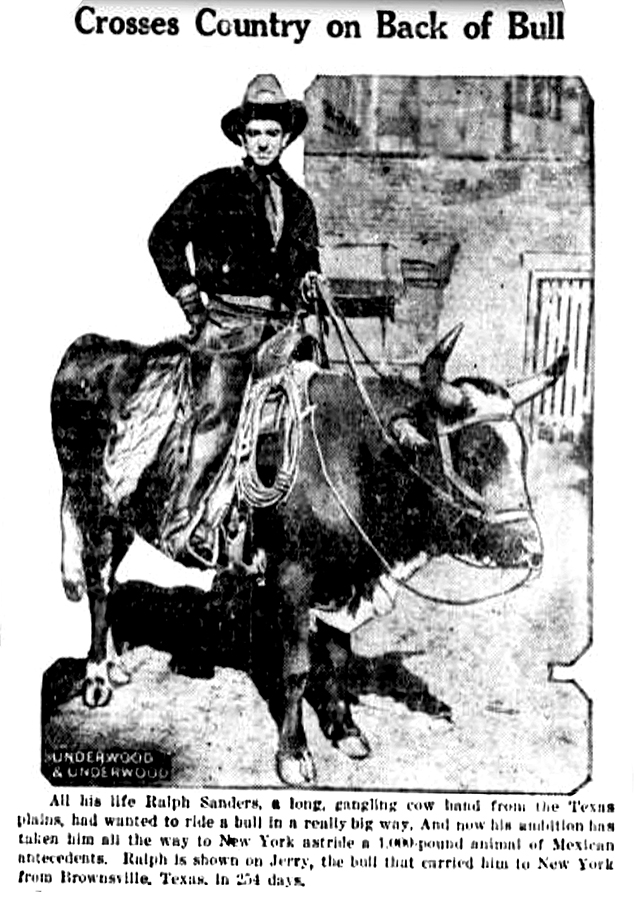
Ralph had sent word to the mayor about the set of Longhorns he’d brought from Texas, “but was told the mayor was ill.
“Well,” Ralph said, “I guess I won’t bother him then.”
Among the yellowed papers, the letters and records of the trip, Ralph’s grandson Billy Ralph Johnson found a letter written March 19th, 1931, as spring approached. It was addressed to “J. A. Hide, Superintendent, Dallas and signed by Fred Fuscal.
“This will be your authority to deduct from my check the amount of $43.69 to cover the balance of express charges on the bull from New York to Fort Worth, consigned to Mr. Sanders,” he wrote.
A year after Ralph rode into New York, in January of 1932, George Saunders, President of Saunders Livestock Commission Company of Forth Worth and San Antonio, wrote responding to Ralph who was by then back with Mattie and his girls in Mt. Pleasant.
“Dear Sir: I wrote Schriener but he is getting rid of his horned breeding cattle. I think your best chance at present to make something out of Jerry would be to change his name to Pancho Villa after the outlaw Mexican bandit, get a lot in town and charge kids 25 cents for a ten minute ride.”
In February, Ralph received a letter answering his pitch to the Southwestern Exposition and Fat Stock Show, Fort Worth, Texas.
“Dear Mr. Sanders, We regret that when your letter was received we had exhausted the 1932 advertising appropriation . . .”
Harold Sanders the local cattleman was a boy when his uncle returned to Mt. Pleasant.
“He moved into a grey house over by the old West Ward school and he kept Jerry in a pasture that ran down to the edge of the graveyard,” Mr. Sanders said. “I used to ride with him when he ran a dozer for the county – I remember riding on a grader with him, being pulled by a caterpillar.
“He finally sold his bull to a circus or some carnival outfit. He asked them to load him because he didn’t want to watch. They went down and Jerry went wild and tore up the loading chute. They couldn’t handle him so Uncle Ralph went down there and told him to load. He went up in the trailer and they carried him off.”
Ralph Sanders quit the county. He and Mattie moved to Jefferson where he opened a butcher shop.
“He wasn’t any more a butcher than I am,” his daughter Mrs. Johnson laughed. “But he made himself one before anybody caught on that he wasn’t.”