Reconnaissance flight put pilot over Normandy
From East Texas Journal, June 1994 edition
CHERBOURG, France – A month before D-Day, Tom Connor’s plane ripped through the air at full speed. Or what was left of full speed.
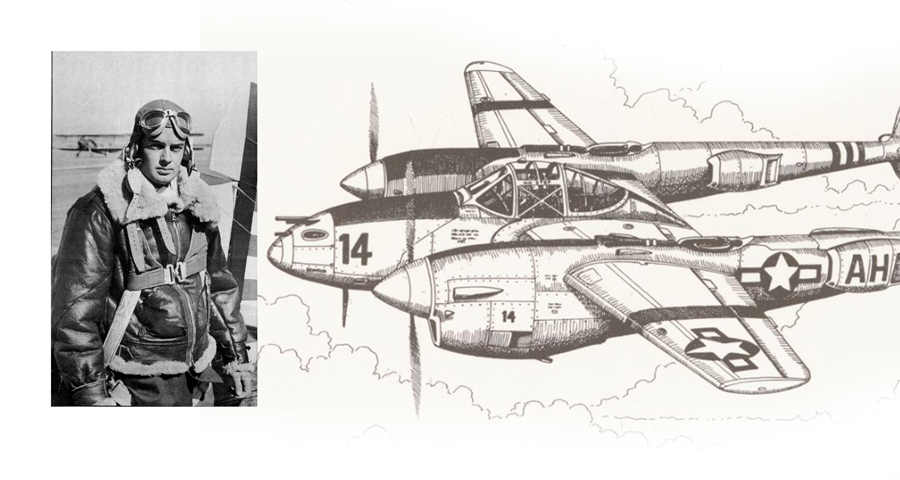
The P-38, technology’s most nimble and agile bird of the time, lumbered along at 20,000 feet, groaning at the wind. One engine, all instruments and a good bit of the craft’s steering had disintegrated moments before in a burst of anti-aircraft fire.
The clouds over the French coast that day were four miles thick. Taking off from an airstrip near Oxford that morning, Tom’s plane vanished into the clouds around 800 feet above the English Channel. He broke out around 18,000 feet, began looking for holes down through the clouds through which he might photograph German guns along the French coast.
He was alone.
His plane was unarmed.
The plane did carry along a 300 gallon auxiliary fuel tank.
On occasion, Tom’s spy camera would be sent as far behind the lines as Berlin.
He was a 130 pound crusty old veteran of 24 this morning, standing all of his weight on one pedal of the plane, trying to get the thing aimed back toward the English Channel.
The moment after he was hit, he’d dropped his auxiliary tank.
“The P-38’s flew pretty well on one engine,” said Tom.

He first flew P38s testing them for the military after Lockheed built them over at Dallas. That was where he first learned about the plane’s capabilities flying on one engine.
The army wanted to know, among other things, about the plane’s performance while taking aloft a 600-gallon auxiliary fuel tank. Worked good with two engines, Tom’s test-pilot research showed. But it didn’t work nearly so well the day he lost an engine just after takeoff and found his plane over Dallas, floundering toward the ground.
The thought of freeing the plane by dropping the auxiliary fuel tank did cross his mind.
“But I was over Dallas,” he said. It was a beautiful clear day so that as he zipped along above the earth, he could look down and clearly see the thread-like line of trees lining Bachman Creek. He turned his nose that way and guided the plane in by letting it fall faster than plain old gravity was pulling it down.
” I came in right over the creek and the trees on either side took off both wings,” he said. The cockpit slammed into a hole of water on the creek as Tom put to use tenant one of more than a year of training — try not to hit anything with the nose of your plane if you crash.
A fisherman helped him ashore.
” I just happened to come in there and he just happened to be there,” Tom remembered, and the odd thing about it was that the fellow was from Omaha, Texas.
So was Tom.
He grew up working in his father’s pharmacy — his first job was emptying and cleaning the spittoon at Connor and Bullington Drug. He hit his teenage years in the Great Depression era and his dream became to be a pilot. To that end, he got the required year of college at East Texas State, then passed his entrance exam and made it into the Army Air Corps flight school.
A month later, the Japanese bombed Pearl Harbor.
High-altitude photo reconnaissance was a new concept then.
The military wasn’t certain, for example, how men would react to the lack of oxygen at high altitude. So in addition to filling potential pilots’ minds with information about photography and flying, they were put into air tight tanks for hours on end.
“You just had to sit there and breathe oxygen and wait to see what happened,” Tom said. Some men got “the bends,” the same phenomenon that occurs with pressure changes associated with deep sea diving. Tom didn’t get the bends.
” I got my wings June 23, 1942, and got them clipped the same day,” he jokes. It was the day he married ‘Gin’, an Arkansas girl he’d met back home in Connor and Bullington Drug.
The army had spent a lot of time grooming Tom Connor and the nation re-cooped on the investment.
Before the war’s end, he’d flown 510 actual combat hours. He flew a hodge-podge of planes — British Spitfires and Mosquitos, B-17s and B-24s. But until the war’s final months, his beloved P-38 was the classiest thing in the sky.
He was in the air also on opening day of Germany’s last great offensive — the Battle of the Bulge, some six months after the allied invasion of Europe’s D-Day beginning.
Somewhere in there he was flying along when a German plane came in out of nowhere.
“He literally flew a circle around my P-38,” Tom recalled. It was the first jet he’d ever seen.
The day his plane was hit over Cherbourg, Tom had a target considerably larger than a Bachman Creek to get back to.
At the age of 24, tumbling through the sky over France, Tom stood on the pedal that was supposed to turn his plane and prayed he could get aimed back toward the English channel and the safety of Great Britain.
Still above the clouds, he got the plane turned back the way he believed he should go. Without instruments then he scooted down into the four-mile cloud bank and lost all perception of altitude and distance.
But England wasn’t far, and if he’d guessed right, he was over the channel.
Tom reached up and unbuckled the plane’s canopy. Wind ripped it away and roared into the cockpit. Ejector seats were still on the drawing board and it was impossible for a man to stand and jump against the wind. Tom reached back to another concept he’d picked up in training — stick both arms as far out of the plane as possible and hope there’s enough draft to suck you out of the seat.
The force yanked both arms from their sockets.
As he went out, he smashed into something and lost consciousness.
” I came to, in a free fall,” he said.
At that moment, he discovered that his arms were useless, refusing to steer his hand to his parachute’s rip cord. Plummeting along, Tom managed eventually to get his hand locked in a death grip on the rip cord. He pulled his knee up between his chest and his arm and began using his leg then to push the useless arm until it extended far enough to trip his parachute.
He came out of the clouds still over the channel, but he could see land and could tell by the way he was moving quickly inland that he was going to make the shore.
He came down a hundred yards inland, and the last thing he remembers before waking up in a British hospital was hollering for an Englishman he saw to come help him.
” I remember he seemed hesitant,” Tom said. “He probably thought I was a German.”
In three weeks he was recovered enough to be back in the cockpit. Reconnaissance flights had been beefed up as the pilots brought home more and more information about the German fortifications along the French coast.
Within days then, the pilots got the briefing they’d know was coming.
During the night of June 5, some 4,000 transports and 800 warships were assembled off the coast of France.
Reconnaissance flights that previously had been designed to bring back mapping information were now needed to chart progress of the greatest naval assault in history.
Tom’s was one of 11,000 allied planes in the air over France on a June day 81 years ago.
He successfully returned from his first D-Day mission just in time to be briefed on his second.