Eli may not have known Monticello
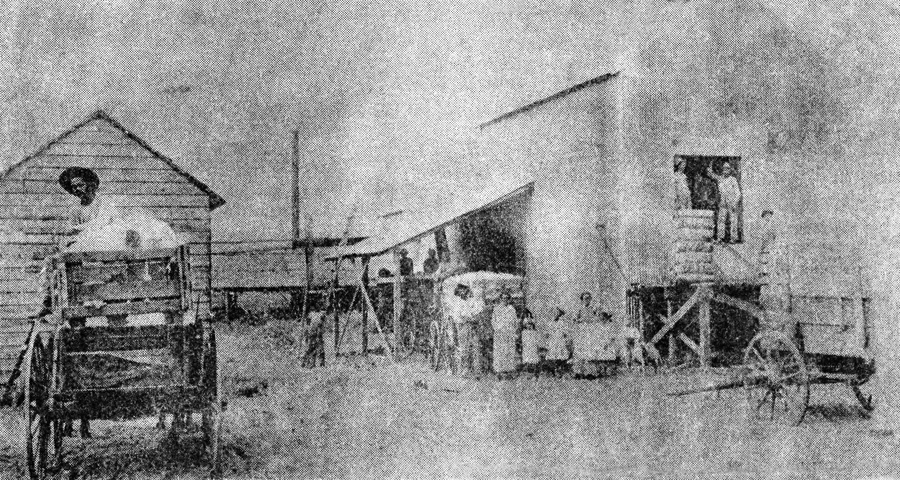
WILL J, TAYLOR, who built the cotton gin in Monticello in 1915, stands to the right of the doorway in the picture above. Shortly after its construction, the gin burned, but was rebuilt and continued operation until the 1940’s.
From The Citizens Record, January 1985
Monticello, Texas – It is unlikely that Eli Whitney would Have heard of Monticello, Texas, but his invention made possible the Taylor family business that flourished for approximately30 years there.
Will J. Taylor, 1878-1940, was born 85 years after Whitney invented the cotton gin, a machine that removed the cotton seeds from the fibers. With this machine, one man could do the work that once took 50 men picking seeds out by hand.
Taylor built, his cotton gin in September of 1915. Shortly after its construction, the gin burned down under suspicious circumstances, said his daughter, Mrs. Willie Narramore. Undaunted, Taylor bought new equipment and machinery and rebuilt the gin which served the people of Monticello and the surrounding communities until around 1946.
Cotton had always played a large role in the deep South and the Southwest, with Texas being one of the states in the cotton belt. Cotton became so important years ago that people called it “King Cotton” and composed songs about it. It is still the most important fiber man uses to make clothing. It can be made into more products ranging from diapers to explosives than any other fiber.
Chemists have been able to make cotton fireproof, waterproof, rot-proof, shrink-proof, and wrinkle-resistant. The snowy crop has come a long way from the days when it was produced almost entirely by hand and mule labor.
The farmers would plant their cotton in April or May and harvesting would begin about mid- August.
Picking cotton was usually a family affair with the children starting in the fields from the time they turned 4 or 5 years of age.
The blistering summer sun shone down upon the cotton fields as the weary workers labored to fill their sacks that trailed behind them.
The sacks were made from a coarse cotton material called duck with an opening at one end and a strap to carry them with. After the sacks were full, they were weighed by hanging them on cotton scales which were usually suspended in a nearby tree
It was back-breaking work that kept them bent over, or on their knees for countless hours a day many farmers would pick from sun-up to sun-down and the chore was not finished until all the cotton rows were picked clean.
On the average, an adult could pick around 200 pounds of cotton a day. But someone remembered that Jack Bell could pick 500 pounds on a good day.
Cotton fields yielded about one bale per acre. A farmer in those days would work about 270 hours to produce one bale of cotton.
When the wagon was finally full of cotton, the men would hitch up their team of horses or mules and head for the cotton gin. They were usually met with long lines and would take the opportunity to visit with friends and neighbors while waiting to get their cotton ginned.
The gin worked by passing cotton through the drier which sent it into the burr machine. Then the cotton went to a machine called a gin stand, which pulled the lint off the seeds.
Finally, the lint went to the bale press which packed it into 480-pound bales (about the size of a large home refrigerator).
In its prime, the gin produced between one thousand and three thousand bales a season. During good years, the bales would bring about 40 cents a pound, but there were times when the price has been as low as 4 1/2 cents.
Four people could keep the gin operating. Over the years the list of employees included Edgar Narramore, J. H. Weave, Bud Stewart, Robert Crow, and Jack Taylor, son of Will J. Taylor.
G. M. Scott, Sr. was the largest cotton producer in the area. The cotton business slowed down when World War II came along and gradually the fields of fluffy white cotton bolls were replaced with green pastureland dotted with cattle.
The old cotton gin eventually fell into disrepair and was finally torn down.
But back in the early 1900’s, the fields surrounding Monticello must have looked much the same as the Greek and Roman travelers had described them upon their first look at cotton centuries ago. They likened the cotton plants to “fleeced tiny lambs growing on trees.”